Rejection hurts. Losing days to it is what costs you.
A message changes tone. Feedback lands. Someone goes quiet. A plan shifts. From the outside, it may look small. Inside, it can feel immediate, physical and hard to shake.
Then comes the part people do not always see: the replaying, the urgency, the over-explaining, the self-attack, the need to work out what it all means right now, and the collapse in confidence that can follow one difficult moment.
If you have ever wondered why something that seems “minor” can affect your focus, energy, relationships or whole day, you are not broken and you are not being dramatic. You may need more support for the aftermath, not more pressure to “just let it go.”
This may sound familiar:
- You replay messages, feedback or conversations long after they have happened.
- You feel pulled to explain, apologise, chase reassurance or fix the moment immediately.
- You understand things logically, but your body still reacts as though something important is at risk.
- You lose momentum, peace, confidence or whole days to spirals that look small from the outside but feel huge on the inside.
This is exactly where The Rejection Recovery Blueprint™ begins — helping you recover with more support, clarity and self-trust, so one hard moment does not keep becoming your whole day.

Private 1:1 Emotional Recovery Support
The Rejection Recovery Blueprint™
A 12-week private support space for ADHD adults who are tired of losing peace, confidence, momentum and self-trust to rejection spirals.
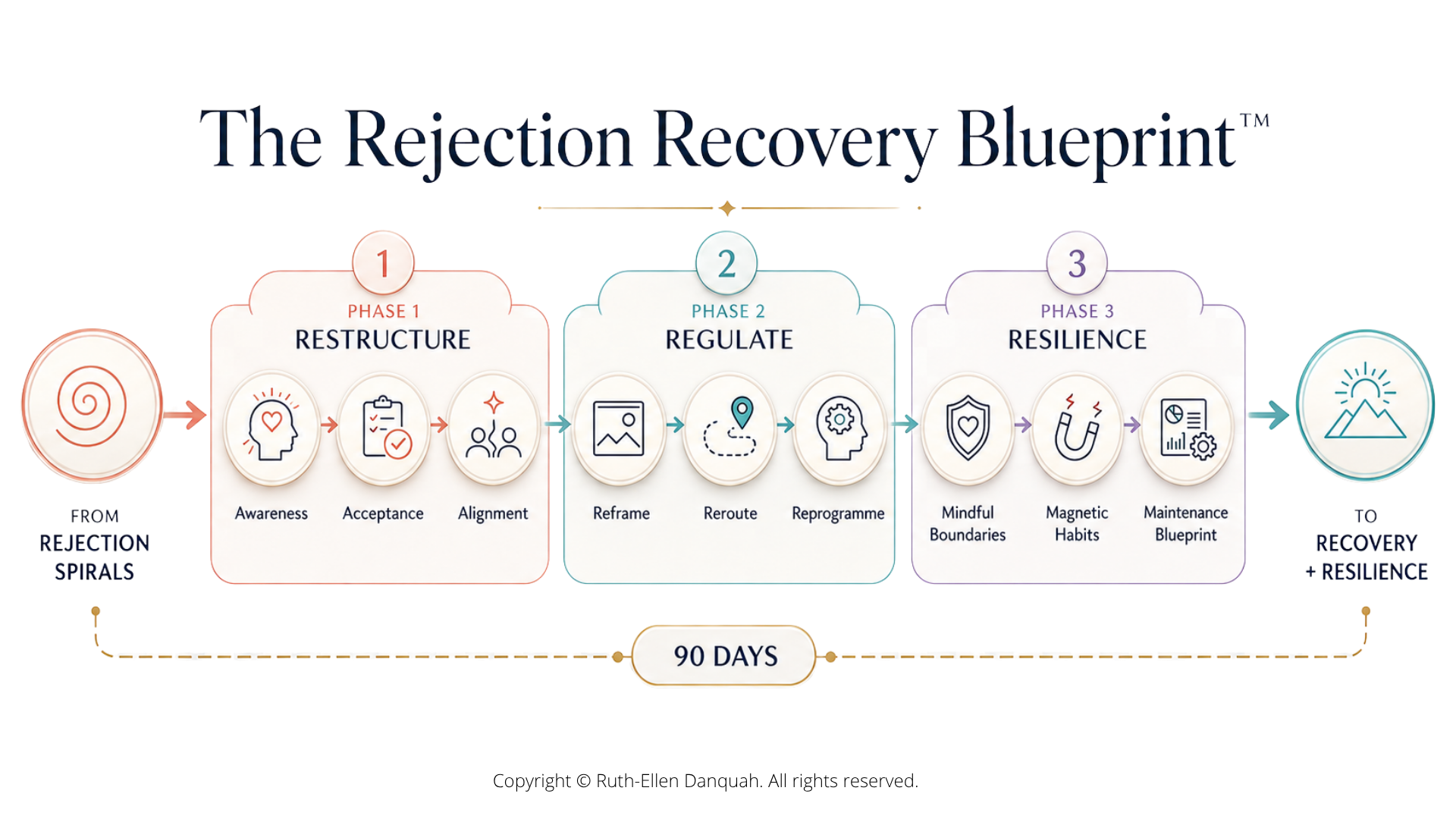
This is personalised support for the repeating pattern beneath the spiral — so you can understand what activates you, interrupt the automatic response, practise a steadier next step and build a recovery pathway that holds up in the situations that matter most.
You are not here to become emotionless.
The work is about helping you recover more safely, more steadily and with less self-abandonment when something difficult happens.
We work with the emotional aftermath and the real-life situation around it — not just the surface-level trigger.
£2,497 · Payment plans available
A calm fit conversation, not a test.
You do not need to be fixed.
You need a recovery pathway that holds up in real life.
Why 1:1 support can be different
The Method gives you tools. The Blueprint helps you build a personalised way of recovering inside your actual life.
Your pattern is not happening in a vacuum.
It shows up in work feedback, dating, family tension, friendship changes, visibility, boundaries, communication, mistakes and the stories you have learned to make about yourself when something feels uncertain.
The Rejection Recovery Blueprint™ is where we slow those patterns down together. We work with your specific triggers, protective responses, nervous-system needs, values and real-life decisions.
This is not a programme you need to perform.
You do not need to arrive calm, articulate or sure what you need. We begin with where you actually are and build from there.
How the 12 weeks work
A spacious process for understanding the pattern, building support and practising self-trust in real life.
There is no pressure to complete emotional recovery in a neat sequence. We move at a pace that supports insight, safety and meaningful change.
Understand your pattern
We identify what activates you, what your body does first, the stories that arrive quickly and the protective responses that keep the spiral going.
Build your recovery pathway
We develop practical ways to support your body, soften self-attack, create space before reacting and separate what happened from what your mind makes it mean. This becomes your personalised pathway for the first moments, the difficult aftermath and the next decision.
Practise self-trust in real life
We apply the work to boundaries, communication, feedback, visibility, relationships and the situations where you are most likely to leave yourself behind — until you have more evidence that you can feel the trigger and still stay on your own side.
What we can work with together
Support that meets the emotional aftermath and the real-life situation around it.
Activation and shutdown
What happens in your body when rejection sensitivity is activated, and what helps you recover without losing the rest of your day.
Self-attack and shame
How to stop turning painful experiences into evidence that you are too much, not enough or fundamentally difficult to love.
Boundaries and communication
How to stay connected to your needs when you are tempted to over-explain, chase, appease, withdraw or accept less than you deserve.
Imagine this instead
The feedback lands. The message is delayed. Someone says no. But you do not lose yourself.
You may still feel it. The aim is not emotional numbness. It is having enough support, structure and self-trust to choose your next step without panic making every decision.
- You recognise activation earlier, before it becomes a full-day spiral.
- You create more space before explaining, apologising, withdrawing or trying to get certainty.
- You can consider feedback, conflict and disappointment without making them a verdict on your worth.
- You return to your values, boundaries and own side more quickly after difficult moments.
The private 12-week programme
The Rejection Recovery Blueprint™
A personalised 1:1 emotional recovery programme for ADHD adults who are ready to stop losing their peace, energy and momentum to rejection spirals.
Inside your support space
- 12 weeks of personalised 1:1 emotional recovery support
- Weekly sessions shaped around your real-life patterns and current challenges
- Rejection spiral mapping, pattern recognition and personalised recovery planning
- Nervous-system support tools for overwhelm, urgency, shutdown and emotional aftershocks
- Self-compassion, reflection, grounding and values-based decision support
- Boundary, communication and repair support for relationships and work
- Practical resources and between-session practices tailored to your capacity, patterns and real-life situations
- A personal ongoing recovery plan for future difficult moments
Before you decide
Questions you may be quietly asking before you let yourself say yes.
You do not need to be certain, articulate or “struggling enough” to explore support. These answers are here so you can make a clear decision without filling in the gaps alone.
You will have weekly 1:1 sessions shaped around what is happening in your real life: work feedback, delayed replies, dating, boundaries, conflict, visibility, self-attack or the aftermath of a difficult moment.
This is not twelve weeks of generic advice about breathing, journalling or “not taking things personally.” We use your actual patterns to understand what activates you, what happens next, what keeps the spiral going and what helps you return to yourself with more clarity.
The workbook gives you language, prompts and tools you can use independently. The Blueprint is for when you need support applying that work to your actual life.
You are not paying for more information. You are paying for personalised pattern recognition, a space to work with live situations, practical experimentation and a recovery pathway built around the moments where you are most likely to over-explain, chase reassurance, shut down, disappear or turn the experience against yourself.
Between sessions, you will have tailored practices, reflection prompts and recovery tools that help you notice and work with the pattern in real life. We use the following session to review what happened, what helped, what did not and what needs adapting.
The aim is not to give you endless homework. It is to make the work usable on the days when your capacity is low and the emotional aftermath is high.
Therapy can be the right place for diagnosis, trauma treatment, clinical mental-health care and crisis support. The Rejection Recovery Blueprint™ is coaching and educational support focused on helping you understand and practise a more supportive response to present-day patterns.
We work with the situations where rejection sensitivity shows up: feedback, relationships, boundaries, communication, visibility, self-trust, shutdown and the recovery time afterwards. Some people may use therapy and practical coaching support alongside each other where appropriate.
This work is not about teaching you to tolerate poor treatment or convincing you that every uncomfortable feeling is irrational. Sometimes something genuinely is off. Sometimes a boundary is needed. Sometimes feedback is unfair.
The work is about slowing the moment down enough to respond from clarity rather than panic, self-attack or urgency. You learn to stay connected to your perception without automatically abandoning yourself or escalating before you have the information you need.
No. You do not need to arrive with the perfect label. The Blueprint is for adults who recognise the pattern: rejection, feedback, uncertainty, silence or conflict can trigger an intense emotional aftermath that affects confidence, focus, relationships, work or whole days.
You may identify with ADHD, autism, anxiety, masking, attachment patterns, people-pleasing or emotional dysregulation. We begin with your lived experience, not whether you can name it perfectly.
You do not need to arrive calm, polished or able to tell the story in the “right” order. Many people minimise when they are calm, then struggle to organise their thoughts when they are activated. That is not a failure of the process; it is part of the pattern we work with.
The programme is designed for real life, not perfect participation. We begin with what you can share and build understanding from there.
It is a calm fit conversation, not a sales test. We look at what has been happening, what it is costing you, what support you have already tried and whether the Blueprint is the right next step.
You do not need to decide on the call. If it feels aligned, I will explain the structure, investment and payment-plan options. If it is not the right support for where you are now, I will tell you clearly.
I review applications within 2 working days. If the Blueprint looks like a potential fit, I will email you with a link to book your Rejection Recovery Conversation. If it is not the right support for where you are now, I will let you know clearly rather than leaving you waiting or guessing.
This may not be the right fit if you need crisis support. If you feel at risk, unsafe or need urgent mental-health support, please contact an appropriate emergency, crisis or qualified healthcare service.
Ready to go deeper?
You do not have to keep rebuilding yourself from scratch after every emotional setback.
Rejection may still hurt. But you can learn to meet it with more support than panic, self-attack, over-explaining or another night spent replaying what happened.
Book Your Rejection Recovery ConversationPrivate 1:1 support · 12 weeks · £2,497 · Payment plans available
