


When underperformance is misdiagnosed and the wrong process begins.
A senior analyst joins your company. Within 48 hours, his manager is having an informal conversation about “disruptive and loud behaviour.” Within ten days, the manager is taking advice from HR about the capability procedure. Within three weeks of an occupational health assessment that recommends adjustments, the capability process is invoked anyway. Eight months later, the employee is dismissed without the adjustments ever being implemented and without the capability procedure being completed.
That’s Sherbourne v Npower (2019). Autism. Indirect discrimination upheld. Failure to make reasonable adjustments upheld. The tribunal called it “continuous management failure” — and the specific failure it named was “a mixing up of welfare and capability procedures.”
The manager wasn’t malicious. The tribunal explicitly noted she was “process driven.” She followed the process she had. The process she had was the wrong one for the situation in front of her.
This is the pattern Heads of People need to see clearly, because it’s running quietly across your organisation right now. The diagnostic question is not “is this person performing?” The diagnostic question is “have we ever actually asked what they can sustain?”
What Sherbourne v Npower tells you about your own capability pipeline
Strip the case to its structural elements and the pattern is repeatable:
The employee’s behaviour read as a performance issue to a manager working from a consistency frame — same output, same way, same pace. The behaviour was, in fact, a capacity signal from a nervous system the manager had no framework for. The manager moved to the process she had been trained on. The process she had been trained on was capability. Capability was the wrong category.
By the time occupational health surfaced the actual category — disability, adjustments, environmental factors — the capability machinery was already moving. The tribunal recorded that the capability process was invoked on 2 May 2018, three weeks after the OH assessment that had recommended adjustments rather than capability. The two processes ran simultaneously. The adjustments never happened. The dismissal did.
The tribunal’s language on what this constituted is worth reading carefully: a Provision, Criterion or Practice of “failing to implement reasonable adjustments, inappropriate use of the capability procedure and using dismissal as a tool to rid themselves of a disabled employee.” That last phrase is what every Head of People needs to file. The tribunal did not find that the employer set out to discriminate. It found that the cumulative effect of capability-as-default produced discriminatory dismissal anyway.
This is not a one-off. The Acas guidance on neurodiversity at work explicitly warns that if a performance procedure is started before adjustments are considered, it “could have caused stress and made work more challenging. And it might not have addressed the poor performance issue.” The procedural risk and the people risk converge in the same place.
| For managers reading this post:The 9pm question — is this performance or is this something else? — is on NeuroRich.The capacity question your capability process should have asked → |
The diagnostic distinction Heads of People need to embed
Consistency measures whether someone produces the same output, in the same way, at the same pace, every time. It is the yardstick most workplaces inherited from industrial-era work design, and it fits neurotypical nervous systems reasonably well — they tend to fluctuate within a narrow enough band that consistency reads as a reasonable proxy for reliability.
Neurodivergent nervous systems fluctuate across a wider band. Sometimes hour to hour. Applied to that system, consistency-as-yardstick produces a false read. The person looks unreliable when what is actually happening is that the measure is wrong for the system being measured. That false read is what gets logged in the capability file. That is what the tribunal in Sherbourne saw and named.
Capacity-led working is the operational alternative. It measures what a nervous system can actually sustain and designs the work around that rather than against it. Firm what and by-when. Flexible how and when. Output measured over a sensible window rather than hour-by-hour presenteeism. Clear priorities so the strong hours are spent on what matters most. The person still delivers. They deliver differently, and usually more.
The Head of People question is not whether capacity-led working is a nicer way to manage. The question is whether your capability pipeline can distinguish between a performance issue and a capacity issue at the point of entry. Sherbourne v Npower is what happens when it cannot.
What capacity-led working is not
This is the part that gets misread most often, so it needs naming directly.
Capacity-led working is not permission-giving language. It is not saying neurodivergent employees can’t be reliable, that delivery doesn’t matter, or that capacity talk is a way of lowering expectations. Reliability and consistency are not the same thing. Someone can be deeply reliable in outcomes, in integrity, in follow-through, while working in a rhythm that doesn’t look consistent from the outside. Capacity-led working makes that reliability visible and usable. Consistency-led working tends to obscure it, and then penalise the person for the obscuring.
The frame raises the quality of the conversation. It does not lower the bar.
If a capacity-led conversation ends with the employee feeling more seen but no clearer on what they are delivering or by when, the frame has been misapplied. Done well, it ends with the what and the by-when sharper than before, and the how and the when more honestly matched to the person doing the work.
That is the test. Seen and clear. Not one or the other.
What the Equality Act actually requires before capability is appropriate
The legal position is more demanding than most capability policies reflect. Under sections 20 and 21 of the Equality Act 2010, where an employer knows or ought reasonably to know that an employee has a disability, the duty to make reasonable adjustments is engaged before any procedure that puts the disabled employee at a substantial disadvantage compared with non-disabled colleagues.
A capability procedure that measures output against a consistency standard puts a neurodivergent employee at a substantial disadvantage by design, where adjustments would mitigate that disadvantage. Running the capability procedure without first implementing the adjustments is the precise PCP the Sherbourne tribunal identified. It is also the precise pattern called out in the Khorram v Capgemini judgment in 2025 — where the failure to implement ADHD-related adjustments while continuing to apply standard probation expectations was found to be a continuing act of discrimination.
The Acas neurodiversity guidance is explicit: there might be situations when an employer needs to formally investigate a neurodivergent employee’s performance, but only “if there’s a conduct or capability issue even after support is in place.” The sequencing is the legal point. Adjustments first. Performance procedure second, if at all.
If your capability policy does not currently distinguish between (a) performance after adjustments have been implemented and given a fair window, and (b) performance before adjustments have been considered at all, your policy is not Equality Act compliant in operation, even if it is compliant on paper.
The diagnostic the Head of People needs to run
Three questions, sequenced. The first one is the one Sherbourne v Npower turned on.
One — has anyone actually asked the capacity question? Not “is this person performing.” That is the consistency question, and it generates a yes-or-no answer that triggers the capability pipeline. The capacity question is: what can this person sustain in the current environment, and what would change if the environment changed? The answer to that question is not a verdict on the employee. It is a read on the system.
Two — what does the OH or disclosure record actually say, and has it been actioned? If there is an occupational health report with recommended adjustments and those adjustments have not been implemented, the capability procedure cannot fairly start. Sherbourne is the case law on that point. Khorram v Capgemini reinforced it in 2025. The cost of treating an OH report as documentation rather than as instruction is the case you do not want to defend.
Three — is the manager running the capability process the same manager whose decisions are part of what needs to be examined? In Sherbourne, the manager who invoked capability was the same manager who had told the employee “we’re not here to wipe arse” and who had loudly instructed the team to “give Tom some things to do so that he doesn’t look like a lost dog.” The tribunal recorded both. Where a capability process is built on manager observations that themselves sit inside the disadvantage being challenged, the process is unsafe before it begins. A Head of People review at the front end is not bureaucratic overhead. It is the moment the case file either closes cleanly or starts compounding.
What good looks like at the decision point
The structural fix is small. The procedural cost is low. The protective value is high.
Before any capability procedure opens for a neurodivergent employee — disclosed or where the employer ought reasonably to know — a Decision Receipt is generated at the point the manager first considers capability as the next step. Not after. At the point of decision.
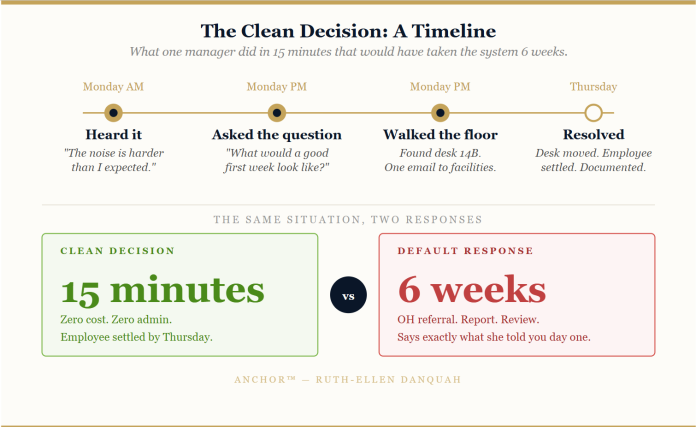
The Decision Receipt does three things in roughly three minutes. It captures the manager’s read of the situation. It surfaces the questions the manager has not yet asked — including the capacity question, the adjustments question, and the disclosure question. It produces a structured record that goes to the Head of People before the capability conversation happens, not after.
The point is not to slow the manager down. The point is to interrupt the capability-as-default reflex at the only moment where interruption is still cheap. After a first capability meeting has been minuted, the cost of reframing is high. Before it, the cost is roughly nothing.
This is the layer ANCHOR provides. Decision Receipts for People Teams — the QA loop that catches the Sherbourne pattern, the Khorram pattern, and the patterns sitting in your organisation that have not yet been named because they have not yet been tribunalised.
| If a capability process is open right now and you are not sure it should be:Run the free Decision Receipt tool on the actual scenario. Three minutes. It surfaces what the capability file did not capture. It gives you something to take into the next conversation that is not just your instinct that something is off.Open the free scenario tool → |
| For People Teams considering ANCHOR:ANCHOR Teams is a paid diagnostic — a two-hour live virtual session with up to six managers and your Head of People, working through three real scenarios from your organisation using the Decision Receipt framework.See how the diagnostic works → |
Related reading
- Khorram v Capgemini: The Email That Nobody Answered — the 2025 case that ran the same pattern as Sherbourne, six years later, in a £120k pre-sales role.
- Reasonable adjustments at work: what the Equality Act actually requires
- NeuroRich: the manager-facing version of this question
Ruth-Ellen Danquah is the founder of ANCHOR™ — Decision Receipts for People Teams. ANCHOR generates structured Decision Receipts at the moment managers make people decisions, before situations escalate to formal ER cases or tribunal.
The Capability Process That Should Never Have Started: What Sherbourne v Npower Tells Heads of People
When underperformance is misdiagnosed and the wrong process begins.
By Ruth-Ellen Danquah
A senior analyst joins your company. Within 48 hours, his manager is having an informal conversation about “disruptive and loud behaviour.” Within ten days, the manager is taking advice from HR about the capability procedure. Within three weeks of an occupational health assessment that recommends adjustments, the capability process is invoked anyway. Eight months later, the employee is dismissed without the adjustments ever being implemented and without the capability procedure being completed.
That’s Sherbourne v Npower (2019). Autism. Indirect discrimination upheld. Failure to make reasonable adjustments upheld. The tribunal called it “continuous management failure” — and the specific failure it named was “a mixing up of welfare and capability procedures.”
The manager wasn’t malicious. The tribunal explicitly noted she was “process driven.” She followed the process she had. The process she had was the wrong one for the situation in front of her.
This is the pattern Heads of People need to see clearly, because it’s running quietly across your organisation right now. The diagnostic question is not “is this person performing?” The diagnostic question is “have we ever actually asked what they can sustain?”
What Sherbourne v Npower tells you about your own capability pipeline
Strip the case to its structural elements and the pattern is repeatable:
The employee’s behaviour read as a performance issue to a manager working from a consistency frame — same output, same way, same pace. The behaviour was, in fact, a capacity signal from a nervous system the manager had no framework for. The manager moved to the process she had been trained on. The process she had been trained on was capability. Capability was the wrong category.
By the time occupational health surfaced the actual category — disability, adjustments, environmental factors — the capability machinery was already moving. The tribunal recorded that the capability process was invoked on 2 May 2018, three weeks after the OH assessment that had recommended adjustments rather than capability. The two processes ran simultaneously. The adjustments never happened. The dismissal did.
The tribunal’s language on what this constituted is worth reading carefully: a Provision, Criterion or Practice of “failing to implement reasonable adjustments, inappropriate use of the capability procedure and using dismissal as a tool to rid themselves of a disabled employee.” That last phrase is what every Head of People needs to file. The tribunal did not find that the employer set out to discriminate. It found that the cumulative effect of capability-as-default produced discriminatory dismissal anyway.
This is not a one-off. The Acas guidance on neurodiversity at work explicitly warns that if a performance procedure is started before adjustments are considered, it “could have caused stress and made work more challenging. And it might not have addressed the poor performance issue.” The procedural risk and the people risk converge in the same place.
| For managers reading this post:The 9pm question — is this performance or is this something else? — is on NeuroRich.The capacity question your capability process should have asked → |
The diagnostic distinction Heads of People need to embed
Consistency measures whether someone produces the same output, in the same way, at the same pace, every time. It is the yardstick most workplaces inherited from industrial-era work design, and it fits neurotypical nervous systems reasonably well — they tend to fluctuate within a narrow enough band that consistency reads as a reasonable proxy for reliability.
Neurodivergent nervous systems fluctuate across a wider band. Sometimes hour to hour. Applied to that system, consistency-as-yardstick produces a false read. The person looks unreliable when what is actually happening is that the measure is wrong for the system being measured. That false read is what gets logged in the capability file. That is what the tribunal in Sherbourne saw and named.
Capacity-led working is the operational alternative. It measures what a nervous system can actually sustain and designs the work around that rather than against it. Firm what and by-when. Flexible how and when. Output measured over a sensible window rather than hour-by-hour presenteeism. Clear priorities so the strong hours are spent on what matters most. The person still delivers. They deliver differently, and usually more.
The Head of People question is not whether capacity-led working is a nicer way to manage. The question is whether your capability pipeline can distinguish between a performance issue and a capacity issue at the point of entry. Sherbourne v Npower is what happens when it cannot.
What capacity-led working is not
This is the part that gets misread most often, so it needs naming directly.
Capacity-led working is not permission-giving language. It is not saying neurodivergent employees can’t be reliable, that delivery doesn’t matter, or that capacity talk is a way of lowering expectations. Reliability and consistency are not the same thing. Someone can be deeply reliable in outcomes, in integrity, in follow-through, while working in a rhythm that doesn’t look consistent from the outside. Capacity-led working makes that reliability visible and usable. Consistency-led working tends to obscure it, and then penalise the person for the obscuring.
The frame raises the quality of the conversation. It does not lower the bar.
If a capacity-led conversation ends with the employee feeling more seen but no clearer on what they are delivering or by when, the frame has been misapplied. Done well, it ends with the what and the by-when sharper than before, and the how and the when more honestly matched to the person doing the work.
That is the test. Seen and clear. Not one or the other.
What the Equality Act actually requires before capability is appropriate
The legal position is more demanding than most capability policies reflect. Under sections 20 and 21 of the Equality Act 2010, where an employer knows or ought reasonably to know that an employee has a disability, the duty to make reasonable adjustments is engaged before any procedure that puts the disabled employee at a substantial disadvantage compared with non-disabled colleagues.
A capability procedure that measures output against a consistency standard puts a neurodivergent employee at a substantial disadvantage by design, where adjustments would mitigate that disadvantage. Running the capability procedure without first implementing the adjustments is the precise PCP the Sherbourne tribunal identified. It is also the precise pattern called out in the Khorram v Capgemini judgment in 2025 — where the failure to implement ADHD-related adjustments while continuing to apply standard probation expectations was found to be a continuing act of discrimination.
The Acas neurodiversity guidance is explicit: there might be situations when an employer needs to formally investigate a neurodivergent employee’s performance, but only “if there’s a conduct or capability issue even after support is in place.” The sequencing is the legal point. Adjustments first. Performance procedure second, if at all.
If your capability policy does not currently distinguish between (a) performance after adjustments have been implemented and given a fair window, and (b) performance before adjustments have been considered at all, your policy is not Equality Act compliant in operation, even if it is compliant on paper.
The diagnostic the Head of People needs to run
Three questions, sequenced. The first one is the one Sherbourne v Npower turned on.
One — has anyone actually asked the capacity question? Not “is this person performing.” That is the consistency question, and it generates a yes-or-no answer that triggers the capability pipeline. The capacity question is: what can this person sustain in the current environment, and what would change if the environment changed? The answer to that question is not a verdict on the employee. It is a read on the system.
Two — what does the OH or disclosure record actually say, and has it been actioned? If there is an occupational health report with recommended adjustments and those adjustments have not been implemented, the capability procedure cannot fairly start. Sherbourne is the case law on that point. Khorram v Capgemini reinforced it in 2025. The cost of treating an OH report as documentation rather than as instruction is the case you do not want to defend.
Three — is the manager running the capability process the same manager whose decisions are part of what needs to be examined? In Sherbourne, the manager who invoked capability was the same manager who had told the employee “we’re not here to wipe arse” and who had loudly instructed the team to “give Tom some things to do so that he doesn’t look like a lost dog.” The tribunal recorded both. Where a capability process is built on manager observations that themselves sit inside the disadvantage being challenged, the process is unsafe before it begins. A Head of People review at the front end is not bureaucratic overhead. It is the moment the case file either closes cleanly or starts compounding.
What good looks like at the decision point
The structural fix is small. The procedural cost is low. The protective value is high.
Before any capability procedure opens for a neurodivergent employee — disclosed or where the employer ought reasonably to know — a Decision Receipt is generated at the point the manager first considers capability as the next step. Not after. At the point of decision.
The Decision Receipt does three things in roughly three minutes. It captures the manager’s read of the situation. It surfaces the questions the manager has not yet asked — including the capacity question, the adjustments question, and the disclosure question. It produces a structured record that goes to the Head of People before the capability conversation happens, not after.
The point is not to slow the manager down. The point is to interrupt the capability-as-default reflex at the only moment where interruption is still cheap. After a first capability meeting has been minuted, the cost of reframing is high. Before it, the cost is roughly nothing.
This is the layer ANCHOR provides. Decision Receipts for People Teams — the QA loop that catches the Sherbourne pattern, the Khorram pattern, and the patterns sitting in your organisation that have not yet been named because they have not yet been tribunalised.
| If a capability process is open right now and you are not sure it should be:Run the free Decision Receipt tool on the actual scenario. Three minutes. It surfaces what the capability file did not capture. It gives you something to take into the next conversation that is not just your instinct that something is off.Open the free scenario tool → |
| For People Teams considering ANCHOR:Explore the Team Decision Diagnostic → a two-hour live virtual session with up to six managers and your Head of People, working through three real scenarios from your organisation using the Decision Receipt framework.See how the diagnostic works → |
Related reading
- Khorram v Capgemini: The Email That Nobody Answered — the 2025 case that ran the same pattern as Sherbourne, six years later, in a £120k pre-sales role.
- Reasonable adjustments at work: what the Equality Act actually requires
- NeuroRich: the manager-facing version of this question
Ruth-Ellen Danquah is the founder of ANCHOR™ — Decision Receipts for People Teams. ANCHOR generates structured Decision Receipts at the moment managers make people decisions, before situations escalate to formal ER cases or tribunal.