



Emotional regulation for neurodivergent entrepreneurs is not the same problem as emotional regulation for everyone else — and the advice written for everyone else is not going to fix it.
You know your worth. You have the track record, the years in, the client results. You walk into the room and you deliver. Under pressure, you thrive.
And then someone asks for your price. Or a pitch goes quiet. Or you send the proposal and spend the next four days running a parallel process in your head about what the silence means — and by the time they respond, you have already half-talked yourself out of following up.
That is not a confidence problem. That is not a character flaw. That is a nervous system doing something very specific — and until you understand what it is and why it is happening, the standard advice about believing in yourself is going to keep not working.
I closed £120 million on the phone in two years. Cold calling. Commission only. I know what it is to perform under pressure and I know what it is to get home from a brilliant day and lie awake convinced it was about to fall apart. Both things can be true at the same time when your nervous system is wired the way mine is.
You are not too sensitive. You are under-resourced. Here is the difference — and here is what actually helps.
Reason 1: Emotional Regulation for Neurodivergent Entrepreneurs Starts With Understanding Your Nervous System
Most emotional regulation advice is written for a nervous system that occasionally spikes. You get stressed. You breathe. You regulate. You return to baseline.
That is not the pattern for many neurodivergent entrepreneurs. And it is not a personal failing — it is a documented neurological difference.
A significant feature of neurodivergence, particularly ADHD and autism, is what researchers call emotional dysregulation: difficulty managing and moderating emotional responses in a way that neurotypical nervous systems do more automatically. Emotional dysregulation is a highly impactful characteristic of ADHD that causes difficulties in emotional expression and identification — and research has found it to be more negatively influential on quality of life than inattentive and hyperactivity traits combined.
For many neurodivergent entrepreneurs, this shows up as a nervous system that is not occasionally activated but running a continuous background process — threat assessment, social monitoring, anticipatory scanning — even when the situation looks calm from the outside. The activation is not episodic. It is structural.
One specific and particularly costly manifestation of this is rejection sensitivity dysphoria — RSD. Rejection sensitive dysphoria is one of the most common and disruptive manifestations of emotional dysregulation, described by clinicians as producing unbearable pain as a result of perceived or actual rejection, teasing, or criticism. One third of adults with ADHD report it is the most impairing aspect of their experience.
In business, where rejection is structural — pitches don’t land, clients don’t convert, proposals go quiet — a nervous system carrying RSD is activated constantly. Which means the breathing advice is not wrong. It is just insufficient. You cannot breathe your way out of a structural condition. You can learn to work with it. That is a different project.
The commercial consequence is specific. Recent research on neurodivergent burnout shows that the emotional and cognitive labour of masking and adapting is intensely costly — cognitively, emotionally, and in terms of time. Many executive function and social decoding tasks that others do on autopilot cost tremendous energy for neurodivergent people. The decisions made from a depleted, hypervigilant state are different in quality from decisions made from a regulated one. The proposals drafted in fawn mode are priced differently from proposals drafted from a place of knowing.
The first step is not a technique. It is recognition. Your nervous system is not broken. It is doing something that made sense at some point and has not been updated. The work is updating it — not silencing it.
The energy spent suppressing, masking, and performing composure is energy that is not available for the work. Research comparing autistic and neurodivergent adults in workplace settings found that masking was consistently employed as a strategy to safeguard against the threat of negative social and employment outcomes — but at significant cost to those doing it. When the mask comes off, the performance goes up. Not because the emotion disappeared. Because you stopped spending half your capacity managing how you appeared to others.
Reason 2: RSD is running your pricing — and it is not qualified to do that
I was coaching a neurodivergent entrepreneur recently — a creative business owner with decades of industry experience, a client list that would make most people’s eyes water, and a reputation in her field that other people talked about even when she wasn’t in the room.
She had been approached to deliver a significant piece of work — write the curriculum, coordinate speakers, market the event, manage the experience from end to end. She had been sitting on the commission for months. Not because she didn’t want it. Because when she tried to land on a price, her nervous system went into fawn mode and she froze.
I asked her what price would make her feel elevated rather than resentful. She said £5,000 without the venue. £8,000 with it.
I asked her: what is the worst that could happen if you said £8,000?
She said: they might say it’s not in their budget.
And I said: close mouths don’t get fed. You can always go down. You can hardly ever go up.
The reason she had not gone back was not that she didn’t know her worth. She knew exactly what the work entailed. She had the evidence of what her years of experience were worth. What she didn’t have was enough distance between the number and her identity — because RSD had been quietly running a parallel process the whole time, one that said: if they reject the price, that is not a commercial negotiation. That is confirmation of something about me.
It isn’t. The price is not attached to your worth. Research indicates that up to 70% of adults with ADHD report heightened emotional sensitivity and rejection-related pain — a pattern rooted not in weakness but in how the brain processes perceived social rejection. What a client is willing to pay reflects their perceived value of the work in that moment, not the actual value of you. Those are permanently different things.
A less experienced person in a similar situation once quoted £25,000 for work where someone more qualified had quoted £8,000. The client said yes. Not because of worth. Because of confidence in naming the number.
They are not paying for the workshop. They are paying for your years of experience. Ask for what those years are actually worth — and then stay silent and let them play their hand.
RSD is not a pricing consultant. It is a protection mechanism. Stop letting it set your rates.
Reason 3: RSD tells you who you are not — and in the quiet moments, you believe it
This is the one that costs the most in the long run.
After a brilliant performance — a pitch that landed, a session that delivered, a room where you thrived under pressure and everyone in it knew it — a rejection-sensitive nervous system does not file that away as settled evidence. It waits. And in the quiet that follows, it starts rewriting.
They probably didn’t really rate it. The silence means they’re not going to rebook. I don’t think we really gelled. I could have done that better.
And then a year later, someone tells you they have been raving about you ever since.
This is not a quirk. It is a pattern. Research into ADHD and rejection sensitivity found that some participants had developed coping mechanisms for handling dysphoria, including reminding themselves not to take things personally in the moment — and that simply learning the term RSD itself was often helpful in understanding the phenomenon and being able to mitigate its effects by making participants cognisant of related tendencies.
The commercial cost is everything that does not happen. The follow-up you don’t send because you’ve already decided they probably weren’t that interested. The rate you don’t charge because you’ve already anticipated the no. The room you don’t walk back into because your nervous system has convinced you the last time didn’t go as well as it did.
Research exploring neurodivergent experiences of RSD found that emotionality is less understood and accepted in professional contexts, which increases feelings of fear of judgement — with participants identifying emotionality as “the most debilitating thing about this condition” while simultaneously being the thing they were least open about.
RSD is really good at telling you who you are not. And if you are not actively, consistently countering that narrative with evidence, you will start to believe it — not because it is true, but because you stopped remembering that it isn’t.
What actually helps: three tools that work with your nervous system, not against it
1. The personal manifesto
A written document — a page, a paragraph — that answers one question evidentially: who am I and what have I actually done? Not aspirationally. Not what you hope to do. What you have already done, documented so that when RSD is rewriting the story at 11pm, you have something concrete to return to.
When your nervous system tells you that you are not enough, the manifesto is not a motivation exercise. It is counter-evidence. Because the brain under stress does not forget what happened — it forgets that what happened still applies to now.
Imposter syndrome does not belong in your sphere of influence if you have earned what you have. Nobody gave you anything. You grafted for it. The imposter framing assumes you are in a space where you don’t deserve to be. If you built the space, that framing has no jurisdiction.
2. The trust jar
A physical container — jar, box, envelope — into which you put tangible evidence of your impact. A message from a client. A screenshot of feedback. A note from someone whose work changed because of yours. Something that does not require interpretation in the moment you reach for it.
When the quiet moment arrives and RSD starts narrating, you reach in and read something real. Not a memory. Not a story you are telling yourself about a memory. An actual piece of evidence that says: this happened. You did this. This is who you are.
Neither the manifesto nor the trust jar is a one-time exercise. They are a consistent practice. Clinicians note that the emotional intensity of RSD is described by patients as a wound — and that the response is well beyond all proportion to the triggering event. A practice of returning to evidence, consistently maintained, is the counter to that disproportionate response. The moment you stop — because things are going well, because you feel fine — is precisely when RSD has room to come back in.
3. Structural design — build the container
When your nervous system is the thing that stalls the follow-up, the answer is not to push through anyway. The answer is to build a system that does not require your nervous system to hold the rejection risk.
If reaching out to a contact activates RSD — if the anticipation of silence feels like rejection before it has even happened — delegate the outreach. Let someone else manage the getting-there. You show up when it is time to show up. That is not avoidance. That is design.
As a neurodivergent business owner, you have more power to build the conditions your nervous system needs than almost anyone else in the workforce. Use it. Protect your transitions between tasks. Know the difference between depletion and dedication. Build movement in before output. And when you are operating from a depleted state — showing up because you feel you should rather than because you have something to give — name that, and respond to it. Neurodivergent people often burn out not because they work too hard, but because they have been performing too hard — sometimes without even knowing they are doing it. The proposals and prices set from that depleted state are not your best work. They are your compliant work.
The tool that gives your nervous system what the standard advice never did
If you are replaying conversations in your head, obsessing over what you could have said differently. If one comment sticks with you for days and you cannot shake it. If the thought of putting yourself out there makes your stomach twist because the rejection risk feels unsurvivable rather than manageable — that is rejection sensitivity doing what it does when it has no tools to work with.
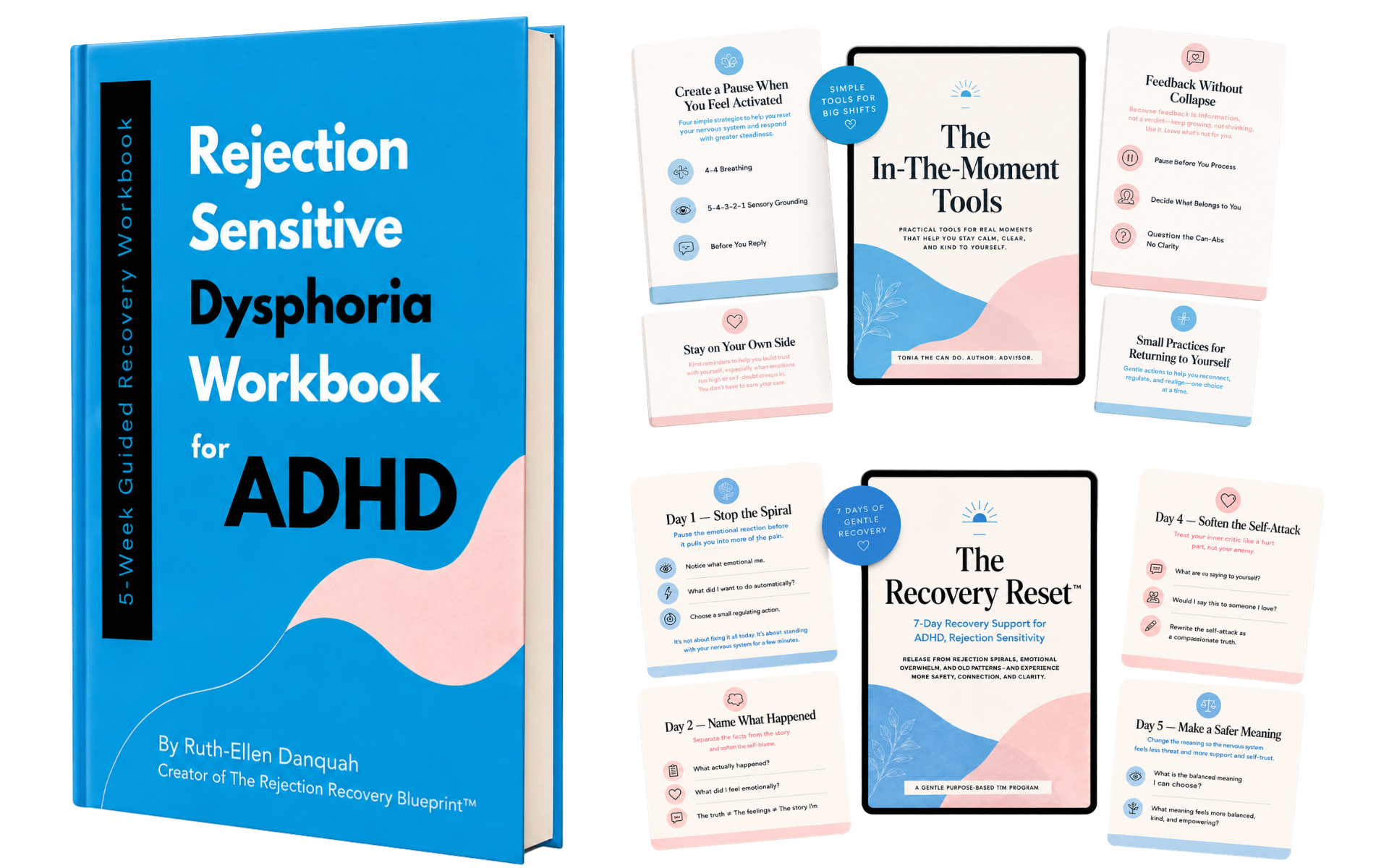
The Rejection Sensitivity Toolkit was built for exactly this. Grounding techniques, emotional regulation tools, and mindset shifts designed specifically for people whose nervous systems process rejection the way yours does. Not generic strategies retrofitted from somewhere else. Real-world tools for the heat-of-the-moment situations a neurodivergent entrepreneur actually faces.
The price you didn’t charge because you froze. The follow-up you didn’t send because the silence felt like a verdict. The room you almost didn’t walk back into. That is what this toolkit is for.
Tired of rejection leaving you overwhelmed? The Rejection Sensitivity Toolkit gives you the tools to stay calm and in control — in the room, on the proposal, and in the quiet moment after. £33. Instant access.
Get the Rejection Sensitivity Toolkit →
Conclusion
Your emotions are not running your business because you are too sensitive. They are running it because your nervous system was never given the right brief — and the tools that work for everyone else were not built for the way yours works.
The price you didn’t charge. The follow-up you didn’t send. The quiet moment after a brilliant performance where RSD rewrote what just happened. These are not small things. They are the operational cost of a nervous system running without the resources to manage it.
Close mouths don’t get fed. You can always go down. The version of you that knows exactly what you are worth — the one with the manifesto, the trust jar, and the years of evidence — that one gets to set the price.
Sources
- Retz W et al. — Emotional dysregulation in adult ADHD — PMC / PLOS One (2026)
- Modestino EJ et al. — Rejection Sensitivity Dysphoria in ADHD: A Case Series — Acta Scientific Neurology (2024)
- Dodson W — Rejection Sensitive Dysphoria: ADHD and Emotional Dysregulation — ADDitude Magazine
- Sandland B — Neurodivergent Experiences of Rejection Sensitive Dysphoria — Sage Journals (2025)
- Evans E et al. — The workplace masking experiences of autistic, non-autistic neurodivergent and neurotypical adults in the UK — PLOS One (2023)
- Baltimore Therapy Group — Rejection Sensitive Dysphoria: What Research Actually Shows (2025)
- Psychology Today — The Hidden Cost of Passing as Normal (2025)
Ruth-Ellen Danquah is a neurodivergent entrepreneur, founder of ANCHOR™, and creator of the Rejection Sensitivity Toolkit. She writes about the gap between how neurodivergent professionals are told to work and how they actually work best. This is not therapy. It is decision governance for your nervous system.