
Table of Contents
The BAFTA 2026 disability inclusion planning failure became a defining case study in what happens when an organisation welcomes someone in without building the room for everyone.
Michael B. Jordan and Delroy Lindo walked onto the stage at the 79th BAFTA Film Awards to present the first award of the night.
They are two celebrated Black actors at the peak of their careers. Their film, Sinners, was the most nominated of the evening. Director Ryan Coogler would go on to become the first Black man to win the BAFTA for best original screenplay. It should have been a triumphant night.
Instead, as they stood on stage at the Royal Festival Hall, someone in the audience shouted the N-word at them.
Lindo paused. Then he continued. Because that’s what Black professionals are expected to do — absorb the impact, maintain composure, keep the show moving. He told Vanity Fair afterwards that he and Jordan “did what we had to do.” Then he added the part that should keep every events and People team awake at night: he wished someone from BAFTA had spoken to them afterwards.
Nobody did.
Here is the question that sits at the centre of this, and it’s the one nobody is asking:
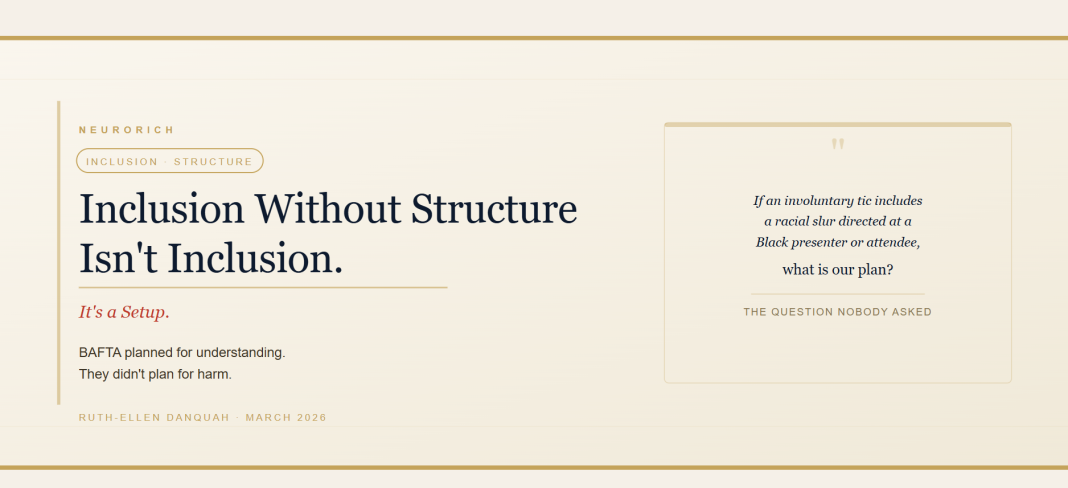
“If an involuntary tic includes a racial slur directed at a Black presenter or attendee, what is our plan — in the room, on the broadcast, and afterwards?”
That question was never asked. And what follows is what that absence cost.
BAFTA 2026: The disability inclusion plan and what it missed
The person who shouted the slur was John Davidson, a Tourette syndrome campaigner and the subject of the BAFTA-nominated film I Swear. His tics are involuntary. He has no control over them. He has spent decades advocating for understanding of his neurotype. He has described feeling a “wave of shame” and has since reached out to apologise.
This is not a piece about Davidson. His tics are neurological. They are not a reflection of his beliefs or character. That is medically established and not in dispute.
This is a piece about BAFTA. About the BBC. About every organisation that plans for the comfort of inclusion but not for the harm that can follow when the structure isn’t stress-tested.
Because here’s what was known before the ceremony started:
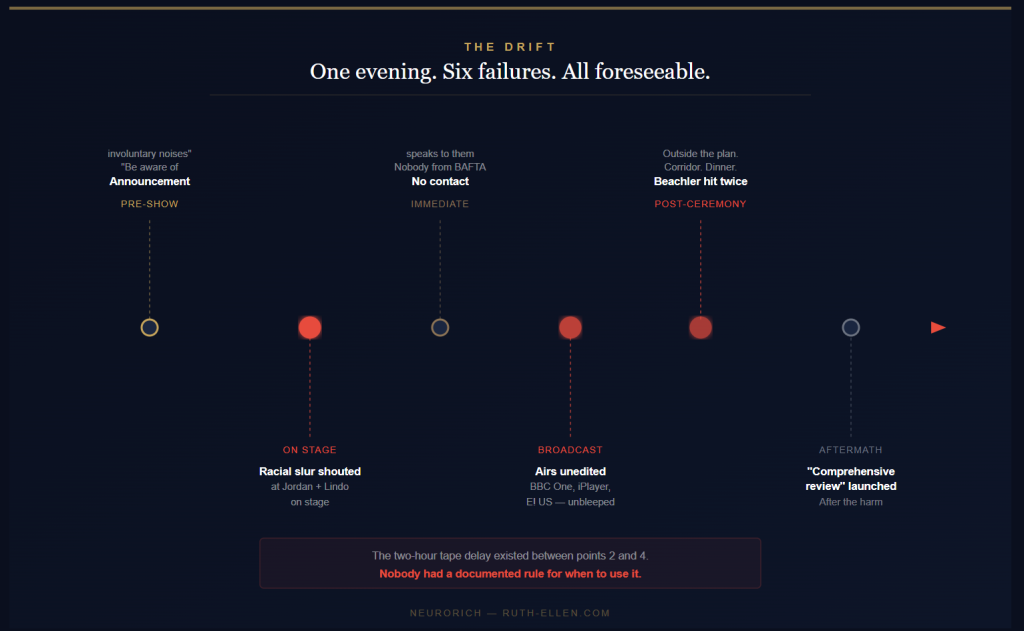
BAFTA knew Davidson would be in the auditorium. They knew his neurotype involves involuntary vocal tics, including expletives. The BBC had met with BAFTA in advance to discuss what might happen if he swore during the broadcast. A floor manager welcomed Davidson warmly before the show. An announcement was made to the auditorium: “John has Tourette’s Syndrome, so please be aware you might hear some involuntary noises or movements during the ceremony.”
Presenters were informed about Davidson’s tics just minutes before the ceremony began.
The intent was clear. The planning was genuine. The welcome was warm.
And none of it accounted for what actually happened.
The harm that the BAFTA 2026 disability planning didn’t address
Here is what the planning didn’t address:
It didn’t address the possibility that an involuntary tic might include a racial slur. Not a generic expletive — a word that carries centuries of dehumanisation, directed at Black people, shouted while two Black men stood on stage in front of their peers.
It didn’t address what would happen to the people on stage when that word was spoken. There was no protocol for reaching out to Jordan and Lindo afterwards. No one from BAFTA contacted them. Lindo had to say it himself, at an afterparty, to a journalist.
It didn’t address what the broadcast team should do. The ceremony was recorded with a two-hour tape delay — a buffer specifically designed for situations like this. The BBC had the capacity to edit the slur out before it aired. They didn’t. It went out on BBC One. It went out on iPlayer. It stayed on iPlayer for fifteen hours. It aired unbleeped on E! in the United States. Warner Bros. reportedly contacted the BBC to request the slur be removed. It still took until the following afternoon.
It didn’t address what would happen beyond the auditorium. Production designer Hannah Beachler, who was nominated for her work on Sinners, reported that she also experienced Davidson’s involuntary racial slurs — once directed at her on the way to dinner after the show, and once at another Black woman. Three incidents in one evening. All after the ceremony. All outside whatever containment the auditorium announcement was supposed to provide.
And it didn’t address the apology. Host Alan Cumming thanked the audience for their “understanding” and apologised if “anyone was offended.” Beachler called it a “throw-away apology” that made the situation worse. Journalist Jemele Hill named the pattern plainly: the expectation was that Black people should be okay with being disrespected and dehumanised so that other people don’t feel bad.
That’s not a failure of intent. BAFTA 2026 disability planning clearly intended to be inclusive. That’s a failure of structure. They planned for understanding. They didn’t plan for harm.
Disability and race are not competing values
One of the most damaging things about Bafta 2026 disability planning impact is how quickly it was framed as a binary: either you support Davidson and understand Tourette’s, or you support Jordan and Lindo and condemn what happened.
That framing is false. And it lets the institution off the hook.
Davidson’s tics are involuntary. That is a medical fact. He did not choose to say that word. People with Tourette syndrome deserve to attend public events without being told they should stay home.
Jordan and Lindo were subjected to a racial slur on one of the biggest stages in their industry. The harm they experienced is real regardless of whether the word was spoken intentionally. The impact of anti-Black language does not depend on the intent behind it. It lands in the body of the person it hits.
Both of these things are true at the same time.
This is where a principle that every People professional knows — but that BAFTA failed to apply — becomes critical: intention does not determine impact.
We teach this in every inclusion training. We say it in every workshop on psychological safety. The person who causes harm may not have intended to. The harm is still real. And the responsibility for closing the gap between intention and impact does not sit with the person who was harmed — it sits with the institution that created the conditions.
The job of the institution was to hold both truths simultaneously and build a structure that protected everyone. That meant including Davidson. And it meant having a concrete, documented plan for the specific harm that could result from that inclusion.
What a structured inclusion decision would have looked like
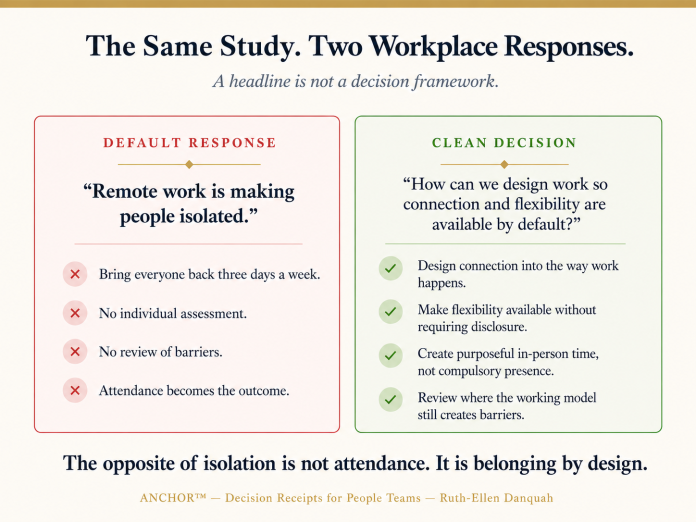
If someone in BAFTA’s planning team had run through a structured decision framework — not just “should we invite Davidson?” but “what are the foreseeable consequences of his attendance, and do we have a plan for each one?” — several things would have been different.
Seating and proximity. Davidson’s seating position relative to the stage and to microphones could have been assessed. His proximity to presenters during transitions could have been managed.
Presenter briefing. Jordan and Lindo were told about Davidson’s tics minutes before the ceremony. A proper briefing — private, respectful, with an offer of support if something occurred on stage — would have been different from a last-minute housekeeping note.
Broadcast protocol. The two-hour tape delay existed for exactly this purpose. A documented protocol stating “any involuntary language that includes slurs will be edited from the broadcast” should have been agreed in writing with the BBC before the ceremony started. The fact that it wasn’t is an institutional failure, not a technical one.
Post-incident contact. A named person should have been assigned to check in with anyone directly affected by a tic during the ceremony. Jordan and Lindo should not have had to wait for a journalist to ask them how they felt at an afterparty.
Post-ceremony plan. The auditorium announcement covered the ceremony. It didn’t cover the dinner, the afterparty, or the walk between venues — where Beachler and another Black woman experienced further slurs. If Davidson was attending post-ceremony events, the same planning needed to extend beyond the auditorium.
Documentation. Every one of these decisions — what was considered, what was agreed, who was responsible — should have been written down before the event. Not as a legal exercise. As evidence that the institution thought about everyone in the room, not just the person they were trying to include.
None of this would have excluded Davidson. All of it would have protected the people around him.
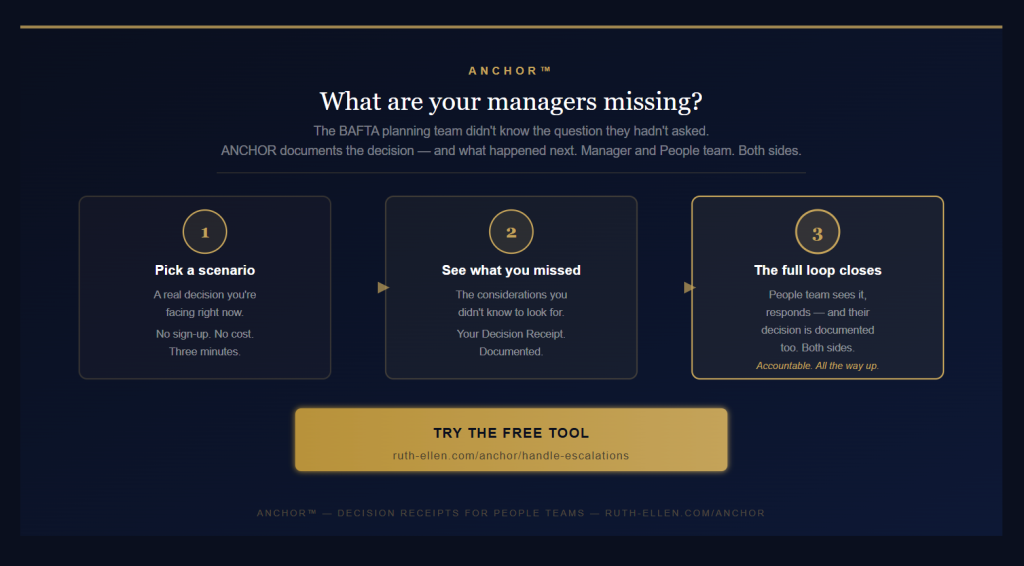
The BAFTA 2026 disability inclusion failure is not an outlier. It is the pattern — awareness without infrastructure, welcome without protocol. If your organisation is planning a high-stakes event or programme involving neurodivergent colleagues, try the free ANCHOR scenario tool before the decision is made.
The six decisions BAFTA’s review probably won’t reach
BAFTA has launched a “comprehensive review.” That review will almost certainly address the obvious failures. But there are deeper structural decisions that most reviews don’t reach, because they require a different kind of thinking — not “what went wrong” but “what decisions were never made in the first place.”
The apology language problem. “Sorry if anyone was offended” centres the audience’s feelings, not the specific harm to specific people. There is a fundamental difference between a broadcast disclaimer and an acknowledgement of racialised harm. BAFTA needs a framework for knowing the difference — because the wrong language in the wrong moment doesn’t just fail to help. It makes things worse.
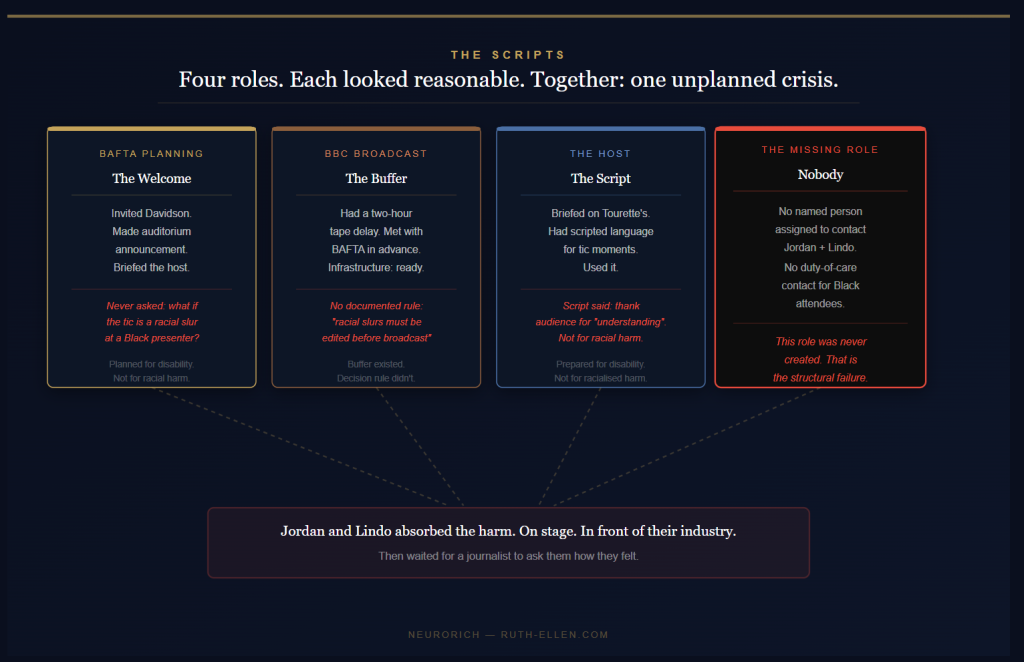
Who speaks to whom — and when. Nobody contacted Jordan or Lindo. But the question isn’t just “why didn’t someone reach out?” — it’s “who was designated to do it?” If no one was assigned, it’s not surprising no one acted. Someone needs to own this role before the event starts.
The boundary of the plan. BAFTA planned for the auditorium. The evening didn’t end at the auditorium. The plan’s boundary was the ceremony. The harm’s boundary was the entire night.
The tape delay decision authority. The BBC had a two-hour buffer. No one had a documented rule for when to use it. The infrastructure existed. The decision framework didn’t.
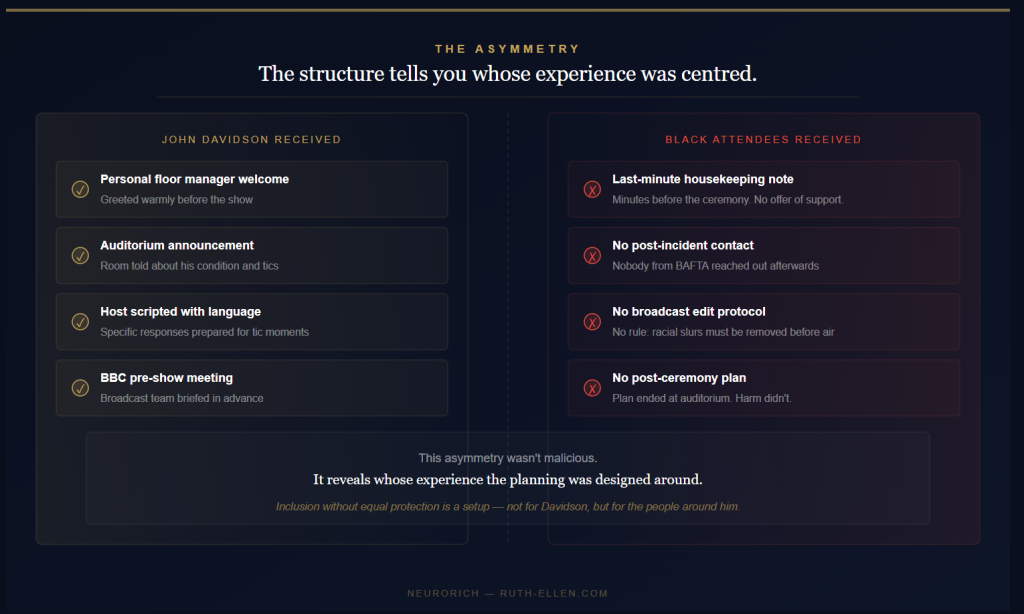
The consent and preparation asymmetry. Davidson received a warm personal welcome and a floor manager greeting. Jordan, Lindo, and every other Black attendee received a last-minute housekeeping note. The people most likely to be harmed received the least preparation, the least agency, and the least follow-up.
Having language ready for the false binary. Within hours, the public debate became “disability rights versus anti-racism.” BAFTA had no framework for holding both simultaneously. An institution that plans for inclusion should have that language ready before the event — not reactive statements drafted under pressure.
The structural question nobody is asking
There’s a deeper problem here. Davidson’s tics weren’t limited to one word or one moment. Over the course of the evening, he directed racial slurs at Jordan and Lindo on stage, at Beachler on the way to dinner, and at another Black woman separately. That is not one incident. That is a pattern across the entire evening.
And the institution treated all of these tics as if they were the same category of harm.
General expletives can be managed with a host acknowledgement and audience goodwill. A racial slur directed at Black attendees requires a different protocol — immediate private acknowledgement, a named duty-of-care contact, a broadcast edit decision, and post-event follow-up.
BAFTA had one tool. The evening required several.
The deeper question is why BAFTA had a plan for disability and no plan for race. Not because the planners were racist — but because disability inclusion was the narrative the institution was comfortable centring, and racial safety was treated as a problem that could be managed with a general announcement. That asymmetry — in briefing, in follow-up, in apology language — reveals whose experience the planning was designed around.
This maps onto a pattern that Black professionals across every industry recognise. The organisation invests deeply in one form of inclusion — and the people who bear the cost of its blind spots are disproportionately Black.
The cost of not planning — and what it means for your organisation
This case is not really about the BAFTAs. It is about every organisation that invites someone who is neurodivergent into a high-stakes environment and plans for the welcome but not for the full range of what might happen next.
The uncomfortable truth is that inclusion without structure isn’t inclusion. It’s a setup. It sets up the person being included to become the centre of a crisis they didn’t cause. And it sets up the people around them to absorb harm that was entirely preventable.
The fix isn’t less inclusion. It’s better decision-making at the point the programme is designed. A documented plan. A structured framework. A paper trail showing that someone asked: “Who might be harmed, and what’s our plan for that?”
That’s what was missing at the BAFTAs. Variants of this gap play out in organisations every week — in events, in reasonable adjustment decisions, in return-to-work planning, in any situation where one person’s needs and another person’s protection need to be held simultaneously.
The BAFTA 2026 disability inclusion failure is not an outlier. Michael B. Jordan and Delroy Lindo deserved better. John Davidson deserved better. The Tourette’s community deserved better. And better was available — it just needed to be planned for.
Ruth-Ellen Danquah is the founder of ANCHOR™ and writes about the gap between good intentions and good decisions at NeuroRich on Substack.