An occupational health report arrived in October 2023. It recommended five adjustments for an employee with ADHD. None of them were implemented. In February 2024, the employee was dismissed. In July 2025, the tribunal handed down its judgment. Five reasonable adjustment failures. Award: £24,200.
She sent him an email in November 2023.
She asked her line manager, Steve Baldwin, to attend ADHD awareness training with her. She had been on the waiting list. She had the OH report recommending it. She had found a format that would work — a group session, not a spotlight, not a private session that made it obvious the training existed because of her.
She sent the email. He didn’t respond.
Not a no. Not a “let me check with HR.” Not a “can we talk about this next week.” No response.
Four months later, Bahar Khorram was dismissed from her £120,000-a-year role at Capgemini UK for “ongoing concerns about her performance.” She had 25 years of experience in cloud architecture and pre-sales. She had disclosed her ADHD diagnosis. She had been referred to occupational health. She had done everything the system asks employees to do.
The system, in return, did not respond to her email.
The tribunal found five reasonable adjustment failures. The award was £24,200. But before you get to the legal analysis, there is a simpler question worth sitting with: what kind of organisation receives an email like that and says nothing?
Not a cruel one. Not a negligent one in the way people usually mean negligent. A normal one. A busy one. One where a manager had a full diary and an inbox and a list of things to do before the end of quarter, and an employee’s email asking about training slipped through without anyone noticing that it wasn’t just an email — it was the moment the case was decided.
What happened in Khorram v Capgemini
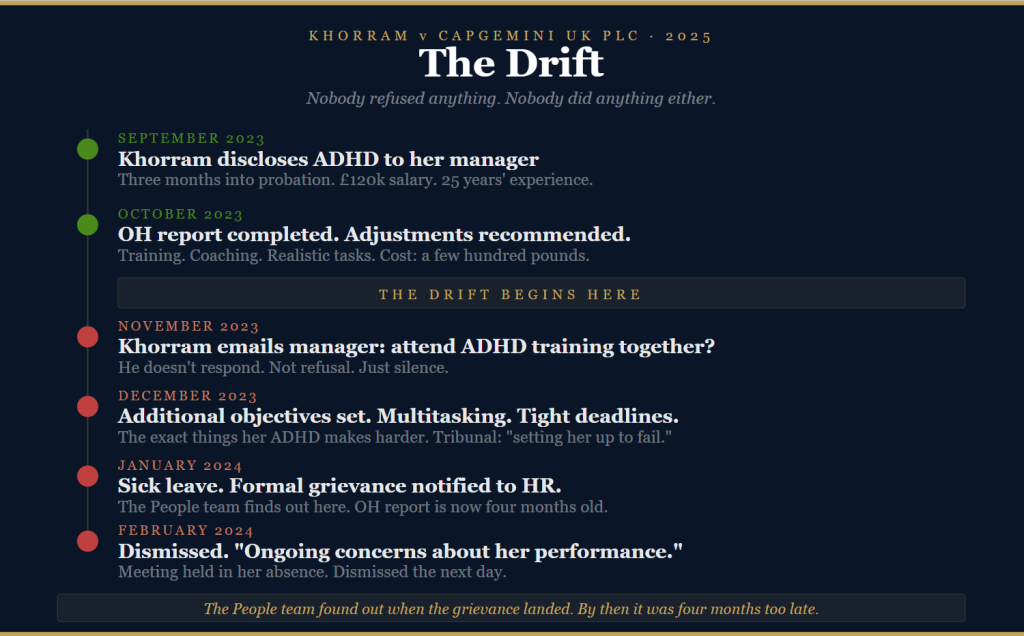
Bahar Khorram joined Capgemini UK in June 2023 as Presales Market Lead in their cloud infrastructure services business unit. Her salary was £120,000 plus benefits. She was a cloud technologist with over 25 years of international experience, having worked at well-known tech firms across the US and London.
She had ADHD, diagnosed in November 2022 following a psychiatric assessment. Her condition significantly affected her executive functioning — particularly her ability to manage unstructured tasks, cope with ambiguity, handle excessive multitasking, and maintain focus in environments that lacked clarity or routine. She could do the work. She needed the work to be structured in a way that worked with her brain, not against it.
She told her line manager, Steve Baldwin, about her ADHD in September 2023, three months into her six-month probation. Baldwin referred her to occupational health. The OH assessment came back in October 2023 with specific, costed, practicable recommendations:
- Setting achievable and realistic tasks to prevent her becoming overwhelmed
- Neurodiversity awareness training for colleagues and managers (a one-hour or three-hour group webinar for up to 15 people — cost: a few hundred pounds)
- ADHD awareness training for the team
- Six two-hour coaching sessions focused on ADHD, time management, and coping strategies
- Coaching sessions with her line manager
These were not radical asks. The training was a webinar. The coaching was six sessions. The tribunal later noted that the cost “was not a prohibitive difficulty” for a company the size of Capgemini.
In November 2023, Khorram sent the email. She invited Baldwin to attend the ADHD training with her. She had made clear she was comfortable being one of many attendees — she just did not want it delivered as a private session that made it obvious the training existed solely because of her. The tribunal accepted this as a reasonable position. The training was for everyone. Its purpose was to help colleagues understand how to work with her.
Baldwin did not respond.
Khorram took two weeks of sick leave and one week of annual leave. She explored a role change. Her sick note cited her struggles functioning at work and a medication change — she was on sertraline, recently increased. In December 2023, a further probation review set new objectives. The tribunal later found that these objectives, still live in January 2024, represented a continuing act of discrimination — because the adjustments that might have helped her meet them had never been put in place.
In January 2024, Khorram notified HR of her intention to raise a formal grievance, citing lack of support and an intimidating working relationship with her manager. Her probation was extended. Then, on 31 January 2024, a probation meeting was held in her absence. The following day, she was dismissed for “ongoing concerns about her performance.”
The claim was heard in May 2025. The judgment was handed down in July 2025. Five failures to make reasonable adjustments were upheld. The award was confirmed in a remedy judgment in December 2025: £24,200.
The harassment claims did not succeed. The section 15 claims did not succeed. But the core of what Khorram had said all along — that Capgemini received an OH report with specific recommendations and did not act on them — was upheld.
The four people in this case. You know all of them.
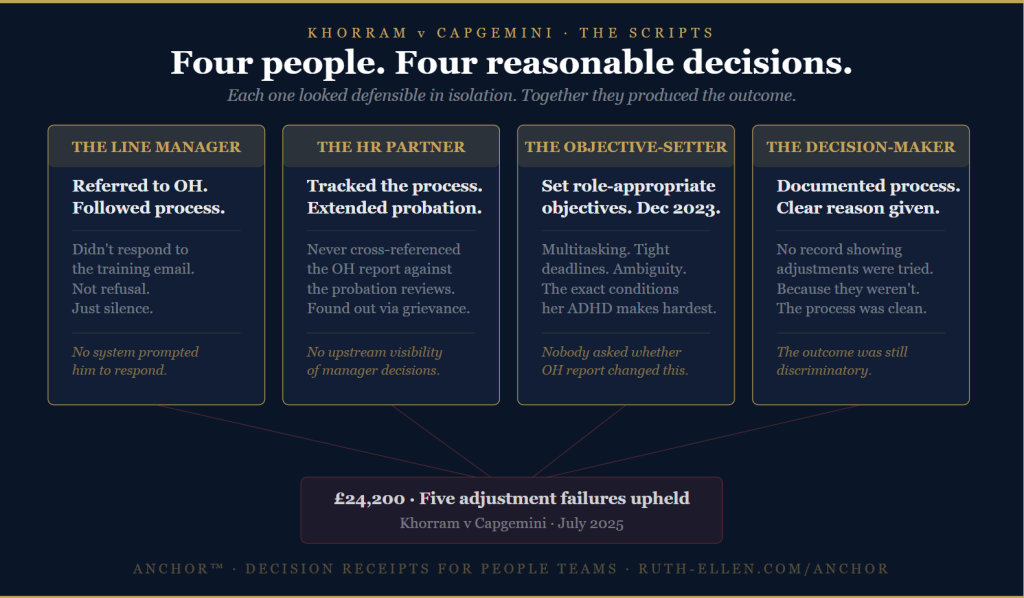
Every case like this has the same cast. Not villains. Not bad people. People doing normal things inside a system that didn’t prompt them to ask the one question that would have changed everything.
The Line Manager Steve Baldwin referred Khorram to occupational health when she disclosed her ADHD. That’s what the process says to do. The OH report arrived. He was busy. The email about training came in. He didn’t respond — not because he decided not to, but because the email didn’t feel like a decision point. It felt like something to get to later. Later became never. A tribunal found that this silence was the moment the adjustment failure was established.
What looks reasonable: He followed the referral process. He didn’t refuse anything explicitly. What was missing: A system that told him that not responding was itself a decision — and a legally significant one.
The HR Business Partner HR knew Khorram had been referred to occupational health. HR received the report. HR’s role in the months that followed appears to have been largely procedural — managing the probation process, setting review dates, noting concerns. The OH report sat in the system. Nobody cross-referenced it against what was actually happening in the probation reviews. Nobody asked: have the adjustments been implemented? If not, why not? When the grievance landed in January 2024, the response was to extend the probation. One month later, Khorram was dismissed.
What looks reasonable: HR tracked the process. They extended the probation when concerns were raised. What was missing: Visibility of what was happening at manager level before it escalated. The loop never closed.
The Objective-Setter In December 2023, new objectives were set. These objectives required the same things the OH report had identified as difficult for Khorram without adjustment: managing multiple workstreams, meeting deadlines, operating in ambiguous environments. The objectives were not created to be punitive. They were created because that was the work. Nobody stopped to ask whether the work, structured the way it was structured, was still appropriate given that the adjustments intended to support her through it had not been put in place.
What looks reasonable: Objectives reflect the role requirements. That’s what probation is for. What was missing: A prompt to ask whether the objectives were being set into conditions that had already been identified as creating a barrier.
The Decision-Maker The decision to dismiss was made after a probation meeting held in Khorram’s absence. The reason given: “ongoing concerns about her performance.” The decision-maker had the probation records. They had the documentation of the meetings. They had evidence of underperformance against objectives. What they did not have — what nobody had produced — was a record showing that the five OH-recommended adjustments had been implemented and had not changed the outcome. That record did not exist. It did not exist because the adjustments had never been put in place.
What looks reasonable: A documented probation process with a clear reason for dismissal. What was missing: The evidence that would have made the dismissal defensible — proof that Capgemini had done what the law required before concluding the work could not be done.
The four people in this case are not unusual. They are operating inside a system that has no mechanism for asking, at the point of decision, whether an OH report has been acted on — and whether any pending adjustments change what the next decision should be. The question was never asked. The system was never designed to ask it.
What the system doesn’t count
I built ANCHOR because of this pattern. Not because I read about it in a case report.
I saw it first as a trainer — building frameworks for managers, watching them leave the room with the right language and then return to environments that had no mechanism for using it. The training was good. The environment hadn’t changed. The manager sat down, opened their inbox, and the next decision happened without the prompt.
Then I saw it as a coach — sitting with neurodivergent individuals who were not failing at their jobs but were exhausted from doing the emotional and administrative labour that should have belonged to the system. They had a workplace needs assessment. They had an OH report. They had documentation of exactly what they needed. And they were spending cognitive resource — resource that should have been available for the work — chasing follow-up, managing their own distress at not being prioritised, presenting their needs again in a slightly different way to see if this time someone would act on them.
That is not an individual failing. That is what happens when a system produces a document and then outsources the follow-through to the person with the least power to enforce it.
In Khorram v Capgemini, Bahar Khorram did everything the system asks. She disclosed her diagnosis. She went through occupational health. She identified training that would work, in a format that would not single her out. She sent the email. She was not passive. She was doing the labour of a system that had abdicated its responsibility to act.
The tribunal found five failures. The award was £24,200. What the tribunal did not and could not measure is the cost that preceded it — the months of following up, the sick leave, the medication changes, the annual leave taken because the environment had become untenable. The legal figure is the floor, not the ceiling.
ANCHOR is built for the moment before that cost accumulates. Not after the grievance. Not after the tribunal bundle. At the manager’s decision point — before the email goes unanswered, before the objective is set into conditions that were already flagged as a barrier, before the individual has to become their own case manager inside an organisation that was already told what they needed.
The downstream problem — the emotional labour placed on the individual when systems fail upstream — is the reason the upstream system exists.
The question is never why didn’t she push harder. She pushed. She emailed. She disclosed. She went through every process available to her. The question is why the system had no mechanism to respond.
The question nobody asked
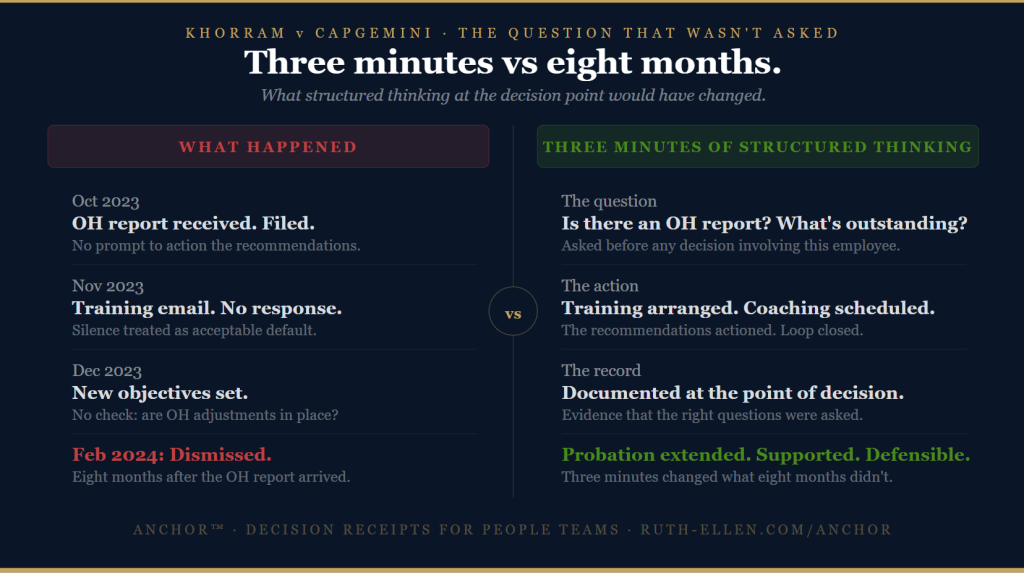
There is one question that, asked at any point between October 2023 and February 2024, would have changed what followed.
We have an OH report recommending adjustments for this employee. Which of those adjustments have been implemented? Which haven’t? And is anything happening in this probation process that those adjustments were supposed to support?
That question is not complicated. It does not require a legal team or an HR director. It requires a prompt — something in the system that fires before a manager sends an email, before new objectives are set, before a probation review is scheduled — that asks: have we done what we said we’d do?
In Khorram v Capgemini, the answer to that question, at every stage, was no. The training had not been arranged. The coaching sessions had not been scheduled. The task-setting guidance had not been applied. The objectives set in December 2023 were set into conditions that the OH report had already identified as creating a barrier — and nobody paused to notice.
The tribunal found that the objectives set in December 2023 were still live in January 2024. Employment Judge Adkin found this represented a continuing act of discrimination — not a single decision, but an ongoing failure that accumulated across months. The discrimination was not in any one action. It was in the sustained absence of the question.
The reasonable adjustment that was perhaps most striking in the judgment was the awareness training. The tribunal found that the format Khorram had proposed — a group session, not a spotlight on her — was practicable and reasonable. It would have helped her colleagues understand how to work with her. It would have reduced the disadvantage she faced from multitasking requirements and tight deadlines. Capgemini argued she hadn’t wanted it. The tribunal found she had objected to one specific delivery format — not to the training itself. That is a distinction that matters. An employer’s obligation is not to offer training in a format the employee has said won’t work. It is to find a format that will.
Nobody found that format. Nobody tried.
Why this keeps happening
This is not a story about a bad employer. Capgemini is a global technology and consulting firm. They had an HR function. They had an occupational health process. They referred Khorram for assessment. They produced probation documentation. They followed the process.
The process did not contain the question.
This is the pattern in almost every reasonable adjustment failure that reaches tribunal. Not malice. Not a deliberate decision to ignore a disabled employee’s needs. A system that was designed to manage performance, and that had no mechanism for asking — at the moment a manager is deciding what to do next — whether an outstanding adjustment changes what that decision should be.
The Equality Act 2010 does not require perfection. It requires that employers take reasonable steps. A one-hour webinar for up to 15 people is a reasonable step. Six coaching sessions is a reasonable step. Setting objectives that account for what the OH report says is a reasonable step. None of these are difficult. All of them require one thing: a prompt that fires before the manager acts, not after the outcome has landed.
ANCHOR is built for that moment. When a manager submits a decision through the free scenario tool, the system asks the questions the manager didn’t know to ask — including whether there is an outstanding adjustment that changes what the right decision is.
Try it on a real situation: free ANCHOR scenario tool →
What the Equality Act actually requires — and what Khorram v Capgemini confirmed
The duty to make reasonable adjustments under the Equality Act 2010 is triggered when an employer knows, or ought to know, that an employee has a disability. ADHD qualifies where it has a substantial and long-term adverse effect on normal day-to-day activities. In Khorram’s case, the tribunal accepted that her ADHD created significant disadvantage — particularly in relation to multitasking requirements and tight deadlines. These were framed as provisions, criteria, or practices (PCPs) applied by Capgemini that put her at a particular disadvantage compared to colleagues without her disability.
What Khorram v Capgemini confirmed — and what People professionals should take seriously — is that reasonable adjustments are not limited to equipment, modified duties, or flexible working. The tribunal upheld the failure to implement awareness training for colleagues and managers as a failure to make reasonable adjustments. That is significant. The disadvantage Khorram faced was not only from the condition itself. It was compounded by how colleagues and managers responded to neurodivergence they did not understand. Training that would have reduced that disadvantage was a reasonable adjustment. Not implementing it was a failure.
The judgment also confirmed the continuing act principle. The adjustments were not made in October 2023, when the OH report arrived. They were not made in November 2023, when Khorram sent her email. They were not made in December 2023, when new objectives were set. Each decision point — each time someone proceeded without asking whether the adjustments had been implemented — was part of a single, continuing act of discrimination. The clock did not reset with each new probation review. The failure accumulated.
For Heads of People, this means one thing practically: the question is not whether your organisation made adjustments at one point. It is whether your managers are checking, at every decision point that involves an employee with a known disability, whether the adjustments are in place and whether the decision being made accounts for them.
If that check does not exist in your system, the risk is live. Not hypothetically. Actively.
Read the pattern in a dyslexia performance management context: Merchant v BT →
What Heads of People need before the next OH report arrives
The failure in Khorram v Capgemini was not the referral to occupational health. That happened. The failure was in the gap between the report arriving and anyone checking whether the recommendations had been acted on.
Three things would have changed the outcome.
1. A closed loop between OH recommendations and manager decisions. When an OH report arrives with specific recommendations, someone needs to own the follow-through — not just log that the report was received, but confirm that each recommendation has been actioned, track which ones are outstanding, and ensure that no further decisions are made about that employee’s performance without cross-referencing what is still pending. This loop does not exist in most performance management frameworks. It needs to be built deliberately.
2. A prompt that fires before any probation decision is made. The December 2023 objective-setting happened without anyone asking whether the OH-recommended adjustments were in place. A prompt — something in the system, not in anyone’s memory — that asks “are there outstanding adjustments for this employee?” before the next decision is made would have changed what happened next. The objective-setter would have had to answer the question before setting objectives into conditions the OH report had already flagged.
3. Visibility of manager decisions before they escalate. HR found out about Khorram’s situation through a grievance notification in January 2024. By then, the adjustment failures had been accumulating for three months. The People team was informed after the damage was done. Upstream visibility — the ability to see what managers are deciding at the point they decide it — is what closes that gap.
The OH report in Khorram v Capgemini was not the problem. The problem was that nobody built a system to check whether the recommendations in it had been followed. An OH report that sits unimplemented is not a defence. It is evidence of a failure that was documented before it happened.
What this case means for managers running ADHD-related processes right now
If you are managing an employee with ADHD — or any disability where an OH report has been produced — there are three questions to ask before your next decision: What did the OH report recommend? Which of those recommendations have been implemented? Does the decision I am about to make assume the adjustments are in place — and if they aren’t, does that change what I should do?
These questions cost nothing to ask. Not asking them is what £24,200 looks like.
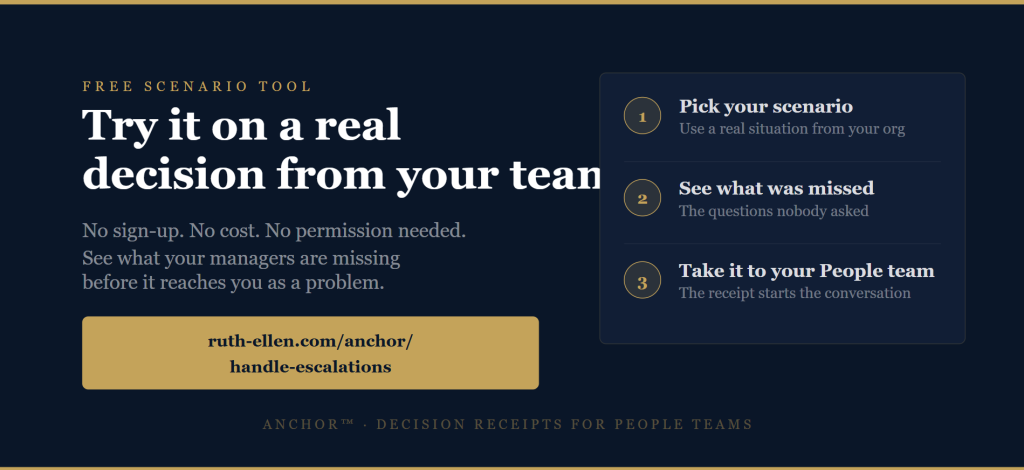
The free ANCHOR scenario tool surfaces these prompts before you act. No sign-up. No cost. Try it on your real situation: ruth-ellen.com/anchor/handle-escalations/
Are your managers reading the manager version of this? NeuroRich breaks down cases like Khorram v Capgemini for the people actually running these conversations — not the legal commentary, but the moment before the decision. What they were thinking. What they missed. What to ask instead. Subscribe at neurorich.substack.com →
What a Sprint produces for a Head of People
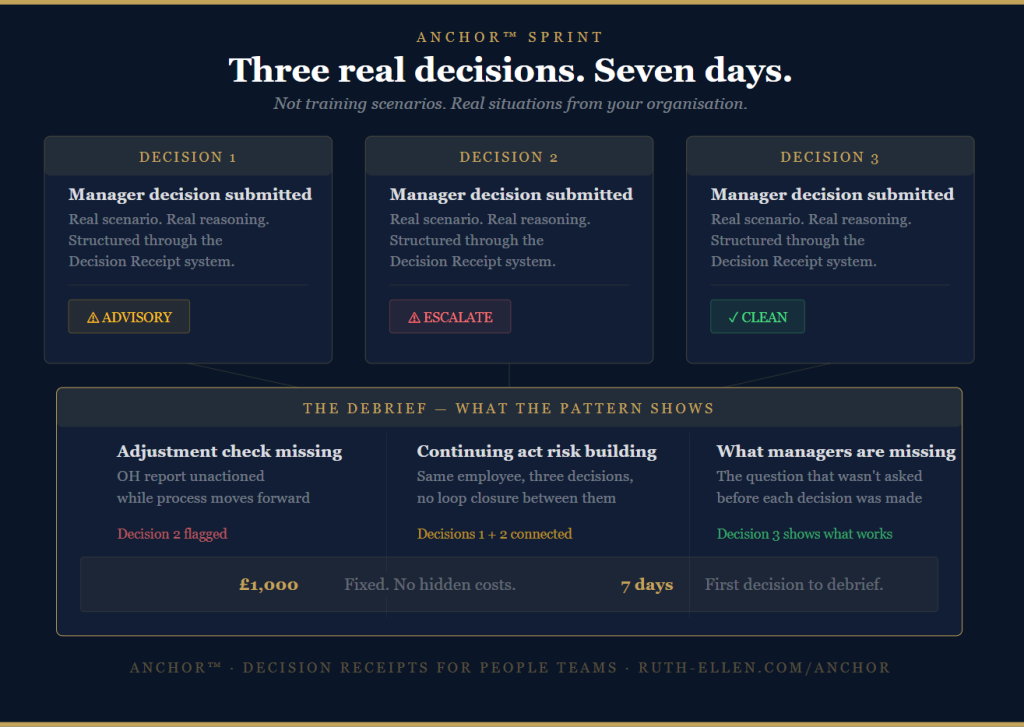
An ANCHOR Sprint runs three real manager decisions from your organisation through the Decision Receipt system over seven days. Each decision is structured, risk-assessed, and returned with a debrief showing what your managers are thinking — and what they are missing — at the moment they decide.
For a Head of People whose managers are navigating ADHD disclosures, OH reports, or reasonable adjustment processes, a Sprint answers the question that is otherwise invisible: is the right question being asked before anyone acts?
The debrief shows you the pattern across three real decisions. Not training scenarios. Real situations from your organisation. Where the adjustment check is missing. Where the continuing act risk is building. Where the OH report is sitting unimplemented while the probation process moves forward.
Khorram v Capgemini was decided by an email that nobody answered. The organisations that don’t end up in that position are not the ones with better policies. They are the ones with a system that asks the question before the inbox moves on.
The clean decision
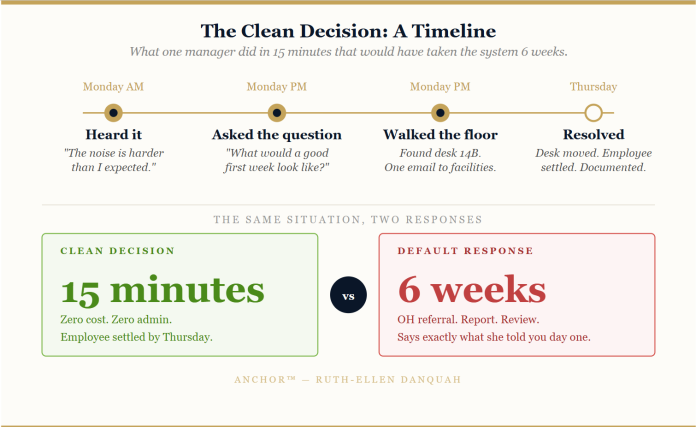
Three minutes. That is what it takes.
Before any probation decision involving an employee with a known disability, before any objective-setting process, before any response (or non-response) to a training request — three minutes of structured thinking:
Is there an OH report? What did it recommend? Has it been implemented? Does this decision account for what hasn’t been done yet?
Khorram emailed Baldwin in November 2023. She had 25 years of experience. She had disclosed her diagnosis. She had been through occupational health. She had identified a format for training that would work. She sent the email.
He didn’t respond.
The tribunal found that this was part of a continuing act of discrimination. Not a decision. The absence of one.
Three minutes would have changed it.
About the author
Ruth-Ellen Danquah is the founder of ANCHOR™ — Decision Receipts for People Teams. A former Inside Sales Representative who closed £120 million over two years, she knows from direct experience what it looks like when a system processes a person instead of asking the question that would have changed the outcome. She writes about the gap between what organisations intend and what managers do at 9am on a Tuesday — and why that gap is where all the risk lives. This is not legal advice. It is decision governance.
Case reference: Khorram v Capgemini UK plc, Central London Employment Tribunal, Case No. 6004705/2024, judgment handed down 14 July 2025. Remedy judgment December 2025.
If you are a manager reading this — this post was written for your Head of People. If you are navigating a situation involving a disability disclosure, an OH report, or a reasonable adjustments conversation, the free ANCHOR scenario tool surfaces the questions you should ask before you go further. Try it on your real situation, then share this page with your People team.