The short answer: Technically, no in answer to do employers have to follow occupational health recommendations?. An OH report is advisory, not binding. But that answer will not help you when a manager has had a report sitting in their inbox for three months and nothing has been actioned. Here is what the law actually requires — and what happens when it isn’t done.
The longer answer is that this distinction almost never matters in the way employers think it does — because the question tribunals ask is not whether you were required to follow the report. It is whether you had a good reason for not doing so, whether you documented that reason at the time, and whether the employee with a disability was placed at a substantial disadvantage as a result.
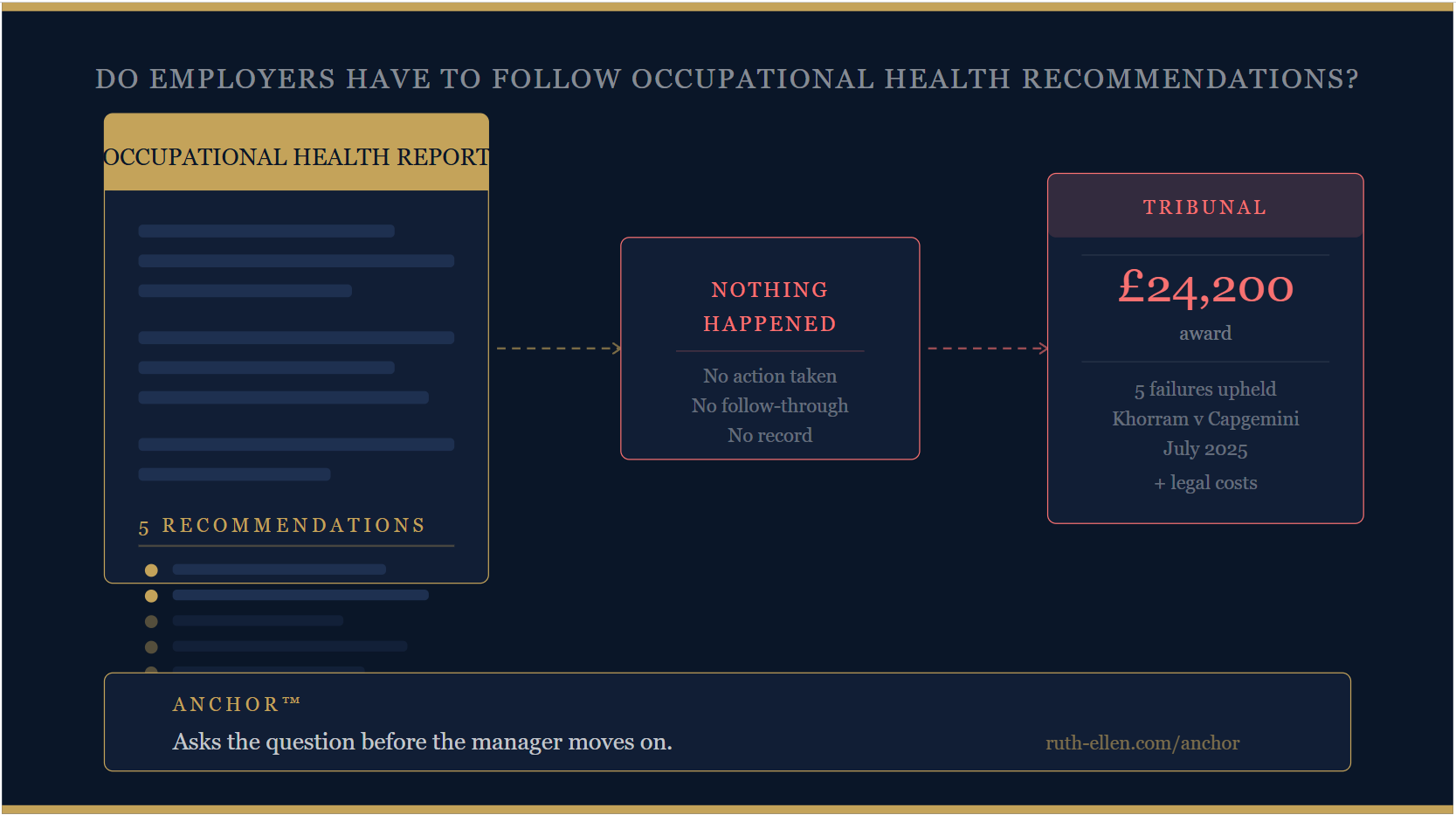
In 2025, the Central London Employment Tribunal handed down its judgment in Khorram v Capgemini. Capgemini had referred a senior employee with ADHD to occupational health. The report arrived with five specific recommendations. None of them were implemented. The employee was dismissed for “ongoing performance concerns” four months later. Five reasonable adjustment failures were upheld. The award: £24,200.
Capgemini did not decide to ignore the report. The report arrived. The manager received it. Nothing happened. The distinction between “decided not to follow” and “nothing happened” is not one the tribunal found meaningful.
That is the actual answer to the question.
What the law requires about following occupational health recommendations
The Equality Act 2010 places a duty on employers to make reasonable adjustments where they know, or ought to know, that an employee has a disability. The duty is triggered by knowledge — not by a diagnosis, not by a formal disclosure process, not by a completed OH report. If a manager has been told, or could reasonably have known, that an employee’s condition affects their ability to work, the duty is active.
An occupational health report does not create the duty. It evidences it. Once a report arrives recommending specific adjustments, an employer who does not act on those recommendations is in a materially different position from one who was never told what was needed. The report removes any argument that the employer did not know what reasonable adjustments would look like.
This is why the “advisory only” framing is operationally dangerous. It is technically accurate and practically misleading. The report is advisory in the sense that you are not legally required to implement every recommendation without question. You can make a different decision — but only if you can show you considered the recommendation, had a legitimate reason for not implementing it, and documented that decision at the time.
What you cannot do is receive a report, take no action, continue a performance or probation process, and then argue at tribunal that the recommendations were advisory. That argument was available to Capgemini. They did not win it.
What “considering” a recommendation actually means
This is where most organisations are exposed and do not know it.
Receiving an OH report and filing it is not considering it. Forwarding it to HR and waiting is not considering it. Telling the employee you will “look into it” and then not doing so is not considering it.
Considering a recommendation means asking three questions — documented, at the point of decision:
1. Can this recommendation be implemented as stated? If yes: action it, confirm to the employee it has been done, and set a review date.
If no: ask why not — is it cost, operational feasibility, or something else? Document the specific reason. Then ask what alternative adjustment could address the same need.
2. If not implemented as stated, what adjustment will be made instead? The duty is to address the disadvantage. If a specific recommendation is not practicable, the employer’s obligation is to find something that is — not to conclude that nothing can be done.
3. Has the employee been told? Whatever the decision — implement, partially implement, or not implement with reasons — the employee needs to know. The loop does not close silently.
None of this requires legal input or a formal process. It requires a manager who has been prompted to ask these questions before moving on to the next thing in their inbox.
That prompt is what most performance management frameworks are missing.
An OH report that has been received, not actioned, and not responded to is not neutral. It is evidence, documented before the outcome landed, that the employer knew what the employee needed and did nothing with that knowledge.
What happens when a manager sits on a report
The pattern in tribunal judgments involving OH reports is remarkably consistent.
The report arrives. It contains specific, costed, practicable recommendations. The manager receives it. There is no system that fires a prompt asking what has been done with it. The performance or probation process continues, measured against standards the report has already flagged as potentially problematic without adjustment. Three, four, five months later — the employee is dismissed, or raises a grievance, or leaves.
The tribunal then works backwards. What did the employer know, and when? The OH report provides a timestamped answer. The tribunal asks: were the recommendations implemented? If not, why not, and is that documented? In the absence of a documented decision with reasons, the tribunal infers that no genuine consideration took place.
In Khorram v Capgemini, one of the recommended adjustments was an ADHD awareness training webinar — one to three hours, for up to 15 people. The tribunal noted the cost “was not a prohibitive difficulty” for Capgemini. The employee had emailed her manager directly asking him to attend. He did not respond. That email, and that non-response, sat at the centre of the tribunal’s analysis of whether the employer had genuinely engaged with the adjustment.
In Merchant v BT, the failure was not in the OH process but in the performance management process that ran alongside it — without pausing to ask whether the adjustments were in place or whether they changed what the process should be doing.
The pattern is not employers deciding to discriminate. It is employers whose systems have no mechanism for asking, at each decision point, whether an outstanding adjustment changes what the right decision is.
The legal position in plain terms
Employers do not have to follow every OH recommendation to the letter. They do have to:
- Genuinely consider each recommendation at the point it is received
- Document any decision not to implement, with specific reasons
- Identify an alternative adjustment if the recommended one is not practicable
- Tell the employee what has been decided and why
- Ensure that any subsequent performance decisions account for what is and is not in place
Failure on any of these points, where the employee has a disability, is a failure to make reasonable adjustments under the Equality Act 2010.
The Head of People problem
The manager received the report. The manager did not act on it. You found out when the grievance landed.
This is the structural problem, and it is not a training problem. A manager who has been through an Equality Act workshop knows they should follow OH recommendations. The same manager, six weeks later, with a full inbox and a probation review to run, receives a report and does not action it — not because they forgot the training, but because nothing in their environment prompted them to treat the report as a decision point rather than a piece of correspondence.
Heads of People who want to change this outcome have two options.
The first is to own the OH follow-up process centrally. Every report that lands gets logged, tracked, and chased. HR asks the manager what has been implemented. HR reviews the outstanding items before signing off any performance or probation decision involving that employee. This works. It also requires a People team with capacity to run it, visibility of every OH referral, and a manager population willing to be chased.
The second is to change what happens at the manager’s decision point. When a manager is about to submit a decision involving an employee with a known disability — a probation review, a performance conversation, a capability process — a structured prompt asks: is there an OH report for this employee? What is outstanding? Does that change what you are about to decide?
That prompt does not require HR capacity. It requires the prompt to exist inside the system the manager is using at the moment they are deciding.
If you have an occupational health report for someone on your team and you have not actioned it:Stop before your next decision about that person’s performance, probation, or capability.Ask: which recommendations have been implemented? Which haven’t? And does this performance concern look different once I account for what hasn’t been put in place yet?The free ANCHOR scenario tool surfaces these prompts before you act. No sign-up. No cost: ruth-ellen.com/anchor/handle-escalations/
What a three-month-old OH report means for your exposure right now
If there is an occupational health report in your organisation that has not been fully actioned — and the employee it was written for is currently in a performance process, on a probation review, or has raised a grievance — your exposure is active.
The report is timestamped. The date of the recommendations is on file. A tribunal will ask when the employer knew what was needed, and the report answers that question precisely. The gap between the report date and today is the period during which the employer had knowledge and took no action.
This does not mean the situation is unrecoverable. What it means is that the next decision involving that employee needs to account for the report — and needs to be documented showing that it did.
The questions to ask before that decision:
- What did the OH report recommend?
- Which recommendations have been implemented, and when?
- Which have not been implemented, and why — documented?
- Is the decision I am about to make affected by what is still outstanding?
- Has the employee been told the current status of each recommendation?
If you cannot answer all five, the decision should wait until you can.
What an ANCHOR Sprint surfaces for a Head of People
An ANCHOR Sprint runs three real manager decisions from your organisation through the Decision Receipt system over seven days. Each decision is structured, risk-assessed, and returned with a debrief showing what your managers are thinking — and what they are missing — at the point they decide.
For a Head of People who suspects there are OH reports sitting unactioned in manager inboxes right now, a Sprint answers the question that is otherwise invisible: are the right questions being asked before anyone moves forward?
The debrief shows the pattern across three real decisions. Where the OH check is missing. Where the performance process is running ahead of the adjustment. Where the exposure is concentrating.
Khorram v Capgemini was five recommendations, none implemented, one unanswered email. The organisations that do not end up there are not the ones with better policies. They are the ones where the question gets asked before the manager moves on.
£1,000 · 7 days · 3 real decisions · Full debrief
About the author
Ruth-Ellen Danquah is the founder of ANCHOR™ — Decision Receipts for People Teams. She writes about the gap between what organisations intend and what managers do at 9am on a Tuesday — and why that gap is where all the legal exposure lives. For managers navigating these situations in real time, the NeuroRich newsletter covers the decision before the process. This is not legal advice. It is decision governance.
If you are a manager reading this — share this page with your Head of People. If you have an OH report for someone on your team that hasn’t been fully actioned, try the free ANCHOR scenario tool before your next decision. It takes three minutes and surfaces the questions you need to answer before you move forward.
ANCHOR™ · Decision Receipts for People Teams · ruth-ellen.com/anchor