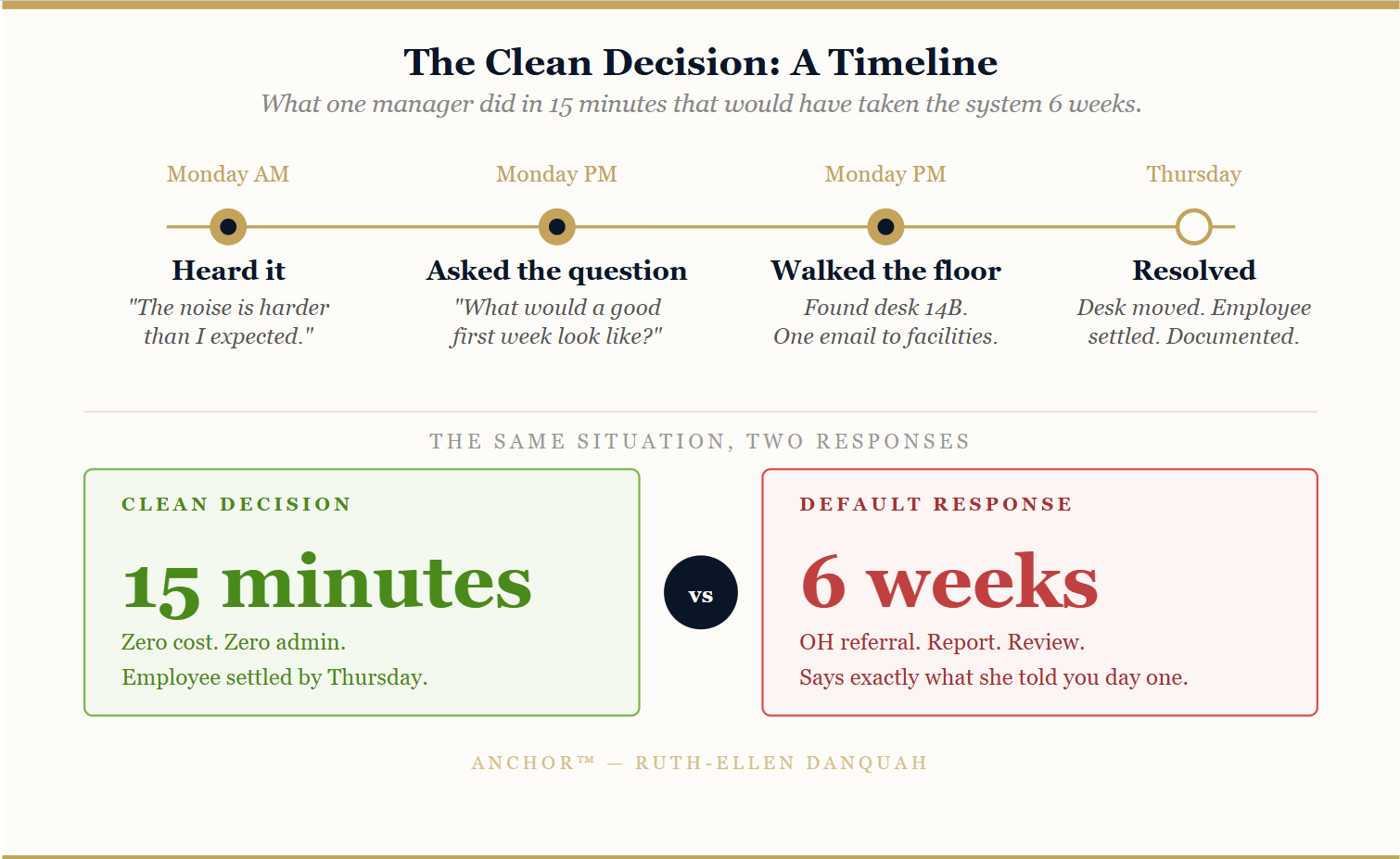
A manager made a clean decision in under ten minutes about one request about the open plan office reasonable adjustments. Here’s what she did differently — and why it matters more than most People teams realise.
He mentioned it on a Thursday.
Not formally. Not in a meeting. Not in an email with HR copied in. He said it at the end of a 1:1, the way people always say the thing that matters most — quietly, almost as an afterthought, already half-standing to leave.
“I don’t know if this is even a thing, but — the open plan is really getting to me. I can’t concentrate. By 2pm I’ve got nothing left.”
He said it like he was apologising. Like admitting the office was too loud was the same as admitting he couldn’t do his job.
Open plan office reasonable adjustments are rarely the first thing a manager thinks about when an employee says the open plan is getting to them.
This is the decision point.
Right here. This exact moment. This is where the outcome is decided — not in an OH referral, not in a tribunal bundle, not in a grievance meeting three months later. In the ten seconds after he finishes speaking, when the manager decides what kind of problem this is.
In 2025, the Employment Tribunal ruled against Peloton Interactive UK in the case of Saunders v Peloton. Ciaran Saunders, an autistic employee working in the company’s London studio, experienced sensory overload from the loud music and strong fragrances in the workplace. He requested adjustments — a quieter environment and scheduled breaks. Peloton did not implement them. The tribunal found the company had failed in its duty to make reasonable adjustments.
The open plan problem has a legal cost. And it starts at the moment a manager decides what to do with an employee who is half-standing to leave.
What Most Managers Do
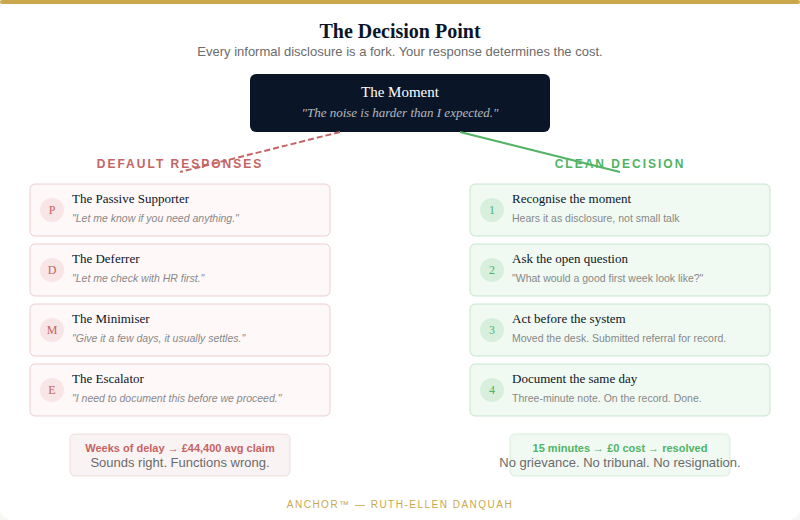
Most managers hear “the open plan is getting to me” and their brain runs one of four scripts.
Script 1: Minimise. “Yeah, it’s noisy for everyone. You get used to it.” The employee hears: my experience doesn’t count. He stops mentioning it. He starts masking. Three months later his performance dips and nobody connects it to this conversation.
Script 2: Defer. “Let me speak to HR about that.” The manager sends an email. HR adds it to a list. Someone suggests an OH referral. The referral takes six weeks. OH recommends adjustments. The recommendations sit in someone’s inbox. Four months pass. Nothing changes. See: Khorram v Capgemini.
Script 3: Sympathise. “I totally get it — I struggle with noise too. Have you tried noise-cancelling headphones?” The employee now has to solve his own problem with a suggestion that may or may not work, while the manager feels helpful without having done anything structural.
Script 4: Freeze. “Okay. Thanks for letting me know.” Then silence. The manager doesn’t know what they’re allowed to do, what requires a formal process, or whether this counts as a disclosure. So they do nothing. And nothing, as always, is the most expensive decision a manager can make.
All four scripts have something in common. In none of them does the manager ask the one question that changes the outcome — and write down the answer.ay or may not work, while the manager feels helpful without having done anything structural.
Script 4: Freeze. “Okay. Thanks for letting me know.” Then silence. The manager doesn’t know what they’re allowed to do, what requires a formal process, or whether this counts as a disclosure. So they do nothing. And nothing, as always, is the most expensive decision a manager can make.
All four scripts have something in common. In none of them does the manager do the one thing that would have made a difference: act, right now, in the room, and write it down.
What This Manager Did Instead
Her name doesn’t matter. What matters is what she did in the ten minutes after he said “the open plan is really getting to me.”
She didn’t minimise. She didn’t defer. She didn’t sympathise. She didn’t freeze.
She asked one question.
“Is there anything about how we’re set up here that I could change this week to make it easier for you?”
Look at what that question does. It doesn’t ask him to diagnose himself. It doesn’t ask him to name their neurotype or any co-occurring condition. It doesn’t ask him to fill in a form or wait for an assessment. It focuses on the environment — “how we’re set up” — not on him. And it puts a timeline on it: “this week.” Not “at some point.” Not “when OH gets back to us.” This week.
He paused. Then he said: “Honestly? If I could work from the quiet room on the days I need to do deep focus work — Tuesdays and Thursdays — that would change everything. And maybe if I could wear headphones without people thinking I’m being antisocial.”
Two things. A quiet room twice a week. Permission to wear headphones.
No cost. No procurement. No six-week OH referral. No policy review. No committee.
She said: “Done. Let’s try it from next Tuesday. I’ll book the quiet room for you on Tuesdays and Thursdays for the next month, and I’ll mention to the team that headphones are fine for focus work — for everyone, not just you. We’ll check in after a month and see if it’s working.”
He nodded. He looked relieved. Not because the solution was complicated. Because someone had actually done something.
The whole conversation took ten minutes.
Then She Did the Thing That Separates a Good Manager from a Clean Decision
She documented it.
Not because HR told her to. Not because she was covering herself. Because documentation is what protects the employee, the manager, and the organisation — and it is the thing that almost never happens after informal conversations.
Here is what she wrote. It took three minutes:
Date: [Thursday’s date]. Employee: [Name]. Context: End of regular 1:1. [Name] mentioned difficulty concentrating in open plan environment. Described feeling depleted by early afternoon.
Discussion: Asked what changes to our setup might help. [Name] requested access to quiet room on Tuesdays and Thursdays for deep focus work, and permission to use headphones during concentration periods.
Action taken: Booked quiet room for Tuesdays and Thursdays for the next four weeks. Will normalise headphone use for the whole team during focus time. Review scheduled for [date one month from now].
No formal referral requested or required at this stage. [Name] did not disclose a specific condition and was not asked to. Adjustments are based on workplace environment, not medical need.
Next review: [date]
Read that last line again. Adjustments are based on workplace environment, not medical need.
That sentence changes everything.
She didn’t wait for a diagnosis. She didn’t need one. She didn’t ask “do you have a condition?” or “have you been assessed?” She responded to what he actually said: the open plan is getting to me. And she solved the environment problem.
If he does have an underlying neurotype — ADHD, autism, anxiety, sensory processing differences, anything — this note becomes the evidence that the organisation responded promptly at the first indication of a barrier. If a formal process happens later, this is the document that shows the manager didn’t wait.
If he doesn’t have a diagnosed condition? The adjustments still make sense. A quieter space for focus work and permission to wear headphones aren’t medical interventions. They’re good management.
The documentation protects everyone either way.
The question that changes the outcome is not “what’s wrong with you?” It is “what is it about how we’re set up that is creating a barrier?” The first question puts the problem inside the person. The second puts it where it belongs — in the environment.
Why the Documentation Matters More Than the Adjustment
The pattern in tribunal cases involving open plan environments and sensory barriers is consistent. It is never that the organisation didn’t care. It is rarely that the adjustment was expensive or complicated. It is almost always that one of two things happened.
Nobody wrote it down. The conversation happened. The manager said something supportive. Maybe they even made a verbal agreement. But six months later, when things have escalated, there is no record. The employee says “I told them in June.” The manager says “I don’t remember the specifics.” The tribunal sees a gap — and that gap is evidence of a failure to act.
Everybody waited. The manager referred it to HR. HR referred it to OH. OH sent a questionnaire. The questionnaire came back with recommendations. The recommendations went to the manager. The manager wasn’t sure how to implement them. Another email to HR. By the time anything happened, it was four months later, the employee’s performance had been flagged, and someone had started a capability process for the very thing the adjustment was supposed to prevent.
In Saunders v Peloton, the employee made the request. The organisation did not act. The tribunal found a failure to make reasonable adjustments. The cost was not just the award — it was the lost performance, the masked distress, the months the employee spent trying to function in an environment that was already known to be creating a barrier.
The manager in this story did neither of those things. She acted in the room and she wrote it down the same day. That is a clean decision.
The ANCHOR Method in Ten Minutes
Open plan office reasonable adjustments don’t require a formal process to be legally effective — they require a manager who asks the right question at the right moment
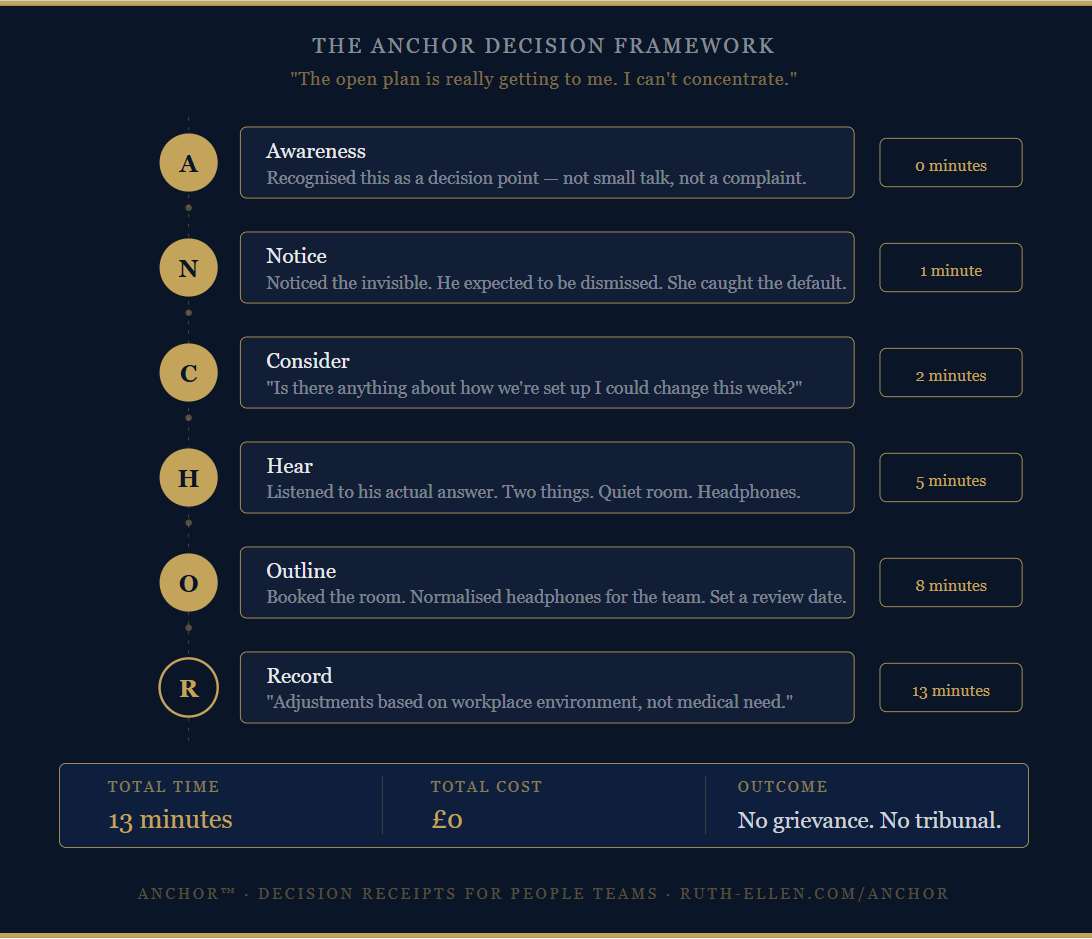
What this manager did — without knowing it — was apply the ANCHOR decision framework at the moment it mattered. This is the same framework that sits inside ANCHOR’s Decision Receipt system, operating in real time at the point a manager is choosing what to do next.
A — Awareness. She recognised this as a decision point. Not admin. Not a complaint. Not something to “keep an eye on.” A moment where her response would determine what happened next. Most managers don’t make this recognition. The conversation ends. The inbox moves on.
N — Notice. She noticed what was invisible. He was apologising for having a need. He expected to be dismissed. The default response was right there, ready — “yeah, it’s noisy for everyone.” She caught it. She asked a different question instead.
C — Consider. She asked the question before acting. “Is there anything about how we’re set up that I could change this week?” — not “what’s wrong with you?” not “should I refer you to OH?” She considered the environment before she considered the person.
H — Hear. She listened to his actual answer. Two things. Quiet room. Headphones. She didn’t add complexity. She didn’t ask for more information than she needed. She heard what he said and took it at face value.
O — Outline. She framed the action. Booked the room. Normalised headphones for the whole team. Set a review date. Simple. Immediate. Reversible if it doesn’t work. A Decision Receipt captures this — the reasoning, the action, the review date — in a structured record that closes the loop.
R — Record. She documented it. Three minutes. Clear, factual, focused on the environment. Protected him, protected her, protected the organisation.
Ten minutes from disclosure to action. Three minutes to document. No OH referral. No four-month delay. No grievance. No tribunal.
If someone has told you something is difficult — about the noise, the light, the structure, the pace — and you haven’t acted on it yet, the window is still open. The question to ask before your next decision about that person: is there anything about how we’re set up that is creating a barrier for them? The free ANCHOR scenario tool surfaces the questions you should ask before you act. Try it on your real situation: ruth-ellen.com/anchor/handle-escalations/
The question Heads of People should be asking
If you’re a Head of People, an HR Director, or anyone responsible for how managers make people decisions in your organisation, here is the question:
How many of your managers would have made the same decision this woman made?
Not “would they have cared?” — of course they care. Not “do they know the policies?” — they’ve done the e-learning. Not “are they good people?” — they are.
Would they have asked that specific question, in that specific moment, and documented it that same day?
If the answer is “some of them” or “I’m not sure” or “probably not” — that’s the gap. And the gap is costing you more than you think.
Every open plan office in the country has someone sitting in it right now who mentioned something three months ago that nobody acted on. Someone who is masking. Someone whose performance is about to dip. Someone who is going to leave — and when they do, the exit interview will say “personal reasons,” and nobody will connect it to the conversation that went nowhere in September. The open plan office reasonable adjustments that work are the ones made in the room, not the ones waiting in an OH referral queue
ANCHOR is built for that gap. Not in a training room three months before the conversation happens. At the moment the manager is deciding — where the Decision Receipt prompts the question, captures the reasoning, and routes the record to the People team in real time.
The loop closes. Before the silence becomes a tribunal case file.
Book a Founding Input Session — 45 minutes, your organisation’s specific situation, no pitch. Or try the free tool first: ruth-ellen.com/anchor/handle-escalations/
Ruth-Ellen Danquah is the founder of ANCHOR™ — Decision Receipts for People Teams. She builds decision infrastructure that sits inside the moment a manager is making a people decision — not after the crisis, not before it in a training room, but at the point of choice. She writes about the gap between what organisations intend and what managers do at 9am on a Tuesday at NeuroRich on Substack. This is not legal advice. It is decision governance.
Listen. Learn. Lead.