



You do not need another person telling you to take a deep breath when your whole body is already shouting.
You may have tried that.
You may have tried journalling, meditation, positive thinking, distracting yourself, getting on with your day, or pretending you are fine until the feeling passes.
And yet there are still moments when one message, one change in tone, one piece of feedback, one demand too many or one thing not going to plan can take over your whole day.
You are not weak because that happens.
You are not failing because you know the tools and cannot always access them in the moment.
And you are not “too sensitive” because your system reacts strongly to things that other people seem able to brush off.
The problem is not that you feel deeply.
The problem is that much emotional-regulation advice is built around the idea that you should be able to calm yourself down quickly, carry on and move on.
But when you are emotionally overloaded, that can feel like being asked to think your way out of something your body is still experiencing as urgent.
The part nobody tells you about emotional regulation
You may not need more techniques.
You may need a different relationship with the moment you are in.
Because emotional regulation is not about making the feeling disappear as quickly as possible.
It is about recognising that something in you needs care, space, clarity or support before you decide what to do next.
That is a very different starting point from:
“How do I stop feeling like this?”
It becomes:
“How do I stay with myself while I feel like this?”
That shift matters.
Because when calming down becomes the goal, you can end up fighting yourself on top of already feeling overwhelmed.
You may tell yourself you are being irrational.
You may force yourself to reply before you are ready.
You may keep checking for reassurance.
You may over-explain because the discomfort feels unbearable.
You may keep pushing because rest feels like failure.
And then the original emotion becomes bigger, not smaller.
You may not be overreacting. You may be overloaded.
There is a difference.
Sometimes you are reacting to the current situation.
Sometimes the current situation is touching something older: being misunderstood, feeling excluded, being criticised, getting something wrong, disappointing someone, losing connection or being seen as too much.
And sometimes both are true at once.
The message may genuinely have felt cold.
The feedback may genuinely have landed badly.
The situation may genuinely need a conversation, a boundary or a change.
But when you are emotionally activated, your mind can also start filling in the gaps quickly.
A delayed reply becomes:
“They are angry with me.”
A short message becomes:
“I have done something wrong.”
Feedback becomes:
“I have failed.”
A misunderstanding becomes:
“Nobody gets me.”
That does not mean you are dramatic.
It means uncertainty may have landed in a place that already feels tender.
The issue is not that you have feelings.
The issue is when the feeling becomes a verdict on who you are.
The old way: fix the feeling before it gets worse
Many of us have learned to deal with emotional intensity by trying to solve it immediately.
Work it out.
Explain it.
Reply.
Get reassurance.
Make it right.
Push through.
Do not let anyone see how much it has affected you.
But that approach has a cost.
You may spend hours mentally replaying something that happened in five minutes.
You may lose access to the rest of your day because your energy is tied up trying to restore certainty.
You may say more than you wanted to say because silence feels unbearable.
You may make decisions from panic that you would not make from steadiness.
You may become so focused on feeling better that you stop asking what you actually need.
And that is where emotional regulation can become less about recovery and more about self-abandonment.
A different path: return before you respond
There is another way to meet these moments.
Not by pretending they do not matter.
Not by bypassing them with positivity.
Not by forcing yourself into calmness.
But by creating enough space to stop the feeling from becoming your whole identity.
Instead of:
“What is wrong with me?”
Try:
“Something in me is having a hard time right now.”
Instead of:
“How do I make this stop?”
Try:
“What would help this feel a little easier to hold?”
Instead of:
“I need to fix this immediately.”
Try:
“Do I need to act now, or do I need a moment first?”
You do not have to deny the feeling to avoid being ruled by it.
You do not have to become less sensitive to become more supported.
What helps when you are emotionally overwhelmed
You do not need to solve the whole feeling in the moment.
Trying to understand everything while you are highly activated can sometimes make the spiral louder.
A more helpful starting point is to reduce the pressure.
Before replying, explaining, deciding or trying to work out what everything means, give yourself a small interruption.
You might:
- put your phone down for ten minutes
- drink water or eat something
- move to a quieter room
- write down what happened without trying to interpret it
- tell yourself that you can revisit this when your body feels less urgent
- choose one ordinary grounding task, such as washing up, taking a shower or stepping outside
- rest before you decide what the feeling means
This is not about avoiding the situation.
It is about giving yourself enough space to respond from more than panic, shame or urgency.
The goal is not to become instantly calm.
The goal is to avoid making the moment bigger by abandoning yourself inside it.
The question that can change the moment
When you feel pulled into overthinking, self-attack, reassurance-seeking or the urge to fix everything immediately, try asking:
What would make this moment 5% easier to hold?
Not solved.
Not fixed.
Not erased.
Just easier to hold.
That question can create a little room between the feeling and the reaction.
Sometimes the answer will be practical.
Sometimes it will be emotional.
Sometimes it will be that you need to stop trying to understand everything before you have had a chance to recover.
The deeper work is learning your own patterns: what tends to trigger you, how your body signals overload, what stories appear when you feel rejected or misunderstood, and what genuinely helps you come back to yourself.
That is where a structured recovery practice can become useful.
The hidden cost of trying to manage it alone
The issue is not only the difficult moment itself.
It is what can happen afterwards.
You may lose hours replaying one conversation.
You may cancel plans because your emotional capacity has gone.
You may become unable to focus on work, food, rest or the things you had intended to do.
You may over-explain to people who did not ask for more explanation.
You may make yourself smaller just to avoid the possibility of feeling this way again.
And over time, that can affect confidence.
Not because you are incapable.
But because every difficult moment starts to feel like evidence that you cannot trust yourself.
You deserve more than coping strategies that only appear once you are already at breaking point.
You deserve a way to understand your patterns and recover without handing every trigger the power to take over your day.
Imagine the next difficult moment differently
The next time something lands badly, imagine not spending the next six hours trying to prove that you are okay.
Imagine noticing the pull to over-explain and choosing to wait.
Imagine recognising that your brain is searching for certainty, rather than treating every thought as evidence.
Imagine having somewhere to begin when your body starts to spiral.
Imagine being able to say:
“This hurts. I do not need to deny that. But I also do not need to decide what it means about me while I am activated.”
That is not a promise that you will never spiral again.
It is a more believable promise:
You can shorten the distance between being triggered and returning to yourself.
You can build a recovery pathway that supports you in real life.
You can learn to meet emotional intensity with more compassion, clarity and choice.
You are not someone who has to abandon yourself to cope
You may have spent years believing that emotional strength means becoming less affected.
Less expressive.
Less needy.
Less intense.
Less “too much.”
But what if emotional strength is not about becoming harder to affect?
What if it is about becoming more able to stay connected to yourself when you are affected?
Not:
“Nothing gets to me.”
But:
“This got to me, and I can still come back to myself.”
Not:
“I should not need anyone.”
But:
“I can ask for support without losing myself.”
Not:
“I need to get over it quickly.”
But:
“I can move through this without turning it into proof that I am the problem.”
You do not need to become a different person to recover.
You need a way of responding to yourself that does not make the pain worse.
A practical next step when you are ready
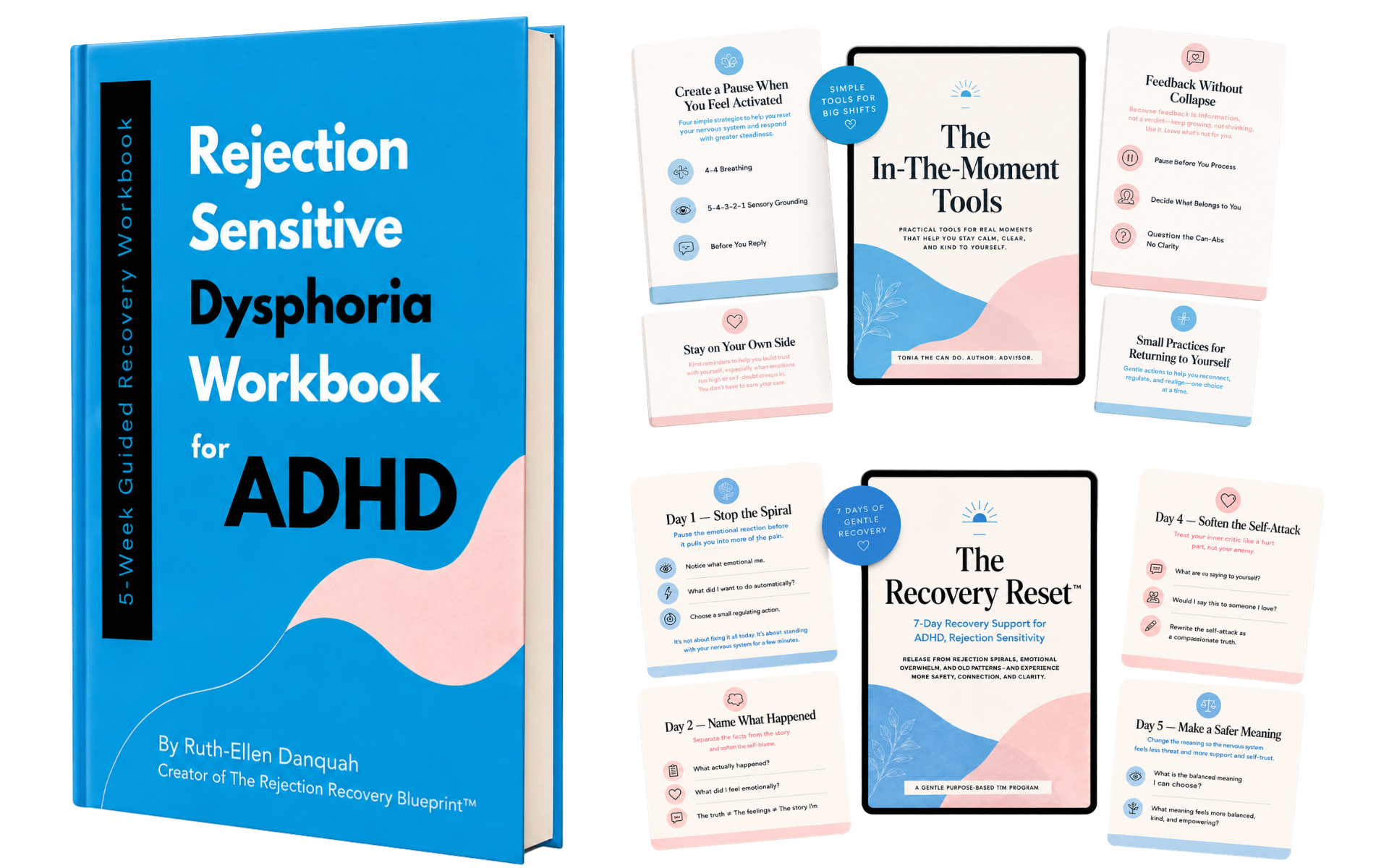
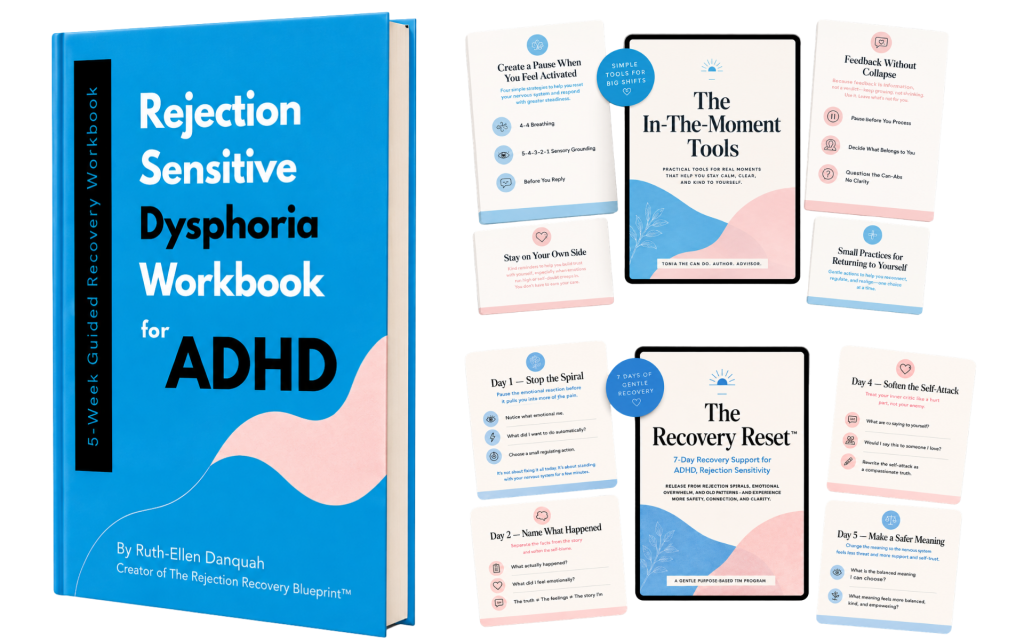
The Rejection Sensitivity Workbook for ADHD is for the moments when emotional intensity starts becoming a spiral.
It is not another list of generic calming techniques.
It is a guided space to help you understand what is happening beneath the reaction, interrupt the self-attack that often follows, and build a more supportive way back to yourself.
Inside, you will work with the patterns that can make rejection, criticism, uncertainty and feeling misunderstood feel so consuming.
You will not be asked to become less sensitive.
You will be supported to become less alone inside the feeling.
Explore the Rejection Sensitivity Workbook for ADHD
When a workbook is not enough
Sometimes you do not only need insight.
You need space to be supported through the patterns in real time.
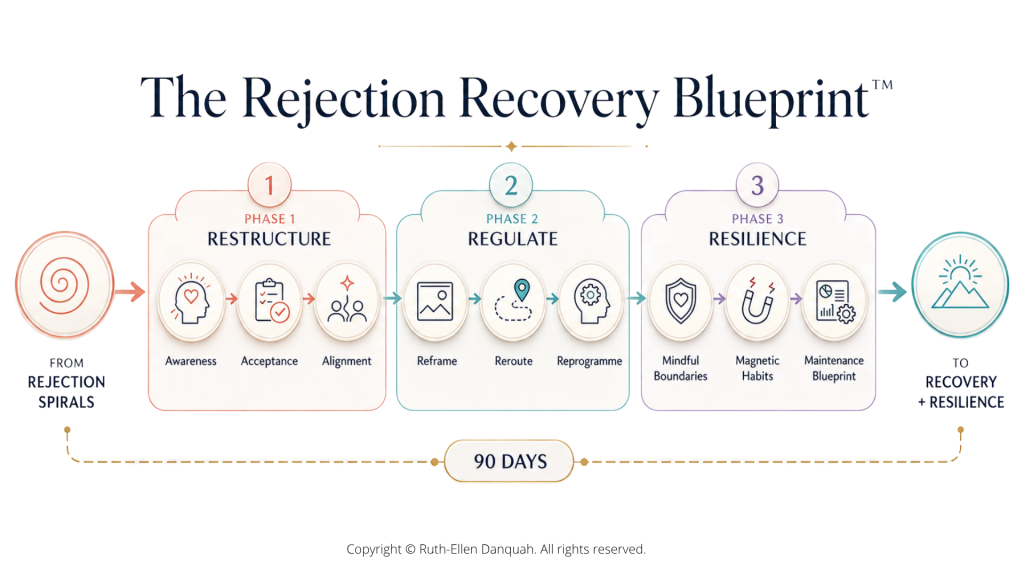
The Rejection Recovery Blueprint™ is 12 weeks of personalised 1:1 support for ADHD adults who are losing days to rejection spirals, shutdown, over-explaining, self-doubt or emotional exhaustion.
This is deeper work for when you are ready to stop trying to carry every difficult moment by yourself.
Explore the Rejection Recovery Blueprint™
A note from Me
I created the Intuitive Regulation Studio because I do not believe you need more pressure to regulate correctly.
Many of us already know how to survive.
We know how to mask, perform, explain, push through and carry on.
What we may need is a place to pause.
A place to understand what is happening.
A place to practise returning to ourselves without shame.
Emotional regulation is not about becoming unshakeable.
It is about knowing how to meet yourself when you are shaken.