Reading time: 5 minutes
Every leadership team I speak to right now is asking the same question: what do we do about AI?
Most of them are getting the answer wrong. Not because they’re not intelligent — they are. But because they’re framing the question incorrectly.
The dominant narrative goes something like this: AI will automate tasks, so we need to identify which roles are at risk, upskill people into new capabilities, and maybe reduce headcount along the way. It’s a workforce planning problem with a technology trigger.
This framing is dangerously incomplete.
The real question isn’t about automation
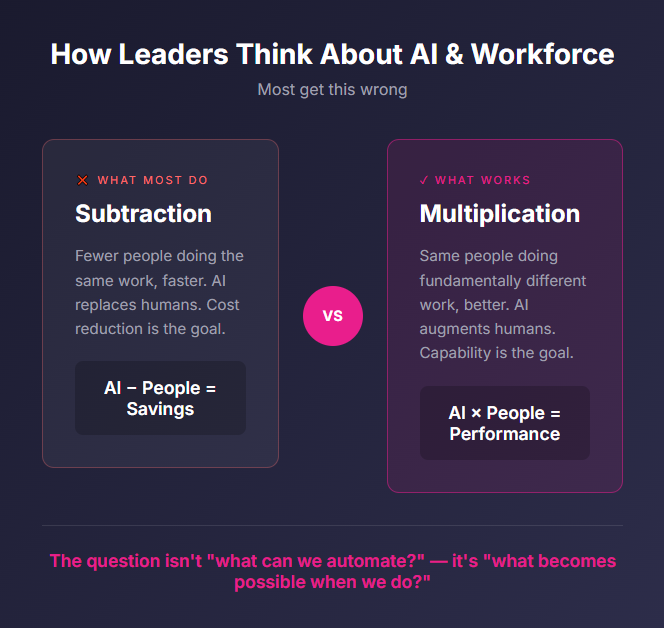
Yes, AI will automate certain tasks. That’s already happening. But the strategic question for leaders isn’t “what can we automate?” — it’s “what becomes possible when we do?”
When you automate administrative load, you don’t just save costs. You change the nature of the work that remains. You shift what you need from your people. You alter which capabilities matter.
Most organisations are still thinking in subtraction: fewer people doing the same work, faster. The opportunity is in multiplication: the same people doing fundamentally different work, better.
Three mistakes I see repeatedly
First, leaders are delegating AI strategy to IT or digital transformation teams. This treats AI as a technology implementation problem. It isn’t. It’s a people strategy problem with technology implications. The CPO should be as central to this conversation as the CTO.
Second, upskilling programmes are being designed in a vacuum. Organisations are rushing to train people on “AI tools” without first answering: what do we actually need people to be brilliant at in three years? Capability building without strategic clarity is just activity.
Third, the human implications are being treated as change management. As if this is just another transformation to be “landed” with comms and engagement plans. What’s actually happening is a fundamental renegotiation of the relationship between people and work. That requires a different kind of leadership.
What the best organisations are doing differently
The leadership teams getting this right are asking a different set of questions:
Where does human judgement remain essential — and how do we protect and develop it?
What capabilities become more valuable, not less, in an AI-enabled environment?
How do we build an organisation that can continuously adapt — not just to this wave, but to the next five?
They’re also being honest about what they don’t know. The leaders I trust most right now are the ones saying: “We’re building the plane while flying it. Here’s how we’re making decisions in uncertainty.”
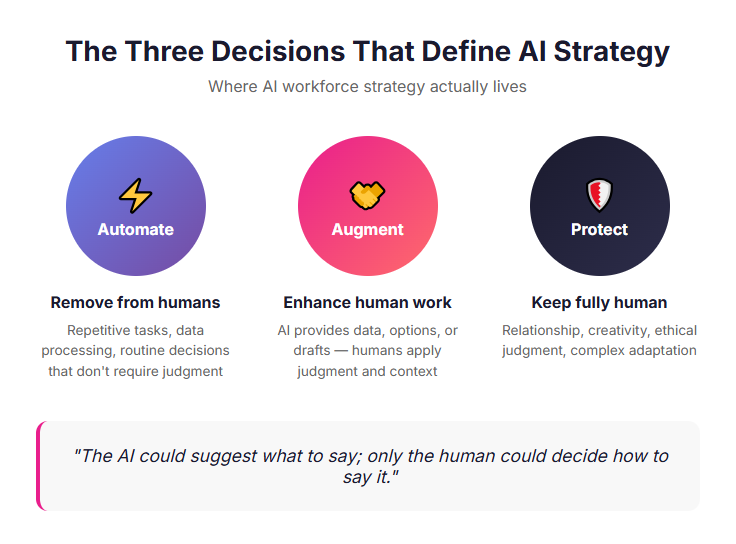
Framework: The Three AI Workforce Decisions
The people function has to lead, not follow
This is the moment for HR and People leaders to step forward — not as implementers of someone else’s strategy, but as architects of how the organisation will work in the future.
That means bringing a clear point of view to the boardroom. It means challenging assumptions about what AI will and won’t do. It means designing talent systems that are genuinely adaptive, not just responsive.
AI will reshape how organisations operate. The question is whether your people strategy shapes that future — or just reacts to it.
The organisations that get this right won’t just survive the AI era. They’ll define it.