

Table of Contents
When the process runs correctly and the outcome is still wrong
A dyslexic employee. A performance management process correctly followed. A tribunal that found for the claimant. What Heads of People need to know about dyslexia, performance management, and the question that should have been asked before the process started.
I know what it feels like to be performance managed instead of supported. Not hypothetically — from direct experience, in a fast-growth SaaS business where I was an Inside Sales Representative closing six-figure deals over the phone. £120 million in two years. I was not underperforming. I was one of the highest performers on the floor. And when something changed — when the environment shifted in ways that affected how I was working — nobody had a conversation with me. Nobody asked what was happening. Instead, HR meetings appeared in my calendar. Scheduled by people who had never sat next to me, never heard a call, never seen what I actually did. The framework activated. The framework did not ask the question that would have changed everything.
That experience is why I built ANCHOR. And it is why Merchant v BT is the case I return to most when I am talking to Heads of People about dyslexia, performance management, and what the Equality Act actually requires before a process begins.
Because Merchant v BT is not a story about a bad employer or a negligent manager. It is a story about a framework that ran exactly as designed — and still produced a discriminatory outcome. The difference between that case and what I experienced is smaller than most People professionals want to believe.
Are your managers reading the manager version of this case? NeuroRich breaks down Merchant v BT for the people actually running performance conversations — what they saw, what they missed, and the one question that changes the outcome before the process opens. Share the post: My Employee With Dyslexia Isn’t Meeting Targets. What Do I Do? Subscribe at neurorich.substack.com — free, weekly, written for managers not lawyers.
What happened in Merchant v BT
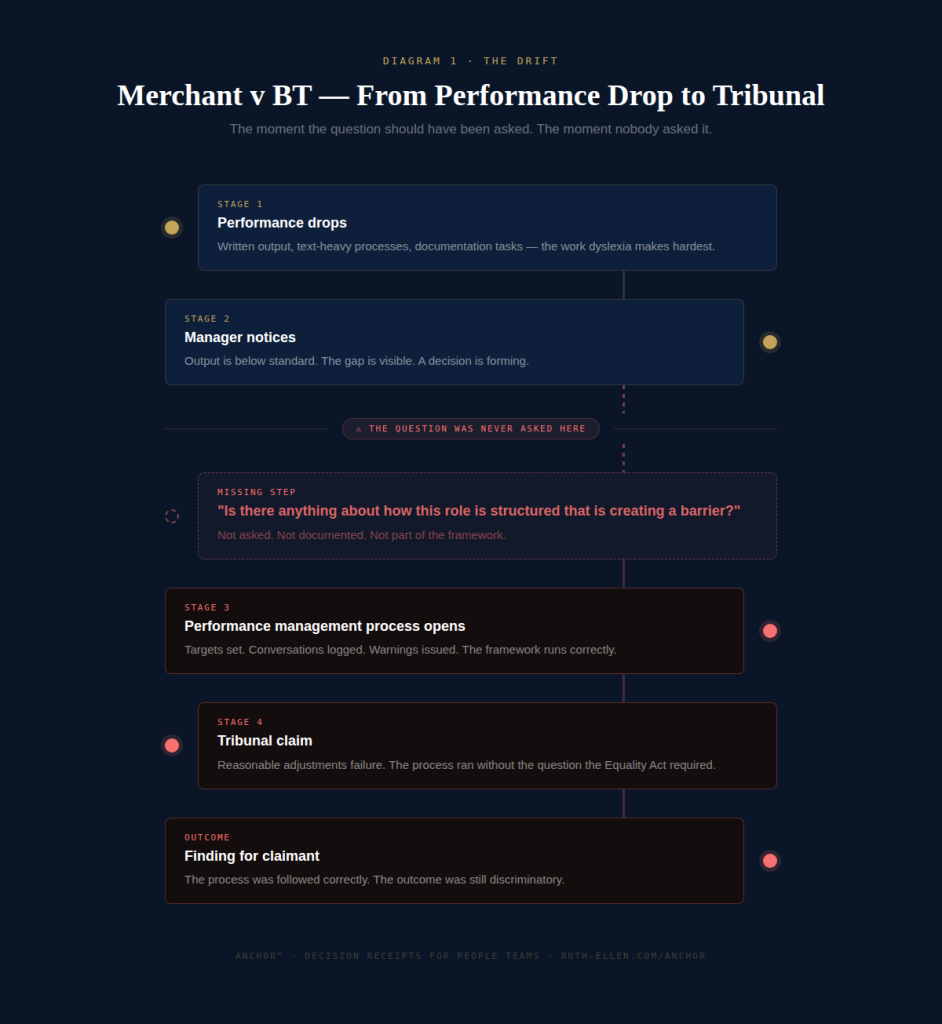
Mr Merchant was a BT employee with dyslexia — a protected characteristic under the Equality Act 2010. His performance fell below the required standard. Specifically, it fell in the areas that dyslexia makes hardest: written output, text-heavy processes, documentation-intensive tasks. The work that his disability made substantially more difficult was precisely the work being measured.
A performance management process was opened. The process was followed correctly. Targets were set. Conversations were logged. Warnings were issued. The machinery worked exactly as designed.
What the machinery did not do — and could not do without a different prompt — was ask whether the role design was creating a barrier that the dyslexia performance management process itself was making harder to meet. Nobody asked whether the work Mr Merchant was struggling with was the work his dyslexia made substantially harder. Nobody asked what adjustments might have changed his output before the process started. Nobody paused between noticing the performance drop and opening the framework to ask the one question the Equality Act requires.
The tribunal found for the claimant on reasonable adjustments grounds. Not because the dyslexia performance management process was wrong. Because the process ran without the question that should have preceded it.
The process was followed correctly. The outcome was still discriminatory. That is the pattern.
The double bind of dyslexia in a performance management context
Before I explain what should have happened in Merchant v BT, I need to name something that the legal commentary almost never addresses: what it actually feels like to be on the receiving end of a dyslexia performance management process that is measuring the exact things your brain finds hardest.
You already know you are struggling with the written output. You have probably known for years. You have developed workarounds — some visible, most invisible — that get you through. You have spent significant cognitive resource every single day compensating for the gap between how you work best and what the environment requires. And then the dyslexia performance management process opens, and suddenly the thing you have been quietly managing is documented, formalised, and presented back to you as a failure.
The manager has followed the framework. The framework says: here is the standard, here is the gap, here are the targets. It does not say: before we do any of this, let’s establish whether the standard itself is the problem. It does not say: let’s ask whether the work that has dropped is the work that dyslexia makes harder, and whether a different way of working would change the output entirely. It says: improve or face consequences.
That is not a bad manager. That is a framework that was never designed to ask the barrier question. And when the barrier question is not asked in a dyslexia performance management process — when the employer knows or ought to know that a disability is relevant — the Equality Act 2010 has been breached. Not because of malice. Because of a missing prompt.
I closed £120 million in deals over two years as an Inside Sales Representative. I did it over the phone, where my brain works well, in an environment built around conversation and persuasion. When that environment shifted and the written, process-heavy tasks increased, my output changed. Nobody asked why. Nobody asked what the barrier was. They scheduled HR meetings. The dyslexia performance management framework ran. The question was never asked.
Merchant v BT. Different industry. Different disability presentation. Same missing question.
Before a dyslexia performance management process opens — before targets are set, before conversations are logged, before any formal machinery begins — ask once: is there anything about how this role is structured, or how we are asking this person to work, that is creating a barrier to performance that was previously available? That question is not optional where a disability is known or ought to be known. It is what the Equality Act requires.
ANCHOR is built for that moment — the thirty seconds before the manager decides what kind of problem they’re dealing with.
The question that should have been asked
Before any dyslexia performance management process opens — before any performance process opens where a disability may be relevant — there is one question that changes everything that follows:
Is there anything about how this role is structured, or how we are asking this person to work, that is creating a barrier to the performance that is otherwise available?
This question does two things.
First, it separates capability problems from barrier problems. A capability problem is where the employee lacks the skill or knowledge to do the job. The right response is development, support, and a documented process. A barrier problem is where something in the environment, role design, or circumstances is preventing performance that was previously available — or that would be available with a different way of working. The right response to a barrier problem in a dyslexia performance management context is a reasonable adjustments conversation before the process opens. Not inside it. Before it.
Second, it creates a record. A Head of People whose managers can demonstrate they asked that question — at the right moment, before the dyslexia performance management process started, with the answer documented — is in a fundamentally different position when a situation is later challenged. The absence of that question is consistently what transforms a defensible performance process into an indefensible one.
In Merchant v BT, the question was never part of the framework. The dyslexia performance management process ran. The tribunal found for the claimant. The sequence is not a coincidence.
The barrier question cannot live inside the performance management framework — it needs to precede it. Most frameworks are designed to establish process. They are not designed to prompt curiosity at the moment of decision. If your framework does not contain this prompt before the dyslexia performance management process opens, it is not a framework that protects your organisation when a claim is reviewed.
Why managers don’t ask it — and why that is a Head of People problem
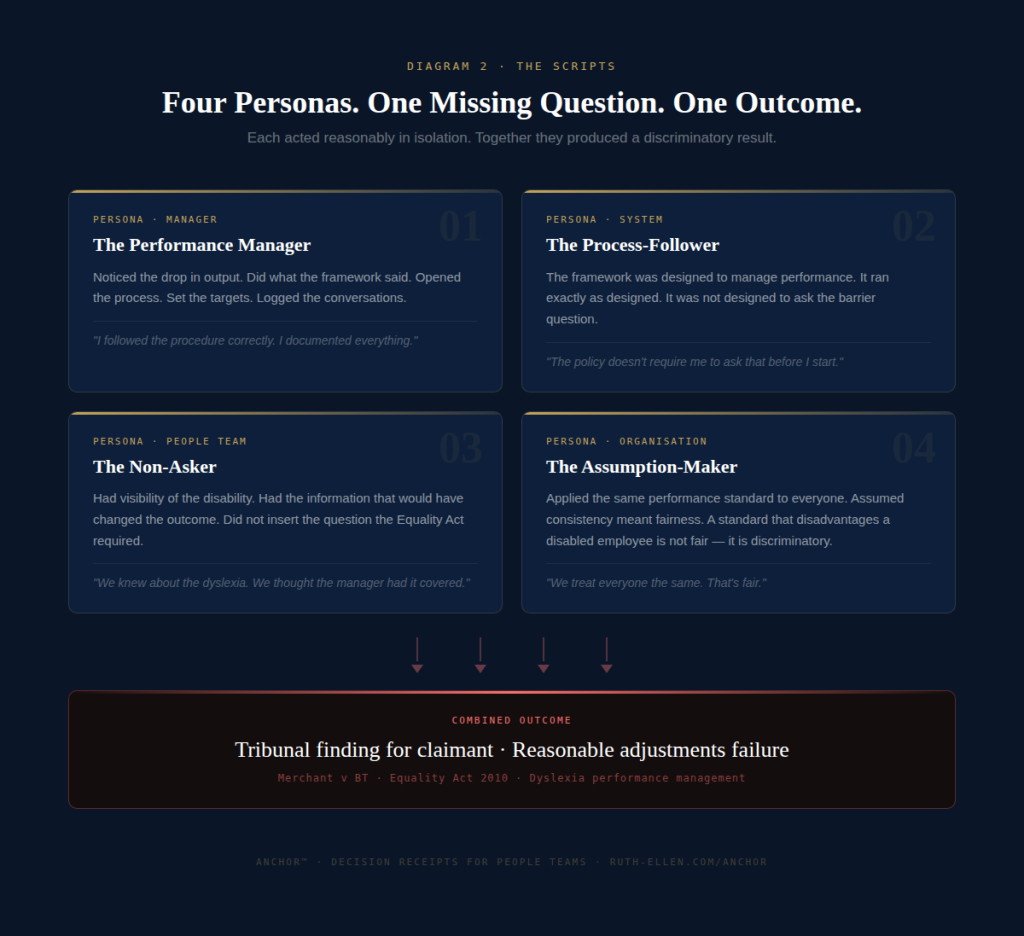
This is not a knowledge gap. Managers who have been through Equality Act training, reasonable adjustments workshops, and management development programmes still routinely omit this question before dyslexia performance management processes begin.
Not because they forgot it. Because at the moment they are sitting across from someone whose output has dropped, the dyslexia performance management framework they are operating inside does not prompt it. Performance frameworks are designed to establish process. They are not designed to insert curiosity at the moment of decision.
The manager follows the framework. The framework does not ask the barrier question. The dyslexia performance management process runs. And the tribunal finds against the employer eighteen months later.
I built ANCHOR because of this gap specifically. Not because I read about it in a case report. Because I experienced it. Because I watched it happen in a high-performing environment where the framework activated before anyone thought to ask what was actually going on. I was closing deals that most people in that building had never come close to. And when things changed, the response was not a conversation. It was a process. HR meetings in the calendar from people who had never heard me on a call. Dyslexia performance management without the word “dyslexia” and without the question that the law required.
The question is not new. The infrastructure to ask it consistently is. ANCHOR is built for that moment — the thirty seconds before the manager decides what kind of problem they’re dealing with.
The free tool puts that prompt in front of you before you act. Try it on a real decision: ruth-ellen.com/anchor/handle-escalations/
This is a Head of People problem because the framework is a Head of People’s asset. The moment a dyslexia performance management process runs without the question that the Equality Act requires is invisible to the People team until the claim arrives. Nobody escalated. Nobody flagged it. The manager acted, the process ran, and the first time the Head of People sees it is in the tribunal bundle.
If your performance management framework does not contain a structured prompt asking the barrier question before the process opens, your managers are running dyslexia performance management processes without the protection that question provides. The framework is your risk. And it is invisible until it fails.
What the Equality Act actually requires in a dyslexia performance management context
The duty to make reasonable adjustments under the Equality Act 2010 is triggered when an employer knows, or ought to know, that an employee has a disability. Dyslexia qualifies where the condition has a substantial and long-term adverse effect on normal day-to-day activities — and the Employment Appeal Tribunal confirmed in Paterson v Commissioner of Police of the Metropolis that even conditions which can be managed may still meet the statutory definition if they cause a real and persistent disadvantage.
An employee does not need a formal diagnosis. They do not need to have used the word “disability.” If dyslexia has been mentioned — formally or informally, in a one-to-one, on a form, or in passing — the duty may already be active. In a dyslexia performance management context, this means the barrier question is not optional. It is legally required.
The Khorram v Capgemini judgment reinforced this pattern. Despite an occupational health referral and specific recommendations, the employer failed to implement the adjustments. The dyslexia performance management process continued. The dismissal followed. Five reasonable adjustment failures were upheld. The award: £24,200.
The pattern in both cases is identical: the employer knew about the condition. The dyslexia performance management process ran without the barrier question. The tribunal found for the claimant.
[Read the full case analysis: Khorram v Capgemini — The Email That Nobody Answered →]
Dyslexia performance management claims do not arise because employers are malicious. They arise because the barrier question was not part of the process at the moment it needed to be. The Equality Act does not require perfection. It requires evidence that the right question was asked, at the right time, and that someone acted on the answer.
What Heads of People need in place before the next dyslexia performance management process opens
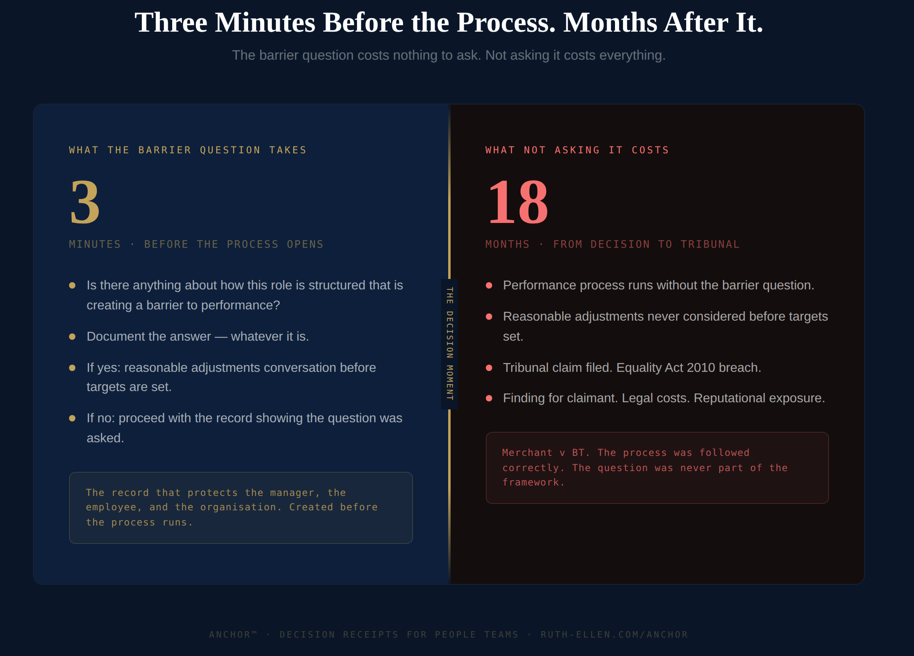
Four things. In order of urgency.
1. A prompt that sits before the performance framework, not inside it.
The barrier question cannot be embedded inside the dyslexia performance management process — it needs to precede it. Heads of People who want their managers to ask the right question need to give them a structure that fires it at the right moment. That structure does not exist in most performance management frameworks. It needs to be added deliberately.
2. A record that shows the question was asked, not just that the process was followed.
The paper trail that protects an organisation in a dyslexia performance management tribunal claim is not the one that shows targets were set and warnings were issued. It is the one that shows the manager paused, asked the barrier question, considered what adjustments might apply, and involved the right people before acting. That record needs to exist at the moment of decision. Not reconstructed afterwards.
3. Visibility of what managers are deciding before it reaches the People team.
The moment the dyslexia performance management framework opens, the Head of People typically finds out. The moment before that — when the manager is deciding whether to open it, what kind of problem it is, what question to ask first — is invisible. That is where the legal exposure lives.
4. A closed loop that confirms adjustments are implemented, not just agreed.
In both Merchant v BT and Khorram v Capgemini, the failure was not in the decision to make adjustments. It was in the absence of follow-through. The dyslexia performance management loop needs to close. Someone needs to own the follow-through and the record that it happened.
A dyslexia performance management process that opens without a documented barrier question, a closed adjustment loop, and People team visibility is a process that is building a claim rather than preventing one.
What a Sprint produces for a Head of People
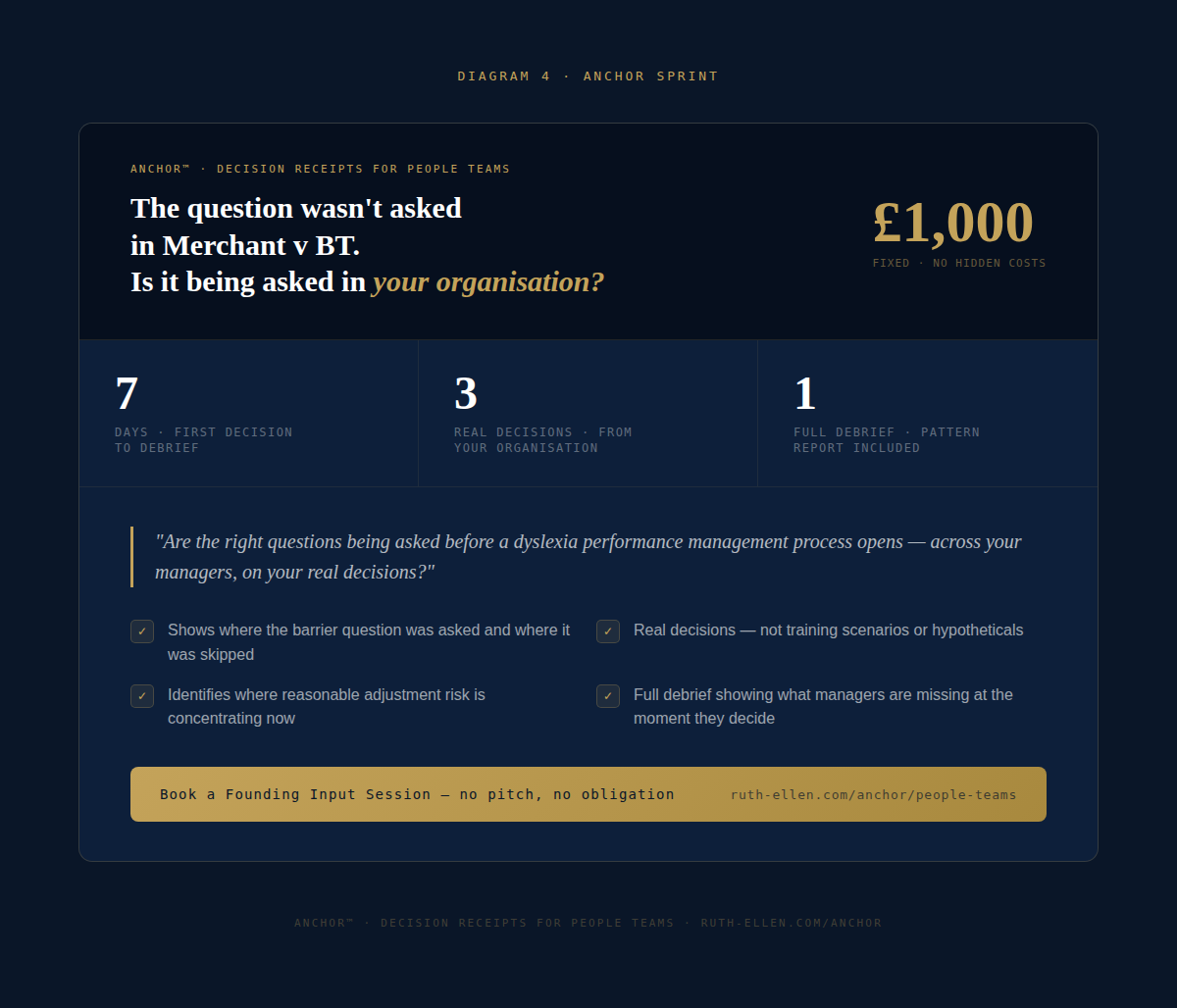
An ANCHOR Sprint runs three real manager decisions from your organisation through ANCHOR’s Decision Receipt system over seven days. Each decision is structured, risk-assessed, and returned with a debrief showing what your managers are thinking — and what they are missing — at the moment they decide.
For a Head of People whose managers are navigating dyslexia performance management processes, a Sprint answers the question that is otherwise invisible: are the right questions being asked before the process opens?
The Sprint debrief shows you the pattern across three real decisions. Not hypotheticals. Not training scenarios. Real situations from your organisation. Where the barrier question was asked and where it wasn’t. Where the dyslexia performance management legal exposure is concentrating right now.
The dyslexia performance management process in Merchant v BT was followed correctly. The tribunal still found for the claimant. The question that would have changed the outcome was never part of the framework. An ANCHOR Sprint shows you whether that question is being asked in your organisation — before the process runs.
£1,000 · 7 days · 3 real decisions · Full debrief
Conclusion
Dyslexia performance management claims do not arise because organisations are negligent or managers are unkind. They arise because a framework ran without the one question the Equality Act requires before it starts. The manager followed the dyslexia performance management process. The process did not contain the prompt. The claim arrived.
I know this pattern from both sides. I know what it feels like when HR meetings appear in your calendar instead of a manager picking up the phone — when you are closing £120 million in revenue and the response to something changing is to activate a process rather than start a conversation. I know what it costs in performance, in trust, in the slow erosion of someone who was delivering until the environment stopped accommodating how they work.
The organisations where dyslexia performance management goes right are not the ones with the most robust policies. They are the ones where one question gets asked before the framework activates. Before the targets are set. Before the meetings are scheduled. Before the process runs.
That question is not complicated. It just needs to be in the system at the right moment.
About the author
Ruth-Ellen Danquah is the founder of ANCHOR™ — a decision governance platform that sits inside the moment a manager is making a people decision, before it becomes a problem. A former Inside Sales Representative who closed £120 million over two years, she knows from direct experience what it looks like when a high performer is managed through a dyslexia performance management process instead of a conversation. She writes about the gap between what organisations say they do and what managers actually do at 9am on a Tuesday — and why that gap is where all the risk lives. This is not legal advice. It is decision governance.
ANCHOR™ · Decision Receipts for People Teams ·
If you’re a manager and you’ve read this far — this post was written for your Head of People. If you’re navigating a performance situation involving a disability or neurodivergent profile and something feels off, the free ANCHOR scenario tool surfaces the questions you should ask before you go further. Try it on your real situation, then share this page with your People team. Try Anchor Now

