When underperformance is misdiagnosed and the wrong process begins.
A senior analyst joins your company. Within 48 hours, his manager is having an informal conversation...
An occupational health report arrived in October 2023. It recommended five adjustments for an employee with ADHD. None of them were implemented. In February...
The short answer: Technically, no in answer to do employers have to follow occupational health recommendations?. An OH report is advisory, not binding. But...
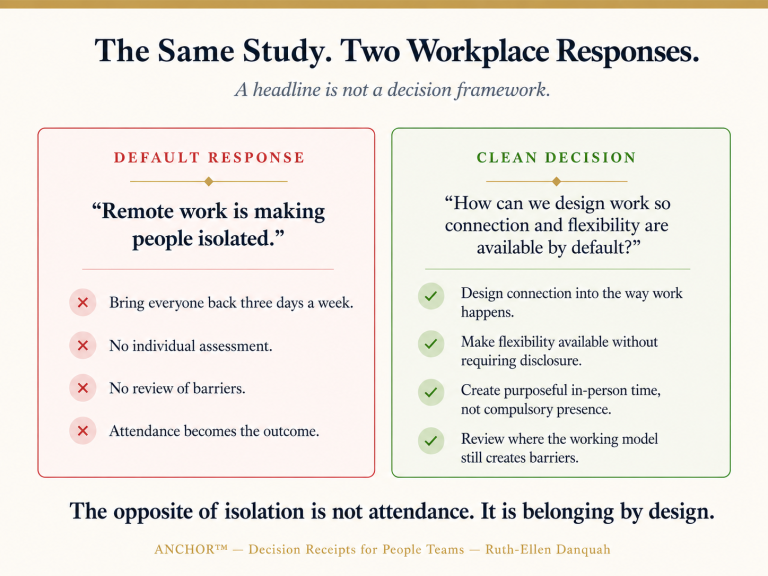
Remote work and mental health are back in the spotlight after a new study was used to make a familiar argument: working from home makes people depressed. Remote work isolates employees. The answer is to get people back into the office.
That is not what the study proves.
The research points to something important: people who work fully remotely, particularly those living alone, can experience more isolation and poorer mental health over time.
That deserves attention.
But the leap from “some remote workers are becoming isolated” to “the office is the answer” is exactly the kind of category error that creates poor workplace policy.
Because isolation is not the same thing as remote work.
And attendance is not the same thing as connection.
What remote work and mental health research should make employers ask
The important finding is not that everyone needs to return to an office.
It is that, for some people, work has been operating as social infrastructure.
It has provided routine. Incidental interaction. Informal learning. A reason to leave the house. Someone noticing when they are not quite themselves. The small, ordinary moments that can make a person feel part of something.
When that infrastructure disappears without being intentionally replaced, isolation can increase.
That is not an argument against flexibility.
It is an argument against treating flexibility as a complete workplace strategy.
A person working remotely five days a week, living alone and without meaningful social connection is in a very different position from someone working flexibly across home, office, community, family, coworking spaces and relationships outside work.
These are not interchangeable arrangements.
Yet many employers are already using one finding about isolation to justify blanket return-to-office policies.
That is not evidence-led management.
It is policy by headline.
The office was never automatically a cure for loneliness
This is the part missing from most of the commentary.
People can be physically present in an office and still be isolated.
They can commute for two hours, sit in an overstimulating open-plan environment, make polite conversation, avoid asking for help, eat lunch alone and go home exhausted.
They can be visible and still feel unseen.
They can be surrounded by colleagues and still have no psychological safety, no sense of belonging and no one they trust enough to say: “I am struggling.”
For many disabled, neurodivergent, chronically ill, caring and geographically excluded workers, remote work did not remove connection.
It removed barriers.
It reduced the energy cost of participation.
It gave people more control over sensory needs, concentration, medication, food, movement, recovery and communication.
For some people, this is not a lifestyle preference.
It is the adjustment that makes sustained work possible.
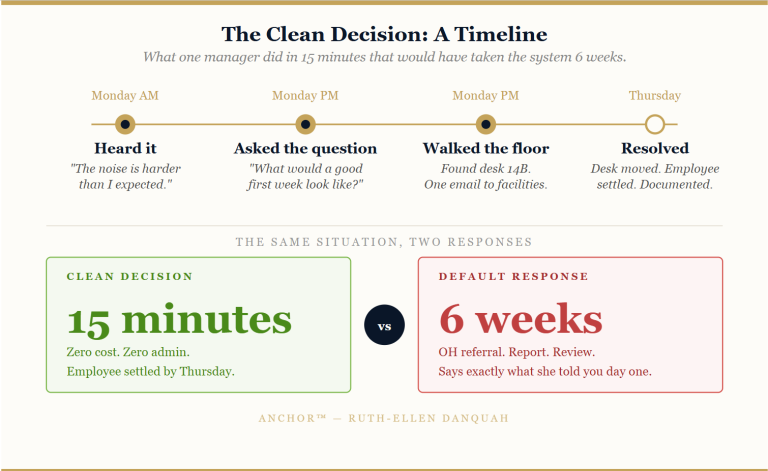
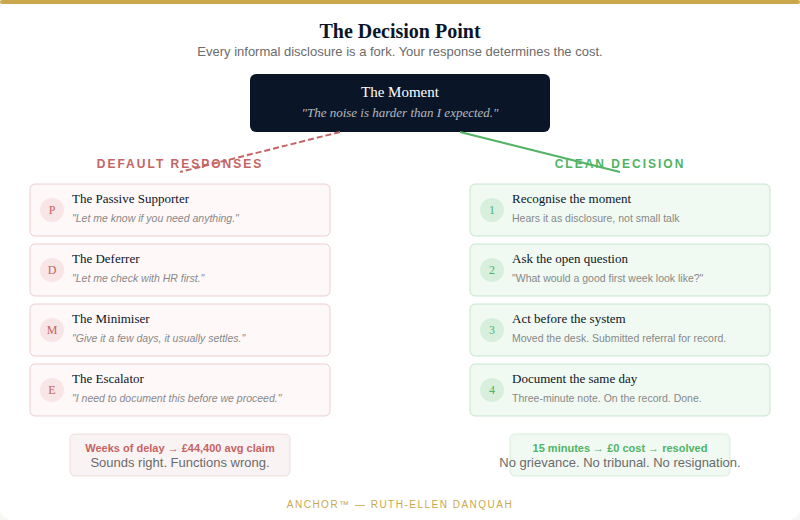
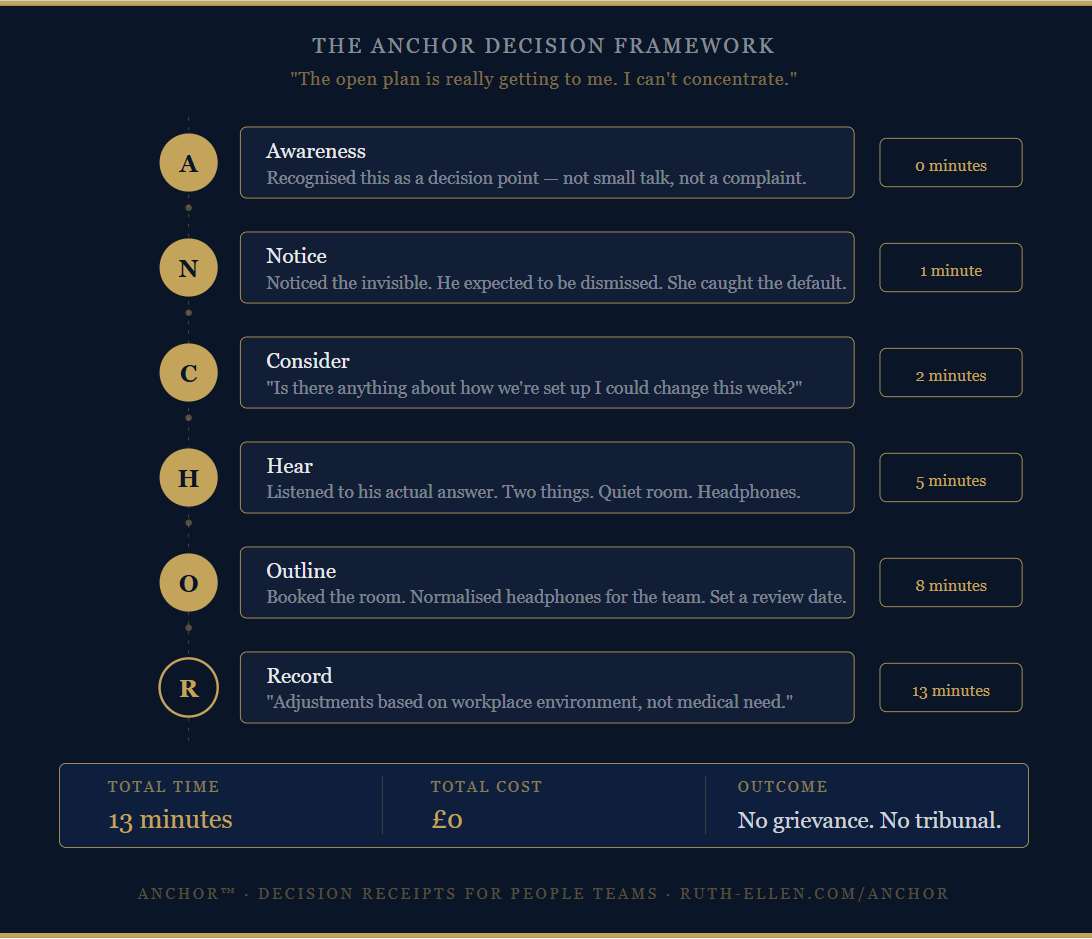
That does not always mean a complex or formal process. Often, the first useful response is to look at the working environment, ask what is creating the barrier and make a practical change before delay becomes the problem. In this open-plan office reasonable-adjustments example, the difference was not a new policy or a six-week referral. It was a manager recognising the decision point, acting on an environmental barrier and recording what changed.
A blanket office-return policy that ignores this does not solve isolation. It simply transfers the cost of organisational uncertainty back onto the employee.
The opposite of isolation is not attendance. It is belonging.
Start with design. Then respond to what remains.
The first responsibility is not to wait for someone to disclose a condition, explain a barrier or make a formal request.
It is to design working practices that make connection, flexibility and participation easier for the widest range of people from the outset.
That includes purposeful in-person time, clear communication, flexible ways to contribute, predictable team rhythms and access to the information people need to do good work.
Reasonable adjustments still matter where a person experiences a barrier that the shared design does not remove.
For some employees, flexibility is not a perk. It is an adjustment.
This is where blanket return-to-office policies become riskier than they first appear.
For a disabled employee, working from home or using a hybrid arrangement may reduce a real workplace disadvantage: sensory overload, fatigue, pain, anxiety, migraine triggers, inaccessible travel, the energy cost of masking, or the cumulative impact of managing a condition alongside work.
That does not mean every remote-working request must be agreed.
It means employers need to examine the barrier before deciding that office attendance is the solution.
A new study about isolation cannot replace an individual conversation about what helps someone do their job sustainably.
The question is not:
“Does this person prefer to work from home?”
It is:
“What disadvantage are they experiencing, what adjustment could reduce it, and what evidence are we using to decide?”
That is the difference between a flexible-working policy and a reasonable-adjustments process.
The problem is not remote work and mental health in isolation. It is whether the organisation has designed connection, clarity and flexibility intentionally enough for people to sustain good work.
The actual risk is unintentional isolation
Remote work becomes harmful when organisations assume physical proximity was doing more work than it actually was.
In-office working used to create accidental connection:
the conversation before a meeting starts
someone noticing when you seem unlike yourself
informal learning through observation
shared routines
quick access to context and support
the moments that make people feel part of a team
When people move remote, those things do not disappear because employees have failed to make an effort.
They disappear because the organisation has not deliberately replaced them.
That is a work-design problem.
Not an employee-location problem.
The leadership question is not:
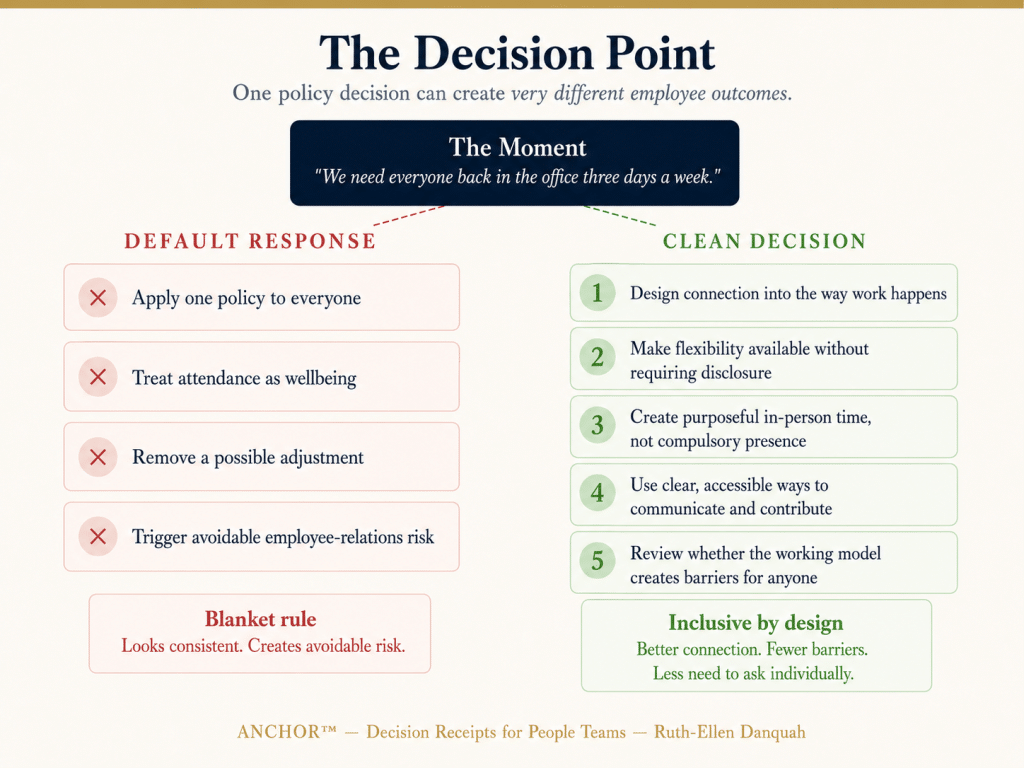
“How many days should everyone be in the office?”
It is:
“What would make connection, flexibility and participation easier to access by default — before anyone has to ask individually?”
What Heads of People should examine before changing policy
1. Is connection designed into the way work happens?
Do not assume the answer is more office attendance.
Look at whether people can build relationships, learn informally, access context, contribute in different ways and stay connected without relying on chance conversations or proximity to a senior person.
Connection should not depend on who feels confident enough to speak up, who can attend an office most easily, or who has disclosed a need.
Build in clear team rhythms, purposeful collaboration, accessible onboarding, multiple ways to contribute and in-person time with a reason behind it.
Then review where the design still leaves people behind.
2. Is this a connection problem or a management problem?
A manager who only contacts remote employees to chase updates is not creating connection.
A team with vague priorities, unclear decisions, poor onboarding and constant reactive messaging will feel disconnected whether people work from home or from the same building.
If the only route to being visible is sitting near a senior person, the organisation does not have a remote-work problem.
It has a management-system problem.
3. Is in-person time purposeful?
People do not need to commute simply to sit on video calls from another location.
In-person time has value when it is designed around a purpose:
relationship building
collaborative problem-solving
mentoring
learning
difficult conversations
decisions that genuinely benefit from being together
“Because it is Tuesday” is not a purpose.
4. Are you creating connection without making it performative?
Not everyone wants after-work drinks, compulsory team-building or high-energy social events.
Connection can be quieter than that.
It can mean structured mentoring, peer spaces, accessible onboarding, optional coworking, clearer communication, team agreements and managers who know how to include people who do not naturally dominate the room.
The goal is not to make everyone socially identical.
The goal is to make belonging possible.
5. Are you confusing attendance with trust?
This sits underneath many return-to-office debates.
When leaders cannot see people working, some become anxious that work is not happening. Attendance becomes a proxy for reassurance.
But presence is not performance.
Someone can be at a desk for eight hours and be unclear, overloaded, interrupted or disengaged.
Someone working remotely can be delivering exceptional outcomes while managing their energy in a way that makes sustained work possible.
Leadership is not about recreating visibility.
It is about creating clarity around outcomes, ownership, support and follow-through.
Remote work is not the issue. Disconnection is.
The study should make employers more thoughtful about how remote work is designed.
It should not give them permission to retreat into a simplistic office-versus-home argument.
Some people need more in-person connection.
Some people need more control over where and how they work.
Many need both.
The organisational task is not to choose one model and impose it on everyone.
It is to build working practices that make connection intentional, expectations clear and flexibility equitable.
Because the question is not where people are sitting.
The question is whether the way work is designed allows them to stay connected, contribute well and sustain themselves over time.
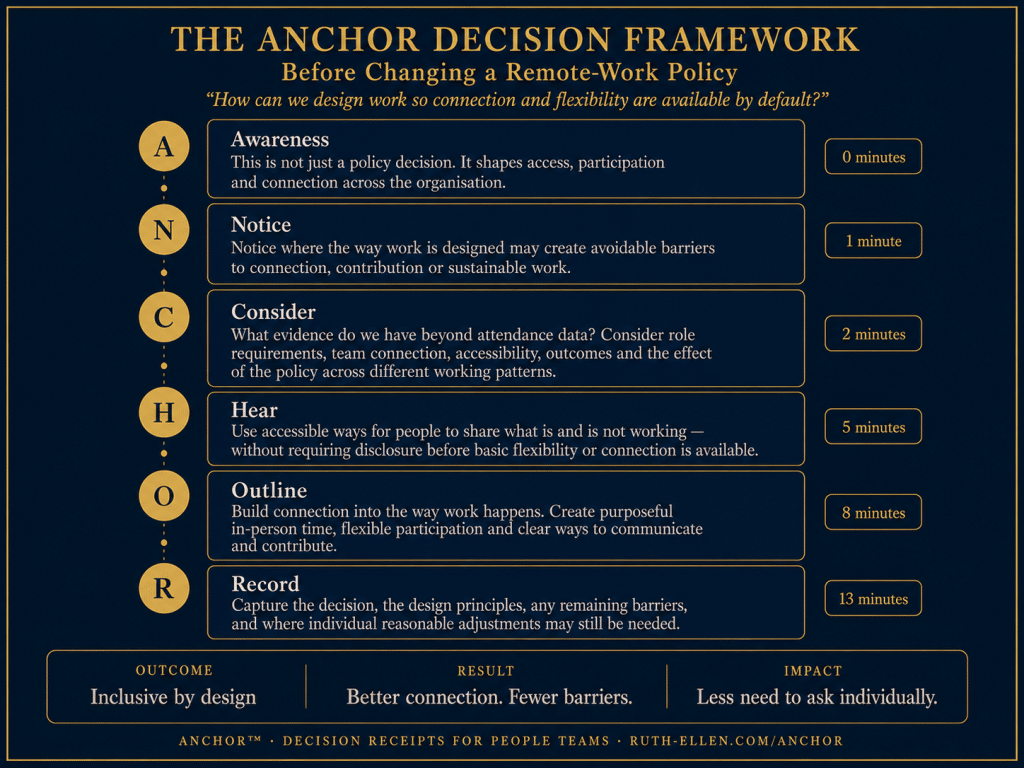
Before you change your remote-work policy
A headline is not a decision framework.
Before introducing or tightening attendance expectations, identify what is actually happening.
Where does the way work is organised make connection, flexibility or participation harder than it needs to be? Are managers relying on visibility because outcomes are unclear? Does the policy create barriers that better design could remove by default?
ANCHOR helps People teams surface the assumptions inside workplace decisions before they become disengagement, adjustment disputes or avoidable turnover.
This article responds to recent research on remote work, isolation and mental health. Its findings on isolation, especially for people living alone, are worth taking seriously. The leadership risk is using those findings to justify blanket attendance rules rather than examining the design of connection, management and flexibility in the organisation.
The study analysed five nationally representative US surveys covering more than 568,000 respondents. It compared pre-pandemic data from 2011–2019 with data from 2022–2024, excluding the acute pandemic years of 2020–21.
It found that the rise in remote work was associated with more time spent alone and poorer mental-health outcomes, particularly for people living alone. It does not establish that office attendance is the solution, nor does it separately test the effect of hybrid work.
When underperformance is misdiagnosed and the wrong process begins.
A senior analyst joins your company. Within 48 hours, his manager is having an informal conversation about “disruptive and loud behaviour.” Within ten days, the manager is taking advice from HR about the capability procedure. Within three weeks of an occupational health assessment that recommends adjustments, the capability process is invoked anyway. Eight months later, the employee is dismissed without the adjustments ever being implemented and without the capability procedure being completed.
That’s Sherbourne v Npower (2019). Autism. Indirect discrimination upheld. Failure to make reasonable adjustments upheld. The tribunal called it “continuous management failure” — and the specific failure it named was “a mixing up of welfare and capability procedures.”
The manager wasn’t malicious. The tribunal explicitly noted she was “process driven.” She followed the process she had. The process she had was the wrong one for the situation in front of her.
This is the pattern Heads of People need to see clearly, because it’s running quietly across your organisation right now. The diagnostic question is not “is this person performing?” The diagnostic question is “have we ever actually asked what they can sustain?”
What Sherbourne v Npower tells you about your own capability pipeline
Strip the case to its structural elements and the pattern is repeatable:
The employee’s behaviour read as a performance issue to a manager working from a consistency frame — same output, same way, same pace. The behaviour was, in fact, a capacity signal from a nervous system the manager had no framework for. The manager moved to the process she had been trained on. The process she had been trained on was capability. Capability was the wrong category.
By the time occupational health surfaced the actual category — disability, adjustments, environmental factors — the capability machinery was already moving. The tribunal recorded that the capability process was invoked on 2 May 2018, three weeks after the OH assessment that had recommended adjustments rather than capability. The two processes ran simultaneously. The adjustments never happened. The dismissal did.
The tribunal’s language on what this constituted is worth reading carefully: a Provision, Criterion or Practice of “failing to implement reasonable adjustments, inappropriate use of the capability procedure and using dismissal as a tool to rid themselves of a disabled employee.” That last phrase is what every Head of People needs to file. The tribunal did not find that the employer set out to discriminate. It found that the cumulative effect of capability-as-default produced discriminatory dismissal anyway.
This is not a one-off. The Acas guidance on neurodiversity at work explicitly warns that if a performance procedure is started before adjustments are considered, it “could have caused stress and made work more challenging. And it might not have addressed the poor performance issue.” The procedural risk and the people risk converge in the same place.
The diagnostic distinction Heads of People need to embed
Consistency measures whether someone produces the same output, in the same way, at the same pace, every time. It is the yardstick most workplaces inherited from industrial-era work design, and it fits neurotypical nervous systems reasonably well — they tend to fluctuate within a narrow enough band that consistency reads as a reasonable proxy for reliability.
Neurodivergent nervous systems fluctuate across a wider band. Sometimes hour to hour. Applied to that system, consistency-as-yardstick produces a false read. The person looks unreliable when what is actually happening is that the measure is wrong for the system being measured. That false read is what gets logged in the capability file. That is what the tribunal in Sherbourne saw and named.
Capacity-led working is the operational alternative. It measures what a nervous system can actually sustain and designs the work around that rather than against it. Firm what and by-when. Flexible how and when. Output measured over a sensible window rather than hour-by-hour presenteeism. Clear priorities so the strong hours are spent on what matters most. The person still delivers. They deliver differently, and usually more.
The Head of People question is not whether capacity-led working is a nicer way to manage. The question is whether your capability pipeline can distinguish between a performance issue and a capacity issue at the point of entry. Sherbourne v Npower is what happens when it cannot.
What capacity-led working is not
This is the part that gets misread most often, so it needs naming directly.
Capacity-led working is not permission-giving language. It is not saying neurodivergent employees can’t be reliable, that delivery doesn’t matter, or that capacity talk is a way of lowering expectations. Reliability and consistency are not the same thing. Someone can be deeply reliable in outcomes, in integrity, in follow-through, while working in a rhythm that doesn’t look consistent from the outside. Capacity-led working makes that reliability visible and usable. Consistency-led working tends to obscure it, and then penalise the person for the obscuring.
The frame raises the quality of the conversation. It does not lower the bar.
If a capacity-led conversation ends with the employee feeling more seen but no clearer on what they are delivering or by when, the frame has been misapplied. Done well, it ends with the what and the by-when sharper than before, and the how and the when more honestly matched to the person doing the work.
That is the test. Seen and clear. Not one or the other.
What the Equality Act actually requires before capability is appropriate
The legal position is more demanding than most capability policies reflect. Under sections 20 and 21 of the Equality Act 2010, where an employer knows or ought reasonably to know that an employee has a disability, the duty to make reasonable adjustments is engaged before any procedure that puts the disabled employee at a substantial disadvantage compared with non-disabled colleagues.
A capability procedure that measures output against a consistency standard puts a neurodivergent employee at a substantial disadvantage by design, where adjustments would mitigate that disadvantage. Running the capability procedure without first implementing the adjustments is the precise PCP the Sherbourne tribunal identified. It is also the precise pattern called out in the Khorram v Capgemini judgment in 2025 — where the failure to implement ADHD-related adjustments while continuing to apply standard probation expectations was found to be a continuing act of discrimination.
The Acas neurodiversity guidance is explicit: there might be situations when an employer needs to formally investigate a neurodivergent employee’s performance, but only “if there’s a conduct or capability issue even after support is in place.” The sequencing is the legal point. Adjustments first. Performance procedure second, if at all.
If your capability policy does not currently distinguish between (a) performance after adjustments have been implemented and given a fair window, and (b) performance before adjustments have been considered at all, your policy is not Equality Act compliant in operation, even if it is compliant on paper.
The diagnostic the Head of People needs to run
Three questions, sequenced. The first one is the one Sherbourne v Npower turned on.
One — has anyone actually asked the capacity question? Not “is this person performing.” That is the consistency question, and it generates a yes-or-no answer that triggers the capability pipeline. The capacity question is: what can this person sustain in the current environment, and what would change if the environment changed? The answer to that question is not a verdict on the employee. It is a read on the system.
Two — what does the OH or disclosure record actually say, and has it been actioned? If there is an occupational health report with recommended adjustments and those adjustments have not been implemented, the capability procedure cannot fairly start. Sherbourne is the case law on that point. Khorram v Capgemini reinforced it in 2025. The cost of treating an OH report as documentation rather than as instruction is the case you do not want to defend.
Three — is the manager running the capability process the same manager whose decisions are part of what needs to be examined? In Sherbourne, the manager who invoked capability was the same manager who had told the employee “we’re not here to wipe arse” and who had loudly instructed the team to “give Tom some things to do so that he doesn’t look like a lost dog.” The tribunal recorded both. Where a capability process is built on manager observations that themselves sit inside the disadvantage being challenged, the process is unsafe before it begins. A Head of People review at the front end is not bureaucratic overhead. It is the moment the case file either closes cleanly or starts compounding.
What good looks like at the decision point
The structural fix is small. The procedural cost is low. The protective value is high.
Before any capability procedure opens for a neurodivergent employee — disclosed or where the employer ought reasonably to know — a Decision Receipt is generated at the point the manager first considers capability as the next step. Not after. At the point of decision.
The Decision Receipt does three things in roughly three minutes. It captures the manager’s read of the situation. It surfaces the questions the manager has not yet asked — including the capacity question, the adjustments question, and the disclosure question. It produces a structured record that goes to the Head of People before the capability conversation happens, not after.
The point is not to slow the manager down. The point is to interrupt the capability-as-default reflex at the only moment where interruption is still cheap. After a first capability meeting has been minuted, the cost of reframing is high. Before it, the cost is roughly nothing.
This is the layer ANCHOR provides. Decision Receipts for People Teams — the QA loop that catches the Sherbourne pattern, the Khorram pattern, and the patterns sitting in your organisation that have not yet been named because they have not yet been tribunalised.
If a capability process is open right now and you are not sure it should be:Run the free Decision Receipt tool on the actual scenario. Three minutes. It surfaces what the capability file did not capture. It gives you something to take into the next conversation that is not just your instinct that something is off.Open the free scenario tool →
For People Teams considering ANCHOR:ANCHOR Teams is a paid diagnostic — a two-hour live virtual session with up to six managers and your Head of People, working through three real scenarios from your organisation using the Decision Receipt framework.See how the diagnostic works →
Ruth-Ellen Danquah is the founder of ANCHOR™ — Decision Receipts for People Teams. ANCHOR generates structured Decision Receipts at the moment managers make people decisions, before situations escalate to formal ER cases or tribunal.
The Capability Process That Should Never Have Started: What Sherbourne v Npower Tells Heads of People
When underperformance is misdiagnosed and the wrong process begins.
By Ruth-Ellen Danquah
A senior analyst joins your company. Within 48 hours, his manager is having an informal conversation about “disruptive and loud behaviour.” Within ten days, the manager is taking advice from HR about the capability procedure. Within three weeks of an occupational health assessment that recommends adjustments, the capability process is invoked anyway. Eight months later, the employee is dismissed without the adjustments ever being implemented and without the capability procedure being completed.
That’s Sherbourne v Npower (2019). Autism. Indirect discrimination upheld. Failure to make reasonable adjustments upheld. The tribunal called it “continuous management failure” — and the specific failure it named was “a mixing up of welfare and capability procedures.”
The manager wasn’t malicious. The tribunal explicitly noted she was “process driven.” She followed the process she had. The process she had was the wrong one for the situation in front of her.
This is the pattern Heads of People need to see clearly, because it’s running quietly across your organisation right now. The diagnostic question is not “is this person performing?” The diagnostic question is “have we ever actually asked what they can sustain?”
What Sherbourne v Npower tells you about your own capability pipeline
Strip the case to its structural elements and the pattern is repeatable:
The employee’s behaviour read as a performance issue to a manager working from a consistency frame — same output, same way, same pace. The behaviour was, in fact, a capacity signal from a nervous system the manager had no framework for. The manager moved to the process she had been trained on. The process she had been trained on was capability. Capability was the wrong category.
By the time occupational health surfaced the actual category — disability, adjustments, environmental factors — the capability machinery was already moving. The tribunal recorded that the capability process was invoked on 2 May 2018, three weeks after the OH assessment that had recommended adjustments rather than capability. The two processes ran simultaneously. The adjustments never happened. The dismissal did.
The tribunal’s language on what this constituted is worth reading carefully: a Provision, Criterion or Practice of “failing to implement reasonable adjustments, inappropriate use of the capability procedure and using dismissal as a tool to rid themselves of a disabled employee.” That last phrase is what every Head of People needs to file. The tribunal did not find that the employer set out to discriminate. It found that the cumulative effect of capability-as-default produced discriminatory dismissal anyway.
This is not a one-off. The Acas guidance on neurodiversity at work explicitly warns that if a performance procedure is started before adjustments are considered, it “could have caused stress and made work more challenging. And it might not have addressed the poor performance issue.” The procedural risk and the people risk converge in the same place.
The diagnostic distinction Heads of People need to embed
Consistency measures whether someone produces the same output, in the same way, at the same pace, every time. It is the yardstick most workplaces inherited from industrial-era work design, and it fits neurotypical nervous systems reasonably well — they tend to fluctuate within a narrow enough band that consistency reads as a reasonable proxy for reliability.
Neurodivergent nervous systems fluctuate across a wider band. Sometimes hour to hour. Applied to that system, consistency-as-yardstick produces a false read. The person looks unreliable when what is actually happening is that the measure is wrong for the system being measured. That false read is what gets logged in the capability file. That is what the tribunal in Sherbourne saw and named.
Capacity-led working is the operational alternative. It measures what a nervous system can actually sustain and designs the work around that rather than against it. Firm what and by-when. Flexible how and when. Output measured over a sensible window rather than hour-by-hour presenteeism. Clear priorities so the strong hours are spent on what matters most. The person still delivers. They deliver differently, and usually more.
The Head of People question is not whether capacity-led working is a nicer way to manage. The question is whether your capability pipeline can distinguish between a performance issue and a capacity issue at the point of entry. Sherbourne v Npower is what happens when it cannot.
What capacity-led working is not
This is the part that gets misread most often, so it needs naming directly.
Capacity-led working is not permission-giving language. It is not saying neurodivergent employees can’t be reliable, that delivery doesn’t matter, or that capacity talk is a way of lowering expectations. Reliability and consistency are not the same thing. Someone can be deeply reliable in outcomes, in integrity, in follow-through, while working in a rhythm that doesn’t look consistent from the outside. Capacity-led working makes that reliability visible and usable. Consistency-led working tends to obscure it, and then penalise the person for the obscuring.
The frame raises the quality of the conversation. It does not lower the bar.
If a capacity-led conversation ends with the employee feeling more seen but no clearer on what they are delivering or by when, the frame has been misapplied. Done well, it ends with the what and the by-when sharper than before, and the how and the when more honestly matched to the person doing the work.
That is the test. Seen and clear. Not one or the other.
What the Equality Act actually requires before capability is appropriate
The legal position is more demanding than most capability policies reflect. Under sections 20 and 21 of the Equality Act 2010, where an employer knows or ought reasonably to know that an employee has a disability, the duty to make reasonable adjustments is engaged before any procedure that puts the disabled employee at a substantial disadvantage compared with non-disabled colleagues.
A capability procedure that measures output against a consistency standard puts a neurodivergent employee at a substantial disadvantage by design, where adjustments would mitigate that disadvantage. Running the capability procedure without first implementing the adjustments is the precise PCP the Sherbourne tribunal identified. It is also the precise pattern called out in the Khorram v Capgemini judgment in 2025 — where the failure to implement ADHD-related adjustments while continuing to apply standard probation expectations was found to be a continuing act of discrimination.
The Acas neurodiversity guidance is explicit: there might be situations when an employer needs to formally investigate a neurodivergent employee’s performance, but only “if there’s a conduct or capability issue even after support is in place.” The sequencing is the legal point. Adjustments first. Performance procedure second, if at all.
If your capability policy does not currently distinguish between (a) performance after adjustments have been implemented and given a fair window, and (b) performance before adjustments have been considered at all, your policy is not Equality Act compliant in operation, even if it is compliant on paper.
The diagnostic the Head of People needs to run
Three questions, sequenced. The first one is the one Sherbourne v Npower turned on.
One — has anyone actually asked the capacity question? Not “is this person performing.” That is the consistency question, and it generates a yes-or-no answer that triggers the capability pipeline. The capacity question is: what can this person sustain in the current environment, and what would change if the environment changed? The answer to that question is not a verdict on the employee. It is a read on the system.
Two — what does the OH or disclosure record actually say, and has it been actioned? If there is an occupational health report with recommended adjustments and those adjustments have not been implemented, the capability procedure cannot fairly start. Sherbourne is the case law on that point. Khorram v Capgemini reinforced it in 2025. The cost of treating an OH report as documentation rather than as instruction is the case you do not want to defend.
Three — is the manager running the capability process the same manager whose decisions are part of what needs to be examined? In Sherbourne, the manager who invoked capability was the same manager who had told the employee “we’re not here to wipe arse” and who had loudly instructed the team to “give Tom some things to do so that he doesn’t look like a lost dog.” The tribunal recorded both. Where a capability process is built on manager observations that themselves sit inside the disadvantage being challenged, the process is unsafe before it begins. A Head of People review at the front end is not bureaucratic overhead. It is the moment the case file either closes cleanly or starts compounding.
What good looks like at the decision point
The structural fix is small. The procedural cost is low. The protective value is high.
Before any capability procedure opens for a neurodivergent employee — disclosed or where the employer ought reasonably to know — a Decision Receipt is generated at the point the manager first considers capability as the next step. Not after. At the point of decision.
The Decision Receipt does three things in roughly three minutes. It captures the manager’s read of the situation. It surfaces the questions the manager has not yet asked — including the capacity question, the adjustments question, and the disclosure question. It produces a structured record that goes to the Head of People before the capability conversation happens, not after.
The point is not to slow the manager down. The point is to interrupt the capability-as-default reflex at the only moment where interruption is still cheap. After a first capability meeting has been minuted, the cost of reframing is high. Before it, the cost is roughly nothing.
This is the layer ANCHOR provides. Decision Receipts for People Teams — the QA loop that catches the Sherbourne pattern, the Khorram pattern, and the patterns sitting in your organisation that have not yet been named because they have not yet been tribunalised.
If a capability process is open right now and you are not sure it should be:Run the free Decision Receipt tool on the actual scenario. Three minutes. It surfaces what the capability file did not capture. It gives you something to take into the next conversation that is not just your instinct that something is off.Open the free scenario tool →
For People Teams considering ANCHOR:Explore the Team Decision Diagnostic → a two-hour live virtual session with up to six managers and your Head of People, working through three real scenarios from your organisation using the Decision Receipt framework.See how the diagnostic works →
Ruth-Ellen Danquah is the founder of ANCHOR™ — Decision Receipts for People Teams. ANCHOR generates structured Decision Receipts at the moment managers make people decisions, before situations escalate to formal ER cases or tribunal.
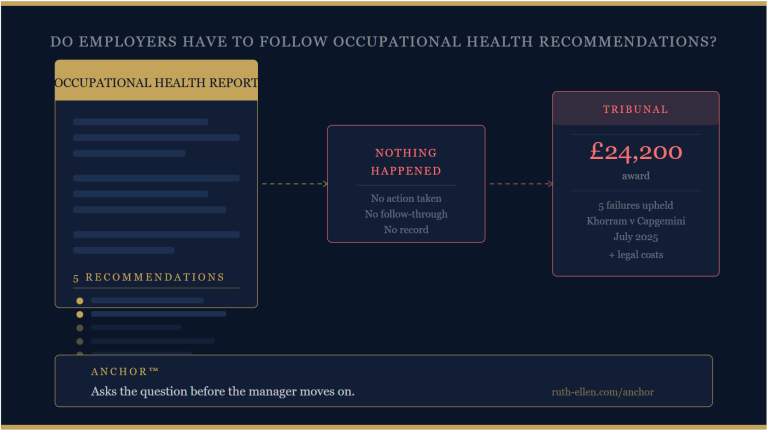
An occupational health report arrived in October 2023. It recommended five adjustments for an employee with ADHD. None of them were implemented. In February 2024, the employee was dismissed. In July 2025, the tribunal handed down its judgment. Five reasonable adjustment failures. Award: £24,200.
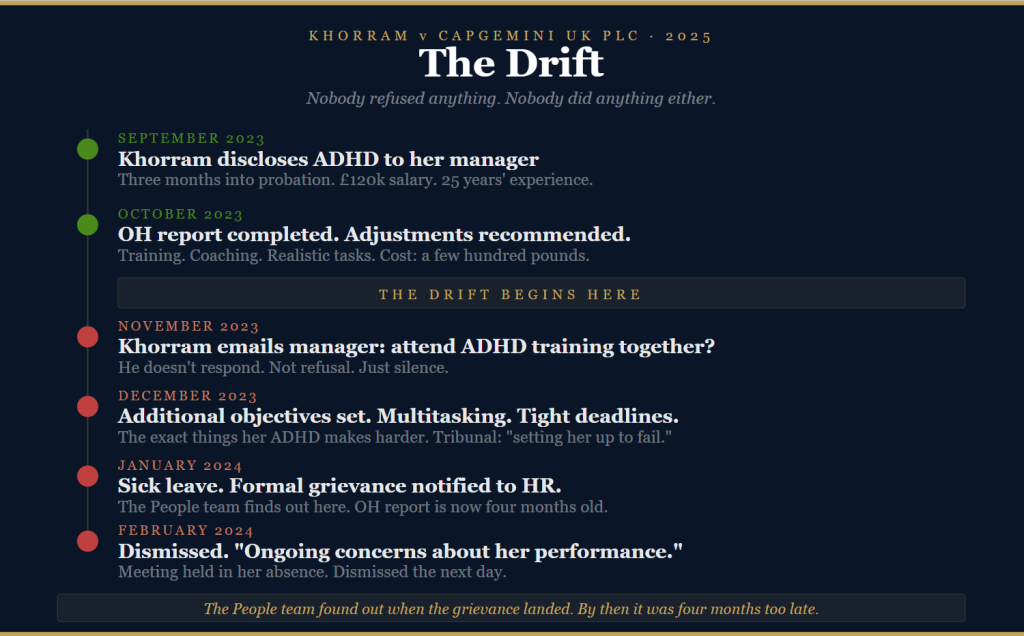
She sent him an email in November 2023.
She asked her line manager, Steve Baldwin, to attend ADHD awareness training with her. She had been on the waiting list. She had the OH report recommending it. She had found a format that would work — a group session, not a spotlight, not a private session that made it obvious the training existed because of her.
She sent the email. He didn’t respond.
Not a no. Not a “let me check with HR.” Not a “can we talk about this next week.” No response.
Four months later, Bahar Khorram was dismissed from her £120,000-a-year role at Capgemini UK for “ongoing concerns about her performance.” She had 25 years of experience in cloud architecture and pre-sales. She had disclosed her ADHD diagnosis. She had been referred to occupational health. She had done everything the system asks employees to do.
The system, in return, did not respond to her email.
The tribunal found five reasonable adjustment failures. The award was £24,200. But before you get to the legal analysis, there is a simpler question worth sitting with: what kind of organisation receives an email like that and says nothing?
Not a cruel one. Not a negligent one in the way people usually mean negligent. A normal one. A busy one. One where a manager had a full diary and an inbox and a list of things to do before the end of quarter, and an employee’s email asking about training slipped through without anyone noticing that it wasn’t just an email — it was the moment the case was decided.
What happened in Khorram v Capgemini
Bahar Khorram joined Capgemini UK in June 2023 as Presales Market Lead in their cloud infrastructure services business unit. Her salary was £120,000 plus benefits. She was a cloud technologist with over 25 years of international experience, having worked at well-known tech firms across the US and London.
She had ADHD, diagnosed in November 2022 following a psychiatric assessment. Her condition significantly affected her executive functioning — particularly her ability to manage unstructured tasks, cope with ambiguity, handle excessive multitasking, and maintain focus in environments that lacked clarity or routine. She could do the work. She needed the work to be structured in a way that worked with her brain, not against it.
She told her line manager, Steve Baldwin, about her ADHD in September 2023, three months into her six-month probation. Baldwin referred her to occupational health. The OH assessment came back in October 2023 with specific, costed, practicable recommendations:
Setting achievable and realistic tasks to prevent her becoming overwhelmed
Neurodiversity awareness training for colleagues and managers (a one-hour or three-hour group webinar for up to 15 people — cost: a few hundred pounds)
ADHD awareness training for the team
Six two-hour coaching sessions focused on ADHD, time management, and coping strategies
Coaching sessions with her line manager
These were not radical asks. The training was a webinar. The coaching was six sessions. The tribunal later noted that the cost “was not a prohibitive difficulty” for a company the size of Capgemini.
In November 2023, Khorram sent the email. She invited Baldwin to attend the ADHD training with her. She had made clear she was comfortable being one of many attendees — she just did not want it delivered as a private session that made it obvious the training existed solely because of her. The tribunal accepted this as a reasonable position. The training was for everyone. Its purpose was to help colleagues understand how to work with her.
Baldwin did not respond.
Khorram took two weeks of sick leave and one week of annual leave. She explored a role change. Her sick note cited her struggles functioning at work and a medication change — she was on sertraline, recently increased. In December 2023, a further probation review set new objectives. The tribunal later found that these objectives, still live in January 2024, represented a continuing act of discrimination — because the adjustments that might have helped her meet them had never been put in place.
In January 2024, Khorram notified HR of her intention to raise a formal grievance, citing lack of support and an intimidating working relationship with her manager. Her probation was extended. Then, on 31 January 2024, a probation meeting was held in her absence. The following day, she was dismissed for “ongoing concerns about her performance.”
The claim was heard in May 2025. The judgment was handed down in July 2025. Five failures to make reasonable adjustments were upheld. The award was confirmed in a remedy judgment in December 2025: £24,200.
The harassment claims did not succeed. The section 15 claims did not succeed. But the core of what Khorram had said all along — that Capgemini received an OH report with specific recommendations and did not act on them — was upheld.
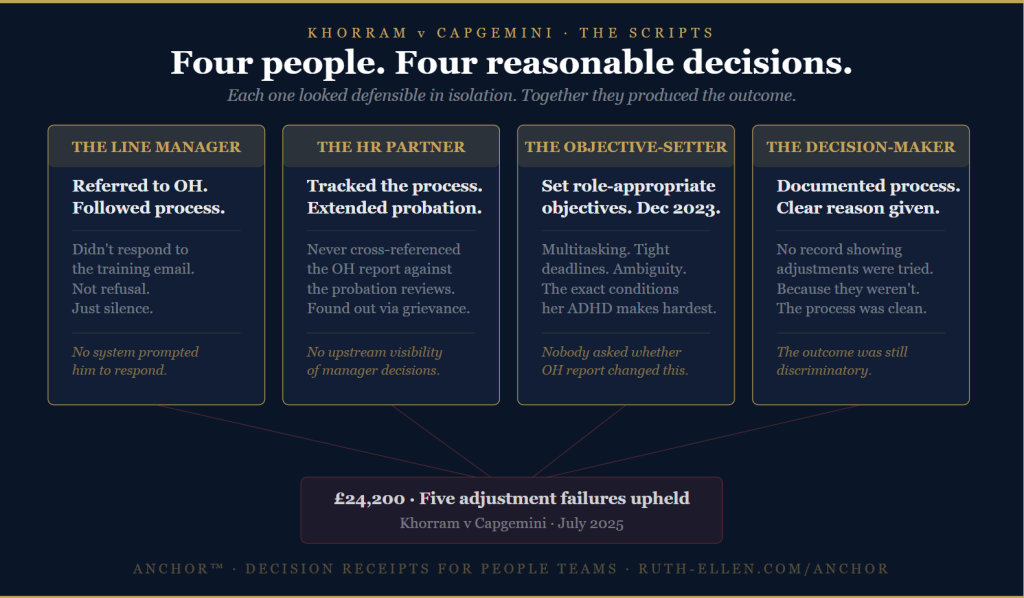
The four people in this case. You know all of them.
Every case like this has the same cast. Not villains. Not bad people. People doing normal things inside a system that didn’t prompt them to ask the one question that would have changed everything.
The Line Manager Steve Baldwin referred Khorram to occupational health when she disclosed her ADHD. That’s what the process says to do. The OH report arrived. He was busy. The email about training came in. He didn’t respond — not because he decided not to, but because the email didn’t feel like a decision point. It felt like something to get to later. Later became never. A tribunal found that this silence was the moment the adjustment failure was established.
What looks reasonable: He followed the referral process. He didn’t refuse anything explicitly. What was missing: A system that told him that not responding was itself a decision — and a legally significant one.
The HR Business Partner HR knew Khorram had been referred to occupational health. HR received the report. HR’s role in the months that followed appears to have been largely procedural — managing the probation process, setting review dates, noting concerns. The OH report sat in the system. Nobody cross-referenced it against what was actually happening in the probation reviews. Nobody asked: have the adjustments been implemented? If not, why not? When the grievance landed in January 2024, the response was to extend the probation. One month later, Khorram was dismissed.
What looks reasonable: HR tracked the process. They extended the probation when concerns were raised. What was missing: Visibility of what was happening at manager level before it escalated. The loop never closed.
The Objective-Setter In December 2023, new objectives were set. These objectives required the same things the OH report had identified as difficult for Khorram without adjustment: managing multiple workstreams, meeting deadlines, operating in ambiguous environments. The objectives were not created to be punitive. They were created because that was the work. Nobody stopped to ask whether the work, structured the way it was structured, was still appropriate given that the adjustments intended to support her through it had not been put in place.
What looks reasonable: Objectives reflect the role requirements. That’s what probation is for. What was missing: A prompt to ask whether the objectives were being set into conditions that had already been identified as creating a barrier.
The Decision-Maker The decision to dismiss was made after a probation meeting held in Khorram’s absence. The reason given: “ongoing concerns about her performance.” The decision-maker had the probation records. They had the documentation of the meetings. They had evidence of underperformance against objectives. What they did not have — what nobody had produced — was a record showing that the five OH-recommended adjustments had been implemented and had not changed the outcome. That record did not exist. It did not exist because the adjustments had never been put in place.
What looks reasonable: A documented probation process with a clear reason for dismissal. What was missing: The evidence that would have made the dismissal defensible — proof that Capgemini had done what the law required before concluding the work could not be done.
The four people in this case are not unusual. They are operating inside a system that has no mechanism for asking, at the point of decision, whether an OH report has been acted on — and whether any pending adjustments change what the next decision should be. The question was never asked. The system was never designed to ask it.
What the system doesn’t count
I built ANCHOR because of this pattern. Not because I read about it in a case report.
I saw it first as a trainer — building frameworks for managers, watching them leave the room with the right language and then return to environments that had no mechanism for using it. The training was good. The environment hadn’t changed. The manager sat down, opened their inbox, and the next decision happened without the prompt.
Then I saw it as a coach — sitting with neurodivergent individuals who were not failing at their jobs but were exhausted from doing the emotional and administrative labour that should have belonged to the system. They had a workplace needs assessment. They had an OH report. They had documentation of exactly what they needed. And they were spending cognitive resource — resource that should have been available for the work — chasing follow-up, managing their own distress at not being prioritised, presenting their needs again in a slightly different way to see if this time someone would act on them.
That is not an individual failing. That is what happens when a system produces a document and then outsources the follow-through to the person with the least power to enforce it.
In Khorram v Capgemini, Bahar Khorram did everything the system asks. She disclosed her diagnosis. She went through occupational health. She identified training that would work, in a format that would not single her out. She sent the email. She was not passive. She was doing the labour of a system that had abdicated its responsibility to act.
The tribunal found five failures. The award was £24,200. What the tribunal did not and could not measure is the cost that preceded it — the months of following up, the sick leave, the medication changes, the annual leave taken because the environment had become untenable. The legal figure is the floor, not the ceiling.
ANCHOR is built for the moment before that cost accumulates. Not after the grievance. Not after the tribunal bundle. At the manager’s decision point — before the email goes unanswered, before the objective is set into conditions that were already flagged as a barrier, before the individual has to become their own case manager inside an organisation that was already told what they needed.
The downstream problem — the emotional labour placed on the individual when systems fail upstream — is the reason the upstream system exists.
The question is never why didn’t she push harder. She pushed. She emailed. She disclosed. She went through every process available to her. The question is why the system had no mechanism to respond.
The question nobody asked
There is one question that, asked at any point between October 2023 and February 2024, would have changed what followed.
We have an OH report recommending adjustments for this employee. Which of those adjustments have been implemented? Which haven’t? And is anything happening in this probation process that those adjustments were supposed to support?
That question is not complicated. It does not require a legal team or an HR director. It requires a prompt — something in the system that fires before a manager sends an email, before new objectives are set, before a probation review is scheduled — that asks: have we done what we said we’d do?
In Khorram v Capgemini, the answer to that question, at every stage, was no. The training had not been arranged. The coaching sessions had not been scheduled. The task-setting guidance had not been applied. The objectives set in December 2023 were set into conditions that the OH report had already identified as creating a barrier — and nobody paused to notice.
The tribunal found that the objectives set in December 2023 were still live in January 2024. Employment Judge Adkin found this represented a continuing act of discrimination — not a single decision, but an ongoing failure that accumulated across months. The discrimination was not in any one action. It was in the sustained absence of the question.
The reasonable adjustment that was perhaps most striking in the judgment was the awareness training. The tribunal found that the format Khorram had proposed — a group session, not a spotlight on her — was practicable and reasonable. It would have helped her colleagues understand how to work with her. It would have reduced the disadvantage she faced from multitasking requirements and tight deadlines. Capgemini argued she hadn’t wanted it. The tribunal found she had objected to one specific delivery format — not to the training itself. That is a distinction that matters. An employer’s obligation is not to offer training in a format the employee has said won’t work. It is to find a format that will.
Nobody found that format. Nobody tried.
Why this keeps happening
This is not a story about a bad employer. Capgemini is a global technology and consulting firm. They had an HR function. They had an occupational health process. They referred Khorram for assessment. They produced probation documentation. They followed the process.
The process did not contain the question.
This is the pattern in almost every reasonable adjustment failure that reaches tribunal. Not malice. Not a deliberate decision to ignore a disabled employee’s needs. A system that was designed to manage performance, and that had no mechanism for asking — at the moment a manager is deciding what to do next — whether an outstanding adjustment changes what that decision should be.
The Equality Act 2010 does not require perfection. It requires that employers take reasonable steps. A one-hour webinar for up to 15 people is a reasonable step. Six coaching sessions is a reasonable step. Setting objectives that account for what the OH report says is a reasonable step. None of these are difficult. All of them require one thing: a prompt that fires before the manager acts, not after the outcome has landed.
ANCHOR is built for that moment. When a manager submits a decision through the free scenario tool, the system asks the questions the manager didn’t know to ask — including whether there is an outstanding adjustment that changes what the right decision is.
What the Equality Act actually requires — and what Khorram v Capgemini confirmed
The duty to make reasonable adjustments under the Equality Act 2010 is triggered when an employer knows, or ought to know, that an employee has a disability. ADHD qualifies where it has a substantial and long-term adverse effect on normal day-to-day activities. In Khorram’s case, the tribunal accepted that her ADHD created significant disadvantage — particularly in relation to multitasking requirements and tight deadlines. These were framed as provisions, criteria, or practices (PCPs) applied by Capgemini that put her at a particular disadvantage compared to colleagues without her disability.
What Khorram v Capgemini confirmed — and what People professionals should take seriously — is that reasonable adjustments are not limited to equipment, modified duties, or flexible working. The tribunal upheld the failure to implement awareness training for colleagues and managers as a failure to make reasonable adjustments. That is significant. The disadvantage Khorram faced was not only from the condition itself. It was compounded by how colleagues and managers responded to neurodivergence they did not understand. Training that would have reduced that disadvantage was a reasonable adjustment. Not implementing it was a failure.
The judgment also confirmed the continuing act principle. The adjustments were not made in October 2023, when the OH report arrived. They were not made in November 2023, when Khorram sent her email. They were not made in December 2023, when new objectives were set. Each decision point — each time someone proceeded without asking whether the adjustments had been implemented — was part of a single, continuing act of discrimination. The clock did not reset with each new probation review. The failure accumulated.
For Heads of People, this means one thing practically: the question is not whether your organisation made adjustments at one point. It is whether your managers are checking, at every decision point that involves an employee with a known disability, whether the adjustments are in place and whether the decision being made accounts for them.
If that check does not exist in your system, the risk is live. Not hypothetically. Actively.
What Heads of People need before the next OH report arrives
The failure in Khorram v Capgemini was not the referral to occupational health. That happened. The failure was in the gap between the report arriving and anyone checking whether the recommendations had been acted on.
Three things would have changed the outcome.
1. A closed loop between OH recommendations and manager decisions. When an OH report arrives with specific recommendations, someone needs to own the follow-through — not just log that the report was received, but confirm that each recommendation has been actioned, track which ones are outstanding, and ensure that no further decisions are made about that employee’s performance without cross-referencing what is still pending. This loop does not exist in most performance management frameworks. It needs to be built deliberately.
2. A prompt that fires before any probation decision is made. The December 2023 objective-setting happened without anyone asking whether the OH-recommended adjustments were in place. A prompt — something in the system, not in anyone’s memory — that asks “are there outstanding adjustments for this employee?” before the next decision is made would have changed what happened next. The objective-setter would have had to answer the question before setting objectives into conditions the OH report had already flagged.
3. Visibility of manager decisions before they escalate. HR found out about Khorram’s situation through a grievance notification in January 2024. By then, the adjustment failures had been accumulating for three months. The People team was informed after the damage was done. Upstream visibility — the ability to see what managers are deciding at the point they decide it — is what closes that gap.
The OH report in Khorram v Capgemini was not the problem. The problem was that nobody built a system to check whether the recommendations in it had been followed. An OH report that sits unimplemented is not a defence. It is evidence of a failure that was documented before it happened.
What this case means for managers running ADHD-related processes right now
If you are managing an employee with ADHD — or any disability where an OH report has been produced — there are three questions to ask before your next decision: What did the OH report recommend? Which of those recommendations have been implemented? Does the decision I am about to make assume the adjustments are in place — and if they aren’t, does that change what I should do?
These questions cost nothing to ask. Not asking them is what £24,200 looks like.
Are your managers reading the manager version of this? NeuroRich breaks down cases like Khorram v Capgemini for the people actually running these conversations — not the legal commentary, but the moment before the decision. What they were thinking. What they missed. What to ask instead. Subscribe at neurorich.substack.com →
What a Sprint produces for a Head of People
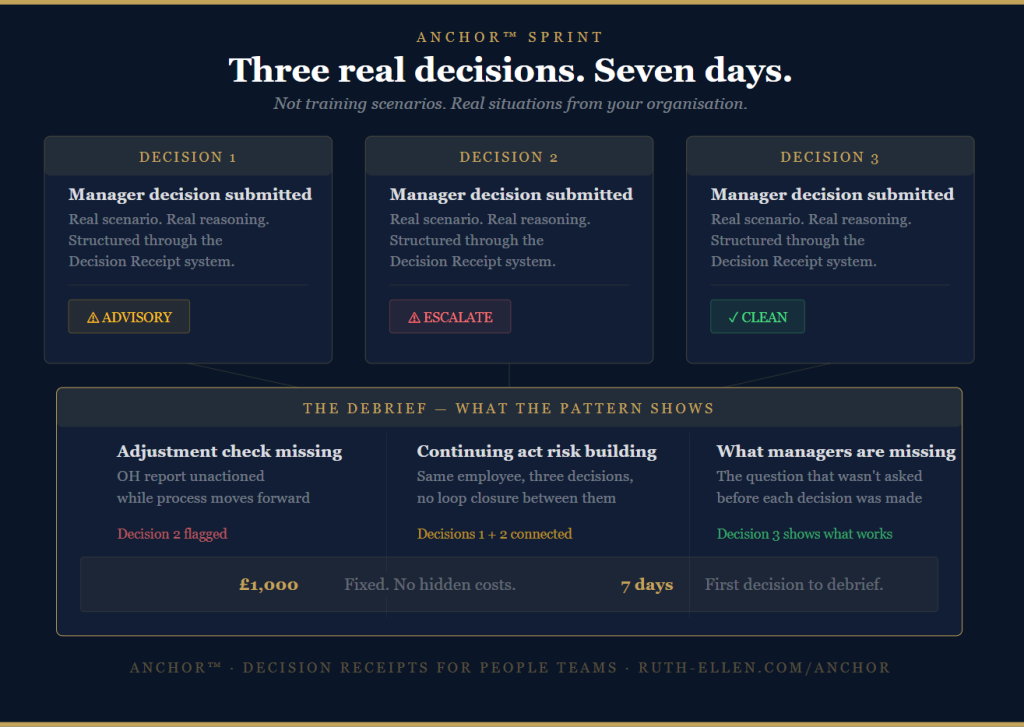
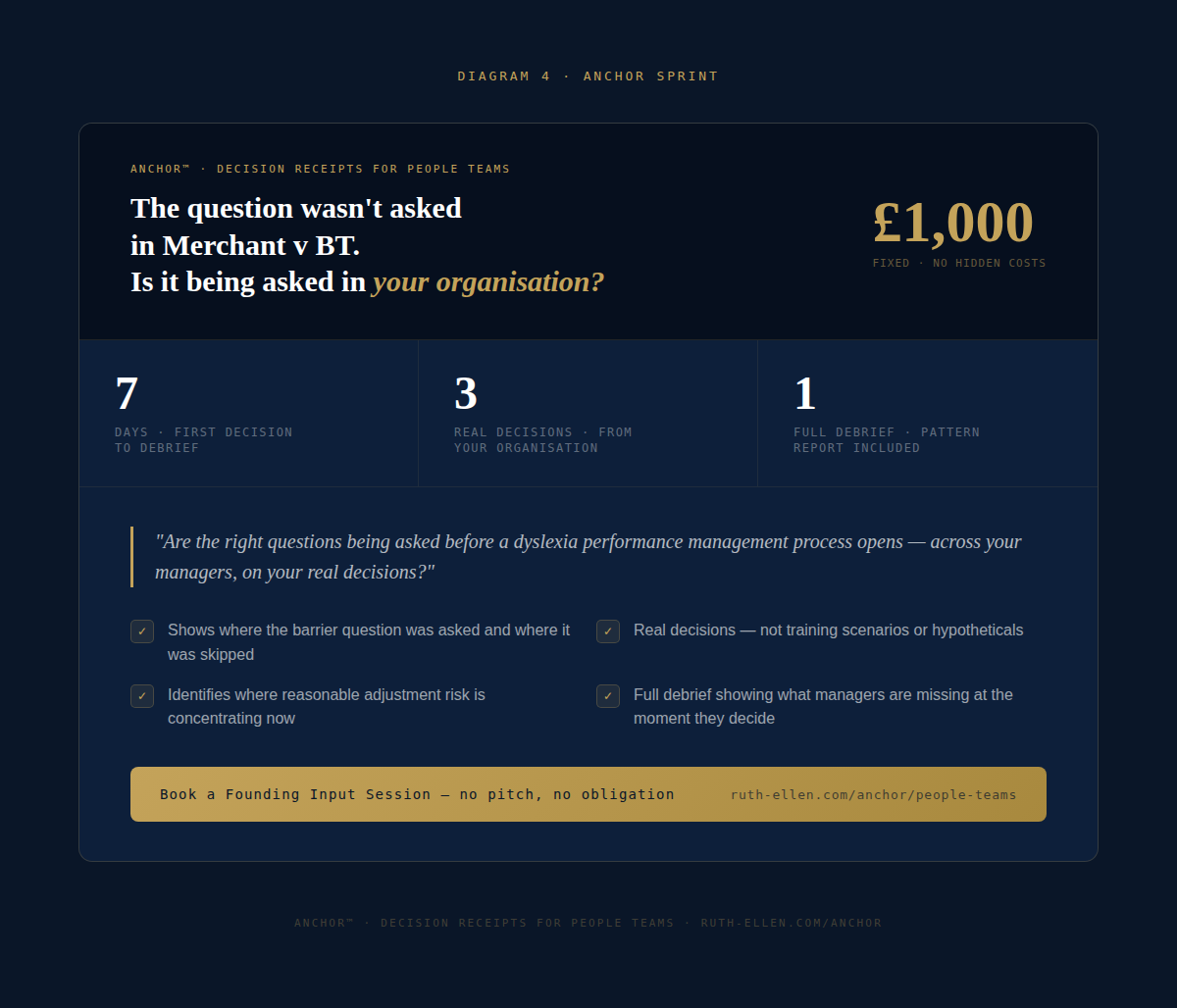
An ANCHOR Sprint runs three real manager decisions from your organisation through the Decision Receipt system over seven days. Each decision is structured, risk-assessed, and returned with a debrief showing what your managers are thinking — and what they are missing — at the moment they decide.
For a Head of People whose managers are navigating ADHD disclosures, OH reports, or reasonable adjustment processes, a Sprint answers the question that is otherwise invisible: is the right question being asked before anyone acts?
The debrief shows you the pattern across three real decisions. Not training scenarios. Real situations from your organisation. Where the adjustment check is missing. Where the continuing act risk is building. Where the OH report is sitting unimplemented while the probation process moves forward.
Khorram v Capgemini was decided by an email that nobody answered. The organisations that don’t end up in that position are not the ones with better policies. They are the ones with a system that asks the question before the inbox moves on.
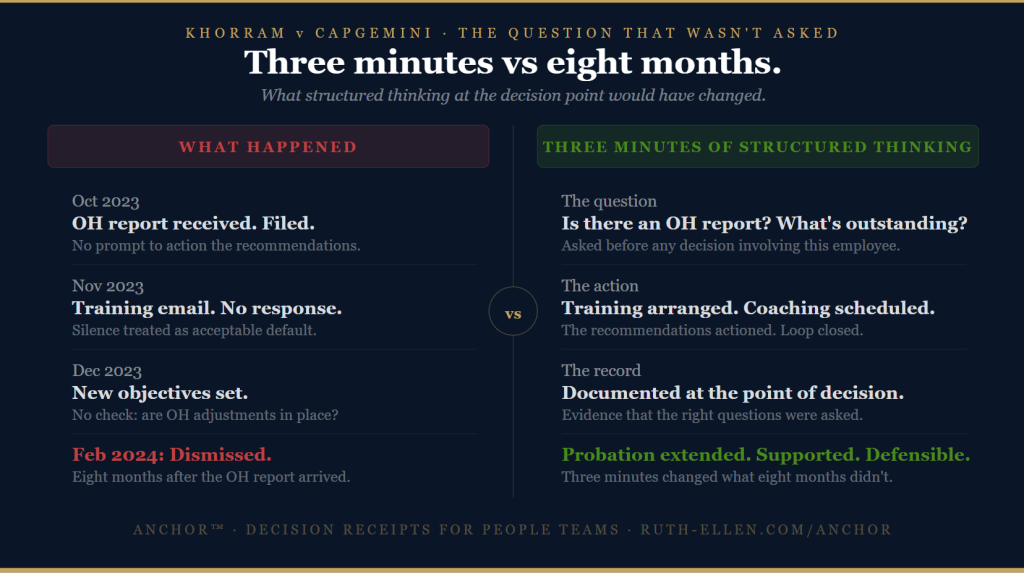
The clean decision
Three minutes. That is what it takes.
Before any probation decision involving an employee with a known disability, before any objective-setting process, before any response (or non-response) to a training request — three minutes of structured thinking:
Is there an OH report? What did it recommend? Has it been implemented? Does this decision account for what hasn’t been done yet?
Khorram emailed Baldwin in November 2023. She had 25 years of experience. She had disclosed her diagnosis. She had been through occupational health. She had identified a format for training that would work. She sent the email.
He didn’t respond.
The tribunal found that this was part of a continuing act of discrimination. Not a decision. The absence of one.
Three minutes would have changed it.
About the author
Ruth-Ellen Danquah is the founder of ANCHOR™ — Decision Receipts for People Teams. A former Inside Sales Representative who closed £120 million over two years, she knows from direct experience what it looks like when a system processes a person instead of asking the question that would have changed the outcome. She writes about the gap between what organisations intend and what managers do at 9am on a Tuesday — and why that gap is where all the risk lives. This is not legal advice. It is decision governance.
Case reference: Khorram v Capgemini UK plc, Central London Employment Tribunal, Case No. 6004705/2024, judgment handed down 14 July 2025. Remedy judgment December 2025.
If you are a manager reading this — this post was written for your Head of People. If you are navigating a situation involving a disability disclosure, an OH report, or a reasonable adjustments conversation, the free ANCHOR scenario tool surfaces the questions you should ask before you go further. Try it on your real situation, then share this page with your People team.
The short answer: Technically, no in answer to do employers have to follow occupational health recommendations?. An OH report is advisory, not binding. But that answer will not help you when a manager has had a report sitting in their inbox for three months and nothing has been actioned. Here is what the law actually requires — and what happens when it isn’t done.
The longer answer is that this distinction almost never matters in the way employers think it does — because the question tribunals ask is not whether you were required to follow the report. It is whether you had a good reason for not doing so, whether you documented that reason at the time, and whether the employee with a disability was placed at a substantial disadvantage as a result.
In 2025, the Central London Employment Tribunal handed down its judgment in Khorram v Capgemini. Capgemini had referred a senior employee with ADHD to occupational health. The report arrived with five specific recommendations. None of them were implemented. The employee was dismissed for “ongoing performance concerns” four months later. Five reasonable adjustment failures were upheld. The award: £24,200.
Capgemini did not decide to ignore the report. The report arrived. The manager received it. Nothing happened. The distinction between “decided not to follow” and “nothing happened” is not one the tribunal found meaningful.
That is the actual answer to the question.
What the law requires about following occupational health recommendations
The Equality Act 2010 places a duty on employers to make reasonable adjustments where they know, or ought to know, that an employee has a disability. The duty is triggered by knowledge — not by a diagnosis, not by a formal disclosure process, not by a completed OH report. If a manager has been told, or could reasonably have known, that an employee’s condition affects their ability to work, the duty is active.
An occupational health report does not create the duty. It evidences it. Once a report arrives recommending specific adjustments, an employer who does not act on those recommendations is in a materially different position from one who was never told what was needed. The report removes any argument that the employer did not know what reasonable adjustments would look like.
This is why the “advisory only” framing is operationally dangerous. It is technically accurate and practically misleading. The report is advisory in the sense that you are not legally required to implement every recommendation without question. You can make a different decision — but only if you can show you considered the recommendation, had a legitimate reason for not implementing it, and documented that decision at the time.
What you cannot do is receive a report, take no action, continue a performance or probation process, and then argue at tribunal that the recommendations were advisory. That argument was available to Capgemini. They did not win it.
What “considering” a recommendation actually means
This is where most organisations are exposed and do not know it.
Receiving an OH report and filing it is not considering it. Forwarding it to HR and waiting is not considering it. Telling the employee you will “look into it” and then not doing so is not considering it.
Considering a recommendation means asking three questions — documented, at the point of decision:
1. Can this recommendation be implemented as stated? If yes: action it, confirm to the employee it has been done, and set a review date.
If no: ask why not — is it cost, operational feasibility, or something else? Document the specific reason. Then ask what alternative adjustment could address the same need.
2. If not implemented as stated, what adjustment will be made instead? The duty is to address the disadvantage. If a specific recommendation is not practicable, the employer’s obligation is to find something that is — not to conclude that nothing can be done.
3. Has the employee been told? Whatever the decision — implement, partially implement, or not implement with reasons — the employee needs to know. The loop does not close silently.
None of this requires legal input or a formal process. It requires a manager who has been prompted to ask these questions before moving on to the next thing in their inbox.
That prompt is what most performance management frameworks are missing.
An OH report that has been received, not actioned, and not responded to is not neutral. It is evidence, documented before the outcome landed, that the employer knew what the employee needed and did nothing with that knowledge.
What happens when a manager sits on a report
The pattern in tribunal judgments involving OH reports is remarkably consistent.
The report arrives. It contains specific, costed, practicable recommendations. The manager receives it. There is no system that fires a prompt asking what has been done with it. The performance or probation process continues, measured against standards the report has already flagged as potentially problematic without adjustment. Three, four, five months later — the employee is dismissed, or raises a grievance, or leaves.
The tribunal then works backwards. What did the employer know, and when? The OH report provides a timestamped answer. The tribunal asks: were the recommendations implemented? If not, why not, and is that documented? In the absence of a documented decision with reasons, the tribunal infers that no genuine consideration took place.
In Khorram v Capgemini, one of the recommended adjustments was an ADHD awareness training webinar — one to three hours, for up to 15 people. The tribunal noted the cost “was not a prohibitive difficulty” for Capgemini. The employee had emailed her manager directly asking him to attend. He did not respond. That email, and that non-response, sat at the centre of the tribunal’s analysis of whether the employer had genuinely engaged with the adjustment.
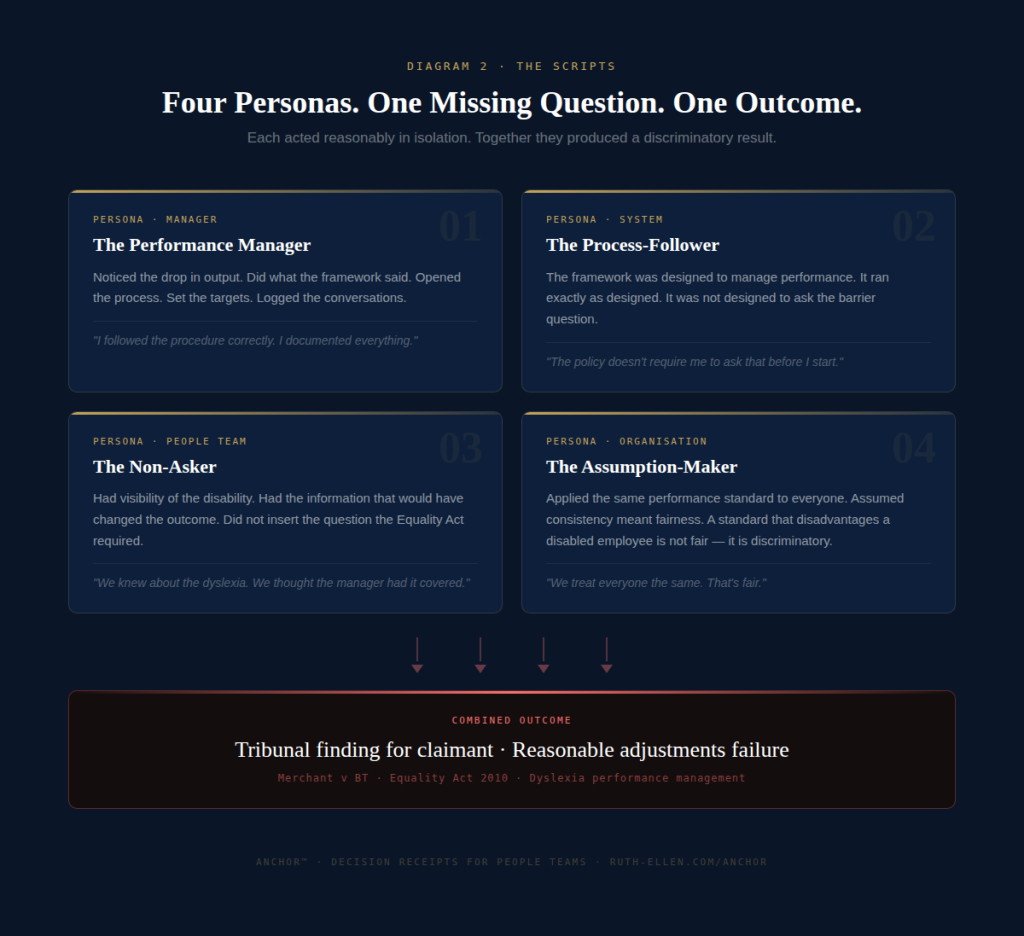
In Merchant v BT, the failure was not in the OH process but in the performance management process that ran alongside it — without pausing to ask whether the adjustments were in place or whether they changed what the process should be doing.
The pattern is not employers deciding to discriminate. It is employers whose systems have no mechanism for asking, at each decision point, whether an outstanding adjustment changes what the right decision is.
The legal position in plain terms
Employers do not have to follow every OH recommendation to the letter. They do have to:
Genuinely consider each recommendation at the point it is received
Document any decision not to implement, with specific reasons
Identify an alternative adjustment if the recommended one is not practicable
Tell the employee what has been decided and why
Ensure that any subsequent performance decisions account for what is and is not in place
Failure on any of these points, where the employee has a disability, is a failure to make reasonable adjustments under the Equality Act 2010.
The Head of People problem
The manager received the report. The manager did not act on it. You found out when the grievance landed.
This is the structural problem, and it is not a training problem. A manager who has been through an Equality Act workshop knows they should follow OH recommendations. The same manager, six weeks later, with a full inbox and a probation review to run, receives a report and does not action it — not because they forgot the training, but because nothing in their environment prompted them to treat the report as a decision point rather than a piece of correspondence.
Heads of People who want to change this outcome have two options.
The first is to own the OH follow-up process centrally. Every report that lands gets logged, tracked, and chased. HR asks the manager what has been implemented. HR reviews the outstanding items before signing off any performance or probation decision involving that employee. This works. It also requires a People team with capacity to run it, visibility of every OH referral, and a manager population willing to be chased.
The second is to change what happens at the manager’s decision point. When a manager is about to submit a decision involving an employee with a known disability — a probation review, a performance conversation, a capability process — a structured prompt asks: is there an OH report for this employee? What is outstanding? Does that change what you are about to decide?
That prompt does not require HR capacity. It requires the prompt to exist inside the system the manager is using at the moment they are deciding.
If you have an occupational health report for someone on your team and you have not actioned it:Stop before your next decision about that person’s performance, probation, or capability.Ask: which recommendations have been implemented? Which haven’t? And does this performance concern look different once I account for what hasn’t been put in place yet?The free ANCHOR scenario tool surfaces these prompts before you act. No sign-up. No cost: ruth-ellen.com/anchor/handle-escalations/
What a three-month-old OH report means for your exposure right now
If there is an occupational health report in your organisation that has not been fully actioned — and the employee it was written for is currently in a performance process, on a probation review, or has raised a grievance — your exposure is active.
The report is timestamped. The date of the recommendations is on file. A tribunal will ask when the employer knew what was needed, and the report answers that question precisely. The gap between the report date and today is the period during which the employer had knowledge and took no action.
This does not mean the situation is unrecoverable. What it means is that the next decision involving that employee needs to account for the report — and needs to be documented showing that it did.
The questions to ask before that decision:
What did the OH report recommend?
Which recommendations have been implemented, and when?
Which have not been implemented, and why — documented?
Is the decision I am about to make affected by what is still outstanding?
Has the employee been told the current status of each recommendation?
If you cannot answer all five, the decision should wait until you can.
What an ANCHOR Sprint surfaces for a Head of People
An ANCHOR Sprint runs three real manager decisions from your organisation through the Decision Receipt system over seven days. Each decision is structured, risk-assessed, and returned with a debrief showing what your managers are thinking — and what they are missing — at the point they decide.
For a Head of People who suspects there are OH reports sitting unactioned in manager inboxes right now, a Sprint answers the question that is otherwise invisible: are the right questions being asked before anyone moves forward?
The debrief shows the pattern across three real decisions. Where the OH check is missing. Where the performance process is running ahead of the adjustment. Where the exposure is concentrating.
Khorram v Capgemini was five recommendations, none implemented, one unanswered email. The organisations that do not end up there are not the ones with better policies. They are the ones where the question gets asked before the manager moves on.
Ruth-Ellen Danquah is the founder of ANCHOR™ — Decision Receipts for People Teams. She writes about the gap between what organisations intend and what managers do at 9am on a Tuesday — and why that gap is where all the legal exposure lives. For managers navigating these situations in real time, the NeuroRich newsletter covers the decision before the process. This is not legal advice. It is decision governance.
If you are a manager reading this — share this page with your Head of People. If you have an OH report for someone on your team that hasn’t been fully actioned, try the free ANCHOR scenario tool before your next decision. It takes three minutes and surfaces the questions you need to answer before you move forward.
When the process runs correctly and the outcome is still wrong
A dyslexic employee. A performance management process correctly followed. A tribunal that found for the claimant. What Heads of People need to know about dyslexia, performance management, and the question that should have been asked before the process started.
I know what it feels like to be performance managed instead of supported. Not hypothetically — from direct experience, in a fast-growth SaaS business where I was an Inside Sales Representative closing six-figure deals over the phone. £120 million in two years. I was not underperforming. I was one of the highest performers on the floor. And when something changed — when the environment shifted in ways that affected how I was working — nobody had a conversation with me. Nobody asked what was happening. Instead, HR meetings appeared in my calendar. Scheduled by people who had never sat next to me, never heard a call, never seen what I actually did. The framework activated. The framework did not ask the question that would have changed everything.
That experience is why I built ANCHOR. And it is why Merchant v BT is the case I return to most when I am talking to Heads of People about dyslexia, performance management, and what the Equality Act actually requires before a process begins.
Because Merchant v BT is not a story about a bad employer or a negligent manager. It is a story about a framework that ran exactly as designed — and still produced a discriminatory outcome. The difference between that case and what I experienced is smaller than most People professionals want to believe.
Are your managers reading the manager version of this case? NeuroRich breaks down Merchant v BT for the people actually running performance conversations — what they saw, what they missed, and the one question that changes the outcome before the process opens. Share the post: My Employee With Dyslexia Isn’t Meeting Targets. What Do I Do? Subscribe at neurorich.substack.com — free, weekly, written for managers not lawyers.
What happened in Merchant v BT
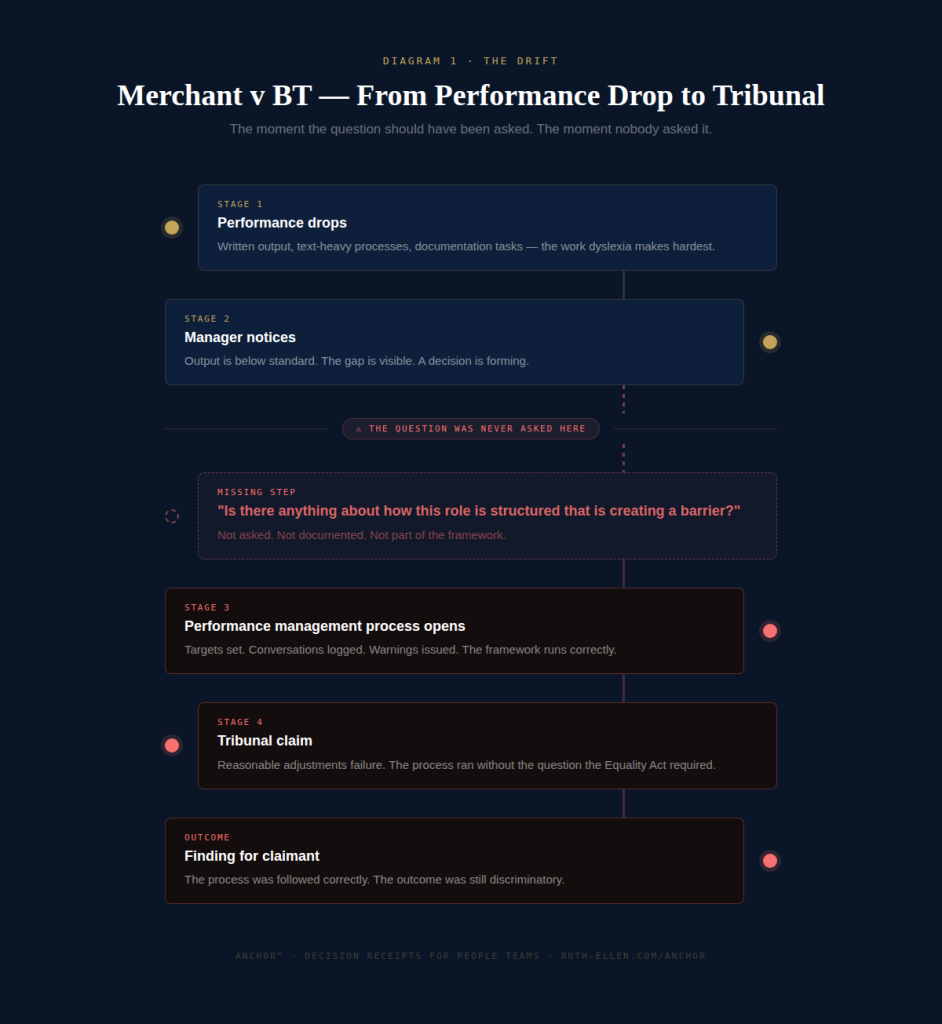
Mr Merchant was a BT employee with dyslexia — a protected characteristic under the Equality Act 2010. His performance fell below the required standard. Specifically, it fell in the areas that dyslexia makes hardest: written output, text-heavy processes, documentation-intensive tasks. The work that his disability made substantially more difficult was precisely the work being measured.
A performance management process was opened. The process was followed correctly. Targets were set. Conversations were logged. Warnings were issued. The machinery worked exactly as designed.
What the machinery did not do — and could not do without a different prompt — was ask whether the role design was creating a barrier that the dyslexia performance management process itself was making harder to meet. Nobody asked whether the work Mr Merchant was struggling with was the work his dyslexia made substantially harder. Nobody asked what adjustments might have changed his output before the process started. Nobody paused between noticing the performance drop and opening the framework to ask the one question the Equality Act requires.
The tribunal found for the claimant on reasonable adjustments grounds. Not because the dyslexia performance management process was wrong. Because the process ran without the question that should have preceded it.
The process was followed correctly. The outcome was still discriminatory. That is the pattern.
The double bind of dyslexia in a performance management context
Before I explain what should have happened in Merchant v BT, I need to name something that the legal commentary almost never addresses: what it actually feels like to be on the receiving end of a dyslexia performance management process that is measuring the exact things your brain finds hardest.
You already know you are struggling with the written output. You have probably known for years. You have developed workarounds — some visible, most invisible — that get you through. You have spent significant cognitive resource every single day compensating for the gap between how you work best and what the environment requires. And then the dyslexia performance management process opens, and suddenly the thing you have been quietly managing is documented, formalised, and presented back to you as a failure.
The manager has followed the framework. The framework says: here is the standard, here is the gap, here are the targets. It does not say: before we do any of this, let’s establish whether the standard itself is the problem. It does not say: let’s ask whether the work that has dropped is the work that dyslexia makes harder, and whether a different way of working would change the output entirely. It says: improve or face consequences.
That is not a bad manager. That is a framework that was never designed to ask the barrier question. And when the barrier question is not asked in a dyslexia performance management process — when the employer knows or ought to know that a disability is relevant — the Equality Act 2010 has been breached. Not because of malice. Because of a missing prompt.
I closed £120 million in deals over two years as an Inside Sales Representative. I did it over the phone, where my brain works well, in an environment built around conversation and persuasion. When that environment shifted and the written, process-heavy tasks increased, my output changed. Nobody asked why. Nobody asked what the barrier was. They scheduled HR meetings. The dyslexia performance management framework ran. The question was never asked.
Merchant v BT. Different industry. Different disability presentation. Same missing question.
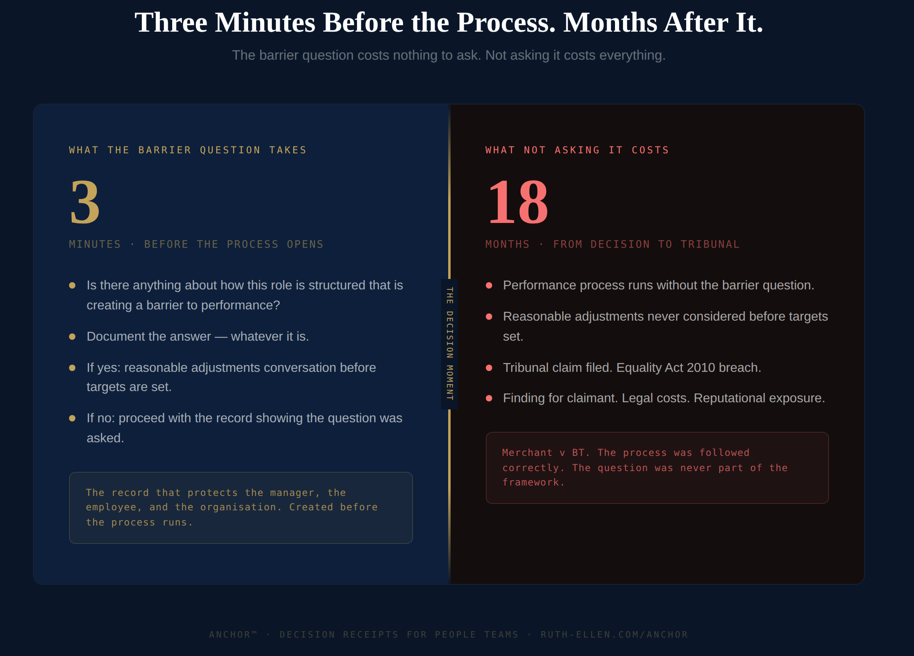
Before a dyslexia performance management process opens — before targets are set, before conversations are logged, before any formal machinery begins — ask once: is there anything about how this role is structured, or how we are asking this person to work, that is creating a barrier to performance that was previously available? That question is not optional where a disability is known or ought to be known. It is what the Equality Act requires.
ANCHOR is built for that moment — the thirty seconds before the manager decides what kind of problem they’re dealing with.
The question that should have been asked
Before any dyslexia performance management process opens — before any performance process opens where a disability may be relevant — there is one question that changes everything that follows:
Is there anything about how this role is structured, or how we are asking this person to work, that is creating a barrier to the performance that is otherwise available?
This question does two things.
First, it separates capability problems from barrier problems. A capability problem is where the employee lacks the skill or knowledge to do the job. The right response is development, support, and a documented process. A barrier problem is where something in the environment, role design, or circumstances is preventing performance that was previously available — or that would be available with a different way of working. The right response to a barrier problem in a dyslexia performance management context is a reasonable adjustments conversation before the process opens. Not inside it. Before it.
Second, it creates a record. A Head of People whose managers can demonstrate they asked that question — at the right moment, before the dyslexia performance management process started, with the answer documented — is in a fundamentally different position when a situation is later challenged. The absence of that question is consistently what transforms a defensible performance process into an indefensible one.
In Merchant v BT, the question was never part of the framework. The dyslexia performance management process ran. The tribunal found for the claimant. The sequence is not a coincidence.
The barrier question cannot live inside the performance management framework — it needs to precede it. Most frameworks are designed to establish process. They are not designed to prompt curiosity at the moment of decision. If your framework does not contain this prompt before the dyslexia performance management process opens, it is not a framework that protects your organisation when a claim is reviewed.
Why managers don’t ask it — and why that is a Head of People problem
This is not a knowledge gap. Managers who have been through Equality Act training, reasonable adjustments workshops, and management development programmes still routinely omit this question before dyslexia performance management processes begin.
Not because they forgot it. Because at the moment they are sitting across from someone whose output has dropped, the dyslexia performance management framework they are operating inside does not prompt it. Performance frameworks are designed to establish process. They are not designed to insert curiosity at the moment of decision.
The manager follows the framework. The framework does not ask the barrier question. The dyslexia performance management process runs. And the tribunal finds against the employer eighteen months later.
I built ANCHOR because of this gap specifically. Not because I read about it in a case report. Because I experienced it. Because I watched it happen in a high-performing environment where the framework activated before anyone thought to ask what was actually going on. I was closing deals that most people in that building had never come close to. And when things changed, the response was not a conversation. It was a process. HR meetings in the calendar from people who had never heard me on a call. Dyslexia performance management without the word “dyslexia” and without the question that the law required.
The question is not new. The infrastructure to ask it consistently is. ANCHOR is built for that moment — the thirty seconds before the manager decides what kind of problem they’re dealing with.
This is a Head of People problem because the framework is a Head of People’s asset. The moment a dyslexia performance management process runs without the question that the Equality Act requires is invisible to the People team until the claim arrives. Nobody escalated. Nobody flagged it. The manager acted, the process ran, and the first time the Head of People sees it is in the tribunal bundle.
If your performance management framework does not contain a structured prompt asking the barrier question before the process opens, your managers are running dyslexia performance management processes without the protection that question provides. The framework is your risk. And it is invisible until it fails.
What the Equality Act actually requires in a dyslexia performance management context
The duty to make reasonable adjustments under the Equality Act 2010 is triggered when an employer knows, or ought to know, that an employee has a disability. Dyslexia qualifies where the condition has a substantial and long-term adverse effect on normal day-to-day activities — and the Employment Appeal Tribunal confirmed in Paterson v Commissioner of Police of the Metropolis that even conditions which can be managed may still meet the statutory definition if they cause a real and persistent disadvantage.
An employee does not need a formal diagnosis. They do not need to have used the word “disability.” If dyslexia has been mentioned — formally or informally, in a one-to-one, on a form, or in passing — the duty may already be active. In a dyslexia performance management context, this means the barrier question is not optional. It is legally required.
The Khorram v Capgemini judgment reinforced this pattern. Despite an occupational health referral and specific recommendations, the employer failed to implement the adjustments. The ADHD performance management process continued. The dismissal followed. Five reasonable adjustment failures were upheld. The award: £24,200.
The pattern in both cases is identical: the employer knew about the condition. The dyslexia performance management process ran without the barrier question. The tribunal found for the claimant.
[Read the full case analysis: Khorram v Capgemini — The Email That Nobody Answered →]
Dyslexia performance management claims do not arise because employers are malicious. They arise because the barrier question was not part of the process at the moment it needed to be. The Equality Act does not require perfection. It requires evidence that the right question was asked, at the right time, and that someone acted on the answer.
What Heads of People need in place before the next dyslexia performance management process opens
Four things. In order of urgency.
1. A prompt that sits before the performance framework, not inside it.
The barrier question cannot be embedded inside the dyslexia performance management process — it needs to precede it. Heads of People who want their managers to ask the right question need to give them a structure that fires it at the right moment. That structure does not exist in most performance management frameworks. It needs to be added deliberately.
2. A record that shows the question was asked, not just that the process was followed.
The paper trail that protects an organisation in a dyslexia performance management tribunal claim is not the one that shows targets were set and warnings were issued. It is the one that shows the manager paused, asked the barrier question, considered what adjustments might apply, and involved the right people before acting. That record needs to exist at the moment of decision. Not reconstructed afterwards.
3. Visibility of what managers are deciding before it reaches the People team.
The moment the dyslexia performance management framework opens, the Head of People typically finds out. The moment before that — when the manager is deciding whether to open it, what kind of problem it is, what question to ask first — is invisible. That is where the legal exposure lives.
4. A closed loop that confirms adjustments are implemented, not just agreed.
In both Merchant v BT and Khorram v Capgemini, the failure was not in the decision to make adjustments. It was in the absence of follow-through. The dyslexia performance management loop needs to close. Someone needs to own the follow-through and the record that it happened.
A dyslexia performance management process that opens without a documented barrier question, a closed adjustment loop, and People team visibility is a process that is building a claim rather than preventing one.
What a Sprint produces for a Head of People
An ANCHOR Sprint runs three real manager decisions from your organisation through ANCHOR’s Decision Receipt system over seven days. Each decision is structured, risk-assessed, and returned with a debrief showing what your managers are thinking — and what they are missing — at the moment they decide.
For a Head of People whose managers are navigating dyslexia performance management processes, a Sprint answers the question that is otherwise invisible: are the right questions being asked before the process opens?
The Sprint debrief shows you the pattern across three real decisions. Not hypotheticals. Not training scenarios. Real situations from your organisation. Where the barrier question was asked and where it wasn’t. Where the dyslexia performance management legal exposure is concentrating right now.
The dyslexia performance management process in Merchant v BT was followed correctly. The tribunal still found for the claimant. The question that would have changed the outcome was never part of the framework. An ANCHOR Sprint shows you whether that question is being asked in your organisation — before the process runs.
Dyslexia performance management claims do not arise because organisations are negligent or managers are unkind. They arise because a framework ran without the one question the Equality Act requires before it starts. The manager followed the dyslexia performance management process. The process did not contain the prompt. The claim arrived.
I know this pattern from both sides. I know what it feels like when HR meetings appear in your calendar instead of a manager picking up the phone — when you are closing £120 million in revenue and the response to something changing is to activate a process rather than start a conversation. I know what it costs in performance, in trust, in the slow erosion of someone who was delivering until the environment stopped accommodating how they work.
The organisations where dyslexia performance management goes right are not the ones with the most robust policies. They are the ones where one question gets asked before the framework activates. Before the targets are set. Before the meetings are scheduled. Before the process runs.
That question is not complicated. It just needs to be in the system at the right moment.
About the author
Ruth-Ellen Danquah is the founder of ANCHOR™ — a decision governance platform that sits inside the moment a manager is making a people decision, before it becomes a problem. A former Inside Sales Representative who closed £120 million over two years, she knows from direct experience what it looks like when a high performer is managed through a dyslexia performance management process instead of a conversation. She writes about the gap between what organisations say they do and what managers actually do at 9am on a Tuesday — and why that gap is where all the risk lives. This is not legal advice. It is decision governance.
ANCHOR™ · Decision Receipts for People Teams ·
If you’re a manager and you’ve read this far — this post was written for your Head of People. If you’re navigating a performance situation involving a disability or neurodivergent profile and something feels off, the free ANCHOR scenario tool surfaces the questions you should ask before you go further. Try it on your real situation, then share this page with your People team. Try Anchor Now
The BAFTA 2026 disability inclusion planning failure became a defining case study in what happens when an organisation welcomes someone in without building the room for everyone.
Michael B. Jordan and Delroy Lindo walked onto the stage at the 79th BAFTA Film Awards to present the first award of the night.
They are two celebrated Black actors at the peak of their careers. Their film, Sinners, was the most nominated of the evening. Director Ryan Coogler would go on to become the first Black man to win the BAFTA for best original screenplay. It should have been a triumphant night.
Instead, as they stood on stage at the Royal Festival Hall, someone in the audience shouted the N-word at them.
Lindo paused. Then he continued. Because that’s what Black professionals are expected to do — absorb the impact, maintain composure, keep the show moving. He told Vanity Fair afterwards that he and Jordan “did what we had to do.” Then he added the part that should keep every events and People team awake at night: he wished someone from BAFTA had spoken to them afterwards.
Nobody did.
Here is the question that sits at the centre of this, and it’s the one nobody is asking:
“If an involuntary tic includes a racial slur directed at a Black presenter or attendee, what is our plan — in the room, on the broadcast, and afterwards?”
That question was never asked. And what follows is what that absence cost.
BAFTA 2026: The disability inclusion plan and what it missed
The person who shouted the slur was John Davidson, a Tourette syndrome campaigner and the subject of the BAFTA-nominated film I Swear. His tics are involuntary. He has no control over them. He has spent decades advocating for understanding of his neurotype. He has described feeling a “wave of shame” and has since reached out to apologise.
This is not a piece about Davidson. His tics are neurological. They are not a reflection of his beliefs or character. That is medically established and not in dispute.
This is a piece about BAFTA. About the BBC. About every organisation that plans for the comfort of inclusion but not for the harm that can follow when the structure isn’t stress-tested.
Because here’s what was known before the ceremony started:
BAFTA knew Davidson would be in the auditorium. They knew his neurotype involves involuntary vocal tics, including expletives. The BBC had met with BAFTA in advance to discuss what might happen if he swore during the broadcast. A floor manager welcomed Davidson warmly before the show. An announcement was made to the auditorium: “John has Tourette’s Syndrome, so please be aware you might hear some involuntary noises or movements during the ceremony.”
Presenters were informed about Davidson’s tics just minutes before the ceremony began.
The intent was clear. The planning was genuine. The welcome was warm.
And none of it accounted for what actually happened.
The harm that the BAFTA 2026 disability planning didn’t address
Here is what the planning didn’t address:
It didn’t address the possibility that an involuntary tic might include a racial slur. Not a generic expletive — a word that carries centuries of dehumanisation, directed at Black people, shouted while two Black men stood on stage in front of their peers.
It didn’t address what would happen to the people on stage when that word was spoken. There was no protocol for reaching out to Jordan and Lindo afterwards. No one from BAFTA contacted them. Lindo had to say it himself, at an afterparty, to a journalist.
It didn’t address what the broadcast team should do. The ceremony was recorded with a two-hour tape delay — a buffer specifically designed for situations like this. The BBC had the capacity to edit the slur out before it aired. They didn’t. It went out on BBC One. It went out on iPlayer. It stayed on iPlayer for fifteen hours. It aired unbleeped on E! in the United States. Warner Bros. reportedly contacted the BBC to request the slur be removed. It still took until the following afternoon.
It didn’t address what would happen beyond the auditorium. Production designer Hannah Beachler, who was nominated for her work on Sinners, reported that she also experienced Davidson’s involuntary racial slurs — once directed at her on the way to dinner after the show, and once at another Black woman. Three incidents in one evening. All after the ceremony. All outside whatever containment the auditorium announcement was supposed to provide.
And it didn’t address the apology. Host Alan Cumming thanked the audience for their “understanding” and apologised if “anyone was offended.” Beachler called it a “throw-away apology” that made the situation worse. Journalist Jemele Hill named the pattern plainly: the expectation was that Black people should be okay with being disrespected and dehumanised so that other people don’t feel bad.
That’s not a failure of intent. BAFTA 2026 disability planning clearly intended to be inclusive. That’s a failure of structure. They planned for understanding. They didn’t plan for harm.
Disability and race are not competing values
One of the most damaging things about Bafta 2026 disability planning impact is how quickly it was framed as a binary: either you support Davidson and understand Tourette’s, or you support Jordan and Lindo and condemn what happened.
That framing is false. And it lets the institution off the hook.
Davidson’s tics are involuntary. That is a medical fact. He did not choose to say that word. People with Tourette syndrome deserve to attend public events without being told they should stay home.
Jordan and Lindo were subjected to a racial slur on one of the biggest stages in their industry. The harm they experienced is real regardless of whether the word was spoken intentionally. The impact of anti-Black language does not depend on the intent behind it. It lands in the body of the person it hits.
Both of these things are true at the same time.
This is where a principle that every People professional knows — but that BAFTA failed to apply — becomes critical: intention does not determine impact.
We teach this in every inclusion training. We say it in every workshop on psychological safety. The person who causes harm may not have intended to. The harm is still real. And the responsibility for closing the gap between intention and impact does not sit with the person who was harmed — it sits with the institution that created the conditions.
The job of the institution was to hold both truths simultaneously and build a structure that protected everyone. That meant including Davidson. And it meant having a concrete, documented plan for the specific harm that could result from that inclusion.
What a structured inclusion decision would have looked like
If someone in BAFTA’s planning team had run through a structured decision framework — not just “should we invite Davidson?” but “what are the foreseeable consequences of his attendance, and do we have a plan for each one?” — several things would have been different.
Seating and proximity. Davidson’s seating position relative to the stage and to microphones could have been assessed. His proximity to presenters during transitions could have been managed.
Presenter briefing. Jordan and Lindo were told about Davidson’s tics minutes before the ceremony. A proper briefing — private, respectful, with an offer of support if something occurred on stage — would have been different from a last-minute housekeeping note.
Broadcast protocol. The two-hour tape delay existed for exactly this purpose. A documented protocol stating “any involuntary language that includes slurs will be edited from the broadcast” should have been agreed in writing with the BBC before the ceremony started. The fact that it wasn’t is an institutional failure, not a technical one.
Post-incident contact. A named person should have been assigned to check in with anyone directly affected by a tic during the ceremony. Jordan and Lindo should not have had to wait for a journalist to ask them how they felt at an afterparty.
Post-ceremony plan. The auditorium announcement covered the ceremony. It didn’t cover the dinner, the afterparty, or the walk between venues — where Beachler and another Black woman experienced further slurs. If Davidson was attending post-ceremony events, the same planning needed to extend beyond the auditorium.
Documentation. Every one of these decisions — what was considered, what was agreed, who was responsible — should have been written down before the event. Not as a legal exercise. As evidence that the institution thought about everyone in the room, not just the person they were trying to include.
None of this would have excluded Davidson. All of it would have protected the people around him.
The BAFTA 2026 disability inclusion failure is not an outlier. It is the pattern — awareness without infrastructure, welcome without protocol. If your organisation is planning a high-stakes event or programme involving neurodivergent colleagues, try the free ANCHOR scenario tool before the decision is made.
The six decisions BAFTA’s review probably won’t reach
BAFTA has launched a “comprehensive review.” That review will almost certainly address the obvious failures. But there are deeper structural decisions that most reviews don’t reach, because they require a different kind of thinking — not “what went wrong” but “what decisions were never made in the first place.”
The apology language problem. “Sorry if anyone was offended” centres the audience’s feelings, not the specific harm to specific people. There is a fundamental difference between a broadcast disclaimer and an acknowledgement of racialised harm. BAFTA needs a framework for knowing the difference — because the wrong language in the wrong moment doesn’t just fail to help. It makes things worse.
Who speaks to whom — and when. Nobody contacted Jordan or Lindo. But the question isn’t just “why didn’t someone reach out?” — it’s “who was designated to do it?” If no one was assigned, it’s not surprising no one acted. Someone needs to own this role before the event starts.
The boundary of the plan. BAFTA planned for the auditorium. The evening didn’t end at the auditorium. The plan’s boundary was the ceremony. The harm’s boundary was the entire night.
The tape delay decision authority. The BBC had a two-hour buffer. No one had a documented rule for when to use it. The infrastructure existed. The decision framework didn’t.
The consent and preparation asymmetry. Davidson received a warm personal welcome and a floor manager greeting. Jordan, Lindo, and every other Black attendee received a last-minute housekeeping note. The people most likely to be harmed received the least preparation, the least agency, and the least follow-up.
Having language ready for the false binary. Within hours, the public debate became “disability rights versus anti-racism.” BAFTA had no framework for holding both simultaneously. An institution that plans for inclusion should have that language ready before the event — not reactive statements drafted under pressure.
The structural question nobody is asking
There’s a deeper problem here. Davidson’s tics weren’t limited to one word or one moment. Over the course of the evening, he directed racial slurs at Jordan and Lindo on stage, at Beachler on the way to dinner, and at another Black woman separately. That is not one incident. That is a pattern across the entire evening.
And the institution treated all of these tics as if they were the same category of harm.
General expletives can be managed with a host acknowledgement and audience goodwill. A racial slur directed at Black attendees requires a different protocol — immediate private acknowledgement, a named duty-of-care contact, a broadcast edit decision, and post-event follow-up.
BAFTA had one tool. The evening required several.
The deeper question is why BAFTA had a plan for disability and no plan for race. Not because the planners were racist — but because disability inclusion was the narrative the institution was comfortable centring, and racial safety was treated as a problem that could be managed with a general announcement. That asymmetry — in briefing, in follow-up, in apology language — reveals whose experience the planning was designed around.
This maps onto a pattern that Black professionals across every industry recognise. The organisation invests deeply in one form of inclusion — and the people who bear the cost of its blind spots are disproportionately Black.
The cost of not planning — and what it means for your organisation
This case is not really about the BAFTAs. It is about every organisation that invites someone who is neurodivergent into a high-stakes environment and plans for the welcome but not for the full range of what might happen next.
The uncomfortable truth is that inclusion without structure isn’t inclusion. It’s a setup. It sets up the person being included to become the centre of a crisis they didn’t cause. And it sets up the people around them to absorb harm that was entirely preventable.
The fix isn’t less inclusion. It’s better decision-making at the point the programme is designed. A documented plan. A structured framework. A paper trail showing that someone asked: “Who might be harmed, and what’s our plan for that?”
That’s what was missing at the BAFTAs. Variants of this gap play out in organisations every week — in events, in reasonable adjustment decisions, in return-to-work planning, in any situation where one person’s needs and another person’s protection need to be held simultaneously.
The BAFTA 2026 disability inclusion failure is not an outlier. Michael B. Jordan and Delroy Lindo deserved better. John Davidson deserved better. The Tourette’s community deserved better. And better was available — it just needed to be planned for.
Ruth-Ellen Danquah is the founder of ANCHOR™ and writes about the gap between good intentions and good decisions at NeuroRich on Substack.
Eight Questions That Stand Between You and the Exits You Can’t Afford
Ruth-Ellen Danquah | Creator, ANCHOR™ Decision Support for People Teams
Before you read any further, answer one question honestly.
In the last six months, how many people have left your organisation where the manager said afterwards: “I didn’t know what to do”, “I was waiting for HR to come back to me”, or “I didn’t think I was allowed to make that call”?
If the answer is zero, this post probably isn’t for you. If it’s one or more, you already know what ANCHOR™ is for — even if you haven’t seen it yet.
The exits people notice come from manager hesitation. But most start earlier — with something the employee said out loud that should have been a signal but wasn’t recognised as one.
“I find meetings really draining.”
“I work better when I have things in writing.”
“I’m struggling to keep on top of everything.”
“Is there another way I could do this?”
These aren’t complaints. They’re adjustment requests in plain language. But without structured support, the manager hears “difficult,” “unmotivated,” or “not coping” — and responds with performance feedback instead of exploring what the employee actually needs.
Here’s what happens next, and your People team will recognise this pattern instantly: the employee stops asking. They came in loud — they raised it, they were specific, they even suggested solutions. But the response they got taught them it wasn’t safe to keep asking. So they go quiet. And quiet gets mistaken for “resolved.” The manager moves on. HR never hears about it. Three months later, the resignation arrives and everyone says they “never saw it coming.”
They saw it. They just didn’t recognise it. The signals were in the first conversation, not the last.
The Invisible Gap
A manager prided themselves on keeping their 1:1s fluid — no agenda, no structure, just an open conversation. The employee liked it too. They’d agreed to it. It felt like trust. But without structured prompts, barriers went unraised — not because the employee was hiding them, but because neither person had a reason to surface them. The workload concern didn’t get mentioned because it didn’t feel urgent enough for a free-flowing chat. The environmental issue didn’t come up because there was no question that invited it. Everything felt fine. The employee left four months later.
This is the retention gap that training doesn’t reach. It’s not always a missed request or an ignored complaint. Sometimes it’s the absence of the right question at the right moment — the awareness that never gets triggered because nothing in the conversation prompts it. ANCHOR doesn’t wait for the employee to raise the barrier. It prompts the manager to look for it.
The Misread Request
A People Partner at a financial services firm told me about an analyst who’d asked three times for meeting agendas in advance. His manager thought he was being controlling. She gave him feedback about “flexibility.” He handed in his notice on a Friday afternoon. Her response: “I didn’t know I was allowed to just send him the agenda.”
That’s the gap ANCHOR closes — whether the employee asked loudly and was misheard, or never had a reason to ask at all. I help Heads of People cut manager escalations by 40% in 10 weeks — without middle managers blocking it, or you having to prove ROI six months later.
Not with more training. Not with another policy. With structured support that helps managers hear what employees are actually saying — and surface what nobody thought to ask about.
These are the questions I hear most from Heads of People before they pilot. Every answer comes back to the number you just counted.
1. “Can’t we just do this with AI ourselves?”
This is the question I’m most glad people ask, because it means they’re taking it seriously. And the answer depends on what “this” means to you. So let me address both versions.
“We’ll just use ChatGPT.”
THE SCENARIO
A team lead at a tech company tells their manager they’re struggling to keep up with Slack messages and feel like they’re missing critical decisions.
What a manager does with ChatGPT:
Pastes the situation in. Gets a paragraph suggesting they “set boundaries around communication channels” and “consider asynchronous updates.” Reasonable advice. The manager reads it, feels slightly more informed, and does… roughly what they would have done anyway. There’s no record it happened. No framing around whether this might be a processing speed difference, an attention regulation issue, or simply a volume problem. No prompt to ask what this person does exceptionally well before deciding how to respond.
With ANCHOR:
In under 60 seconds, the scenario is classified (Adjustment, medium urgency, reversible). The framing surfaces that “struggling to keep up” could mean three different things — and the manager’s assumption about which one determines whether their response helps or harms. Five targeted questions prompt the manager to consider information processing preferences, workload versus capacity, and what’s already working before they act. The Decision Receipt timestamps what was surfaced and what was decided.
The difference isn’t the quality of advice. It’s whether the employee gets a considered response today, or silence while the manager works out what they’re allowed to do. One keeps people. The other is why your best talent updates their LinkedIn on a Sunday evening.
“We’ve already built a Custom GPT with our policies uploaded.”
Good — that tells me your organisation takes this seriously enough to have invested time in it. The output probably looks impressive: a branded chatbot that references your ER policy, your reasonable adjustments guidance, maybe your OH referral pathway. A manager asks a question and gets a policy-aligned answer.
A Custom GPT is a smarter policy document. It helps the manager find the right paragraph faster. It doesn’t help them see what they’re missing.
It doesn’t classify, it gives answers instead of surfacing what’s invisible, uploading a policy isn’t configuring guardrails, there’s no governance trail, and there’s no pattern intelligence. Each GPT conversation is isolated. Nobody is aggregating the patterns. ANCHOR’s Decision Receipts accumulate to surface where your retention risk actually lives — which teams, which scenario types, which gaps in manager capability.
Your Custom GPT was a good instinct. ANCHOR is what turns that instinct into a retention system.
2. “What does this actually look like in practice?”
THE SCENARIO
“I’ve suggested tools and solutions to help the employee manage their workload, but they seem hesitant to try them. I want to give constructive feedback that builds their confidence rather than causing them to withdraw.”
Without ANCHOR:
This manager would likely provide direct feedback about the employee’s reluctance to engage with the suggested tools. The conversation would focus on what the employee isn’t doing, not on what might be making the tools inaccessible in the first place. Repeated unsuccessful suggestions gradually erode the employee’s confidence. Within a few months, they’re either underperforming or gone.
With ANCHOR:
The framing immediately surfaces the question the manager hasn’t asked: what specific behaviours are they interpreting as “hesitance,” and could those behaviours indicate something other than reluctance? The manager who entered this scenario told us afterwards that question two — about what might be making the tools feel challenging — completely reframed how they approached the conversation. They hadn’t considered that the issue wasn’t motivation. It was method. The employee is still there.
3. “How is this different from the inclusion training we’ve already invested in?”
Your managers attended training six months ago. This morning, a senior developer told their line manager they’re finding open-plan noise unbearable. What does that manager actually do in the next ten minutes?
Training gave them principles. Principles don’t retain people — action does.
The gap between knowing and doing, under pressure, with a real person in front of you, is where most exits are born. Your investment in training isn’t wasted. But it’s incomplete without support at the point of decision. ANCHOR meets the manager at that gap — not in a refresher session next quarter, but at the moment the employee’s experience is being shaped.
4. “Our InfoSec team won’t approve AI tools that process employee data.”
They shouldn’t. And ANCHOR doesn’t ask them to.
ANCHOR is scenario-based, not identity-based. A manager describes a situation: “The employee gets overwhelmed in meetings.” No name. No employee ID. No protected characteristic data. The tool works on the situation, not the person. Decision Receipts record what was surfaced and what was decided — not who the employee is.
This matters for retention because the alternative is already happening: managers doing nothing because they’re unsure what’s compliant. ANCHOR removes the excuse by never requiring the data in the first place.
5. “We’ve got 300+ managers. What if they don’t use it?”
Managers don’t adopt tools because they’re mandated to. They adopt tools that remove friction from decisions they’re already struggling with. Right now, your managers are already facing these scenarios and already hesitating. The question isn’t whether they’ll use something that gives them clarity in under 60 seconds. It’s what happens to the employee during the weeks they hesitate without it.
The pilot is deliberately scoped to a small group — People Partners plus a manager cohort — so you can measure adoption before scaling to 300.
In my experience, the adoption problem isn’t getting managers to use it. It’s that once they do, they stop escalating to your People team first — which is exactly the capacity shift you need.
6. “My team is already stretched. We can’t take on another implementation.”
The stretch you’re describing is the symptom. Every routine decision that escalates to your People team — “can I offer this person compressed hours?”, “what am I allowed to do about the noise complaint?”, “should I refer to OH or handle it myself?” — is time your team isn’t spending on the retention strategy, workforce planning, and inclusion work that would actually prevent exits.
There’s no system to integrate, no training programme to schedule, no LMS to configure. A manager describes a scenario, gets framing, decides. The Sprint takes seven days. If it doesn’t work, you’ve spent £1,000 and one diagnostic call. If it does, you’ve just bought back hours of your team’s week.
7. “How do I get this past Legal and Procurement?”
I designed ANCHOR to be un-blockable by the internal gatekeepers that kill good ideas in slow organisations.
For Legal:
ANCHOR doesn’t give legal advice. It doesn’t diagnose conditions. It prompts reflection and documents that reflection happened. Clear disclaimers are built in. The Decision Receipt actually strengthens their position by creating evidence that adjustments were considered at the point of decision, not reconstructed after a claim.
For Procurement:
The Sprint is £1,000. In most organisations between 200 and 5,000 employees, that’s below the threshold that triggers formal procurement. One buyer decision. One PO. If it works, the £5,000 pilot follows with data to support the business case.
While you’re waiting for internal approval, your employees are forming views about whether this organisation is worth staying at.
8. “What’s the ROI?”
One avoidable exit of a mid-level professional in London costs £40,000–£80,000 when you factor in recruitment, onboarding, ramp-up time, and the institutional knowledge that walked out the door. A tribunal award for failure to make reasonable adjustments averages £27,000+ before legal costs.
THE MATHS
One avoidable exit: £40,000–£80,000
One tribunal claim: £27,000+
The Sprint: £1,000
The Pilot: £5,000
But the ROI that never appears on a spreadsheet is the one that matters most to your team: the hours recovered when managers stop escalating every uncertain decision. That’s capacity going back to retention strategy, workforce planning, and the culture work that prevents the next round of exits.
Retention isn’t one decision. It’s whether your organisation has a system that makes considered action the default, every time.
Download the Decision Audit to see three real UK tribunal cases — the decision the manager made, what ANCHOR would have surfaced in under 60 seconds, and the retention cost of the gap between the two.
Back to the number you counted
At the top of this post, I asked you how many people have left in the last six months where the manager didn’t know what to do.
Each of those exits cost your organisation £40,000–£80,000. Each one displaced hours of your People team’s strategic work. Each one told the remaining team that this is an organisation where raising a concern leads to silence.
Right now — while you’re reading this — one of your managers is sitting on the next one. They’re not being negligent. They’re unsupported. They don’t know what they’re allowed to do, so they’re doing nothing. And the employee is drawing conclusions from the silence.
The Sprint exists so that by next Friday, that manager has a structured way to respond — and the employee has a reason to stay.
A manager made a clean decision in under ten minutes about one request about the open plan office reasonable adjustments. Here’s what she did differently — and why it matters more than most People teams realise.
He mentioned it on a Thursday.
Not formally. Not in a meeting. Not in an email with HR copied in. He said it at the end of a 1:1, the way people always say the thing that matters most — quietly, almost as an afterthought, already half-standing to leave.
“I don’t know if this is even a thing, but — the open plan is really getting to me. I can’t concentrate. By 2pm I’ve got nothing left.”
He said it like he was apologising. Like admitting the office was too loud was the same as admitting he couldn’t do his job.
Open plan office reasonable adjustments are rarely the first thing a manager thinks about when an employee says the open plan is getting to them.
This is the decision point.
Right here. This exact moment. This is where the outcome is decided — not in an OH referral, not in a tribunal bundle, not in a grievance meeting three months later. In the ten seconds after he finishes speaking, when the manager decides what kind of problem this is.
In 2025, the Employment Tribunal ruled against Peloton Interactive UK in the case of Saunders v Peloton. Ciaran Saunders, an autistic employee working in the company’s London studio, experienced sensory overload from the loud music and strong fragrances in the workplace. He requested adjustments — a quieter environment and scheduled breaks. Peloton did not implement them. The tribunal found the company had failed in its duty to make reasonable adjustments.
The open plan problem has a legal cost. And it starts at the moment a manager decides what to do with an employee who is half-standing to leave.
What Most Managers Do
Most managers hear “the open plan is getting to me” and their brain runs one of four scripts.
Script 1: Minimise. “Yeah, it’s noisy for everyone. You get used to it.” The employee hears: my experience doesn’t count. He stops mentioning it. He starts masking. Three months later his performance dips and nobody connects it to this conversation.
Script 2: Defer. “Let me speak to HR about that.” The manager sends an email. HR adds it to a list. Someone suggests an OH referral. The referral takes six weeks. OH recommends adjustments. The recommendations sit in someone’s inbox. Four months pass. Nothing changes. See: Khorram v Capgemini.
Script 3: Sympathise. “I totally get it — I struggle with noise too. Have you tried noise-cancelling headphones?” The employee now has to solve his own problem with a suggestion that may or may not work, while the manager feels helpful without having done anything structural.
Script 4: Freeze. “Okay. Thanks for letting me know.” Then silence. The manager doesn’t know what they’re allowed to do, what requires a formal process, or whether this counts as a disclosure. So they do nothing. And nothing, as always, is the most expensive decision a manager can make.
All four scripts have something in common. In none of them does the manager ask the one question that changes the outcome — and write down the answer.ay or may not work, while the manager feels helpful without having done anything structural.
Script 4: Freeze. “Okay. Thanks for letting me know.” Then silence. The manager doesn’t know what they’re allowed to do, what requires a formal process, or whether this counts as a disclosure. So they do nothing. And nothing, as always, is the most expensive decision a manager can make.
All four scripts have something in common. In none of them does the manager do the one thing that would have made a difference: act, right now, in the room, and write it down.
What This Manager Did Instead
Her name doesn’t matter. What matters is what she did in the ten minutes after he said “the open plan is really getting to me.”
She didn’t minimise. She didn’t defer. She didn’t sympathise. She didn’t freeze.
She asked one question.
“Is there anything about how we’re set up here that I could change this week to make it easier for you?”
Look at what that question does. It doesn’t ask him to diagnose himself. It doesn’t ask him to name their neurotype or any co-occurring condition. It doesn’t ask him to fill in a form or wait for an assessment. It focuses on the environment — “how we’re set up” — not on him. And it puts a timeline on it: “this week.” Not “at some point.” Not “when OH gets back to us.” This week.
He paused. Then he said: “Honestly? If I could work from the quiet room on the days I need to do deep focus work — Tuesdays and Thursdays — that would change everything. And maybe if I could wear headphones without people thinking I’m being antisocial.”
Two things. A quiet room twice a week. Permission to wear headphones.
No cost. No procurement. No six-week OH referral. No policy review. No committee.
She said: “Done. Let’s try it from next Tuesday. I’ll book the quiet room for you on Tuesdays and Thursdays for the next month, and I’ll mention to the team that headphones are fine for focus work — for everyone, not just you. We’ll check in after a month and see if it’s working.”
He nodded. He looked relieved. Not because the solution was complicated. Because someone had actually done something.
The whole conversation took ten minutes.
Then She Did the Thing That Separates a Good Manager from a Clean Decision
She documented it.
Not because HR told her to. Not because she was covering herself. Because documentation is what protects the employee, the manager, and the organisation — and it is the thing that almost never happens after informal conversations.
Here is what she wrote. It took three minutes:
Date: [Thursday’s date]. Employee: [Name]. Context: End of regular 1:1. [Name] mentioned difficulty concentrating in open plan environment. Described feeling depleted by early afternoon.
Discussion: Asked what changes to our setup might help. [Name] requested access to quiet room on Tuesdays and Thursdays for deep focus work, and permission to use headphones during concentration periods.
Action taken: Booked quiet room for Tuesdays and Thursdays for the next four weeks. Will normalise headphone use for the whole team during focus time. Review scheduled for [date one month from now].
No formal referral requested or required at this stage. [Name] did not disclose a specific condition and was not asked to. Adjustments are based on workplace environment, not medical need.
Next review: [date]
Read that last line again. Adjustments are based on workplace environment, not medical need.
That sentence changes everything.
She didn’t wait for a diagnosis. She didn’t need one. She didn’t ask “do you have a condition?” or “have you been assessed?” She responded to what he actually said: the open plan is getting to me. And she solved the environment problem.
If he does have an underlying neurotype — ADHD, autism, anxiety, sensory processing differences, anything — this note becomes the evidence that the organisation responded promptly at the first indication of a barrier. If a formal process happens later, this is the document that shows the manager didn’t wait.
If he doesn’t have a diagnosed condition? The adjustments still make sense. A quieter space for focus work and permission to wear headphones aren’t medical interventions. They’re good management.
The documentation protects everyone either way.
The question that changes the outcome is not “what’s wrong with you?” It is “what is it about how we’re set up that is creating a barrier?” The first question puts the problem inside the person. The second puts it where it belongs — in the environment.
Why the Documentation Matters More Than the Adjustment
The pattern in tribunal cases involving open plan environments and sensory barriers is consistent. It is never that the organisation didn’t care. It is rarely that the adjustment was expensive or complicated. It is almost always that one of two things happened.
Nobody wrote it down. The conversation happened. The manager said something supportive. Maybe they even made a verbal agreement. But six months later, when things have escalated, there is no record. The employee says “I told them in June.” The manager says “I don’t remember the specifics.” The tribunal sees a gap — and that gap is evidence of a failure to act.
Everybody waited. The manager referred it to HR. HR referred it to OH. OH sent a questionnaire. The questionnaire came back with recommendations. The recommendations went to the manager. The manager wasn’t sure how to implement them. Another email to HR. By the time anything happened, it was four months later, the employee’s performance had been flagged, and someone had started a capability process for the very thing the adjustment was supposed to prevent.
In Saunders v Peloton, the employee made the request. The organisation did not act. The tribunal found a failure to make reasonable adjustments. The cost was not just the award — it was the lost performance, the masked distress, the months the employee spent trying to function in an environment that was already known to be creating a barrier.
The manager in this story did neither of those things. She acted in the room and she wrote it down the same day. That is a clean decision.
The ANCHOR Method in Ten Minutes
Open plan office reasonable adjustments don’t require a formal process to be legally effective — they require a manager who asks the right question at the right moment
What this manager did — without knowing it — was apply the ANCHOR decision framework at the moment it mattered. This is the same framework that sits inside ANCHOR’s Decision Receipt system, operating in real time at the point a manager is choosing what to do next.
A — Awareness. She recognised this as a decision point. Not admin. Not a complaint. Not something to “keep an eye on.” A moment where her response would determine what happened next. Most managers don’t make this recognition. The conversation ends. The inbox moves on.
N — Notice. She noticed what was invisible. He was apologising for having a need. He expected to be dismissed. The default response was right there, ready — “yeah, it’s noisy for everyone.” She caught it. She asked a different question instead.
C — Consider. She asked the question before acting. “Is there anything about how we’re set up that I could change this week?” — not “what’s wrong with you?” not “should I refer you to OH?” She considered the environment before she considered the person.
H — Hear. She listened to his actual answer. Two things. Quiet room. Headphones. She didn’t add complexity. She didn’t ask for more information than she needed. She heard what he said and took it at face value.
O — Outline. She framed the action. Booked the room. Normalised headphones for the whole team. Set a review date. Simple. Immediate. Reversible if it doesn’t work. A Decision Receipt captures this — the reasoning, the action, the review date — in a structured record that closes the loop.
R — Record. She documented it. Three minutes. Clear, factual, focused on the environment. Protected him, protected her, protected the organisation.
Ten minutes from disclosure to action. Three minutes to document. No OH referral. No four-month delay. No grievance. No tribunal.
If someone has told you something is difficult — about the noise, the light, the structure, the pace — and you haven’t acted on it yet, the window is still open. The question to ask before your next decision about that person: is there anything about how we’re set up that is creating a barrier for them? The free ANCHOR scenario tool surfaces the questions you should ask before you act. Try it on your real situation: ruth-ellen.com/anchor/handle-escalations/
The question Heads of People should be asking
If you’re a Head of People, an HR Director, or anyone responsible for how managers make people decisions in your organisation, here is the question:
How many of your managers would have made the same decision this woman made?
Not “would they have cared?” — of course they care. Not “do they know the policies?” — they’ve done the e-learning. Not “are they good people?” — they are.
Would they have asked that specific question, in that specific moment, and documented it that same day?
If the answer is “some of them” or “I’m not sure” or “probably not” — that’s the gap. And the gap is costing you more than you think.
Every open plan office in the country has someone sitting in it right now who mentioned something three months ago that nobody acted on. Someone who is masking. Someone whose performance is about to dip. Someone who is going to leave — and when they do, the exit interview will say “personal reasons,” and nobody will connect it to the conversation that went nowhere in September. The open plan office reasonable adjustments that work are the ones made in the room, not the ones waiting in an OH referral queue
ANCHOR is built for that gap. Not in a training room three months before the conversation happens. At the moment the manager is deciding — where the Decision Receipt prompts the question, captures the reasoning, and routes the record to the People team in real time.
The loop closes. Before the silence becomes a tribunal case file.
Ruth-Ellen Danquah is the founder of ANCHOR™ — Decision Receipts for People Teams. She builds decision infrastructure that sits inside the moment a manager is making a people decision — not after the crisis, not before it in a training room, but at the point of choice. She writes about the gap between what organisations intend and what managers do at 9am on a Tuesday at NeuroRich on Substack. This is not legal advice. It is decision governance.
Every leadership team I speak to right now is asking the same question: what do we do about AI?
Most of them are getting the answer wrong. Not because they’re not intelligent — they are. But because they’re framing the question incorrectly.
The dominant narrative goes something like this: AI will automate tasks, so we need to identify which roles are at risk, upskill people into new capabilities, and maybe reduce headcount along the way. It’s a workforce planning problem with a technology trigger.
This framing is dangerously incomplete.
The real question isn’t about automation
Yes, AI will automate certain tasks. That’s already happening. But the strategic question for leaders isn’t “what can we automate?” — it’s “what becomes possible when we do?”
When you automate administrative load, you don’t just save costs. You change the nature of the work that remains. You shift what you need from your people. You alter which capabilities matter.
Most organisations are still thinking in subtraction: fewer people doing the same work, faster. The opportunity is in multiplication: the same people doing fundamentally different work, better.
Three mistakes I see repeatedly
First, leaders are delegating AI strategy to IT or digital transformation teams. This treats AI as a technology implementation problem. It isn’t. It’s a people strategy problem with technology implications. The CPO should be as central to this conversation as the CTO.
Second, upskilling programmes are being designed in a vacuum. Organisations are rushing to train people on “AI tools” without first answering: what do we actually need people to be brilliant at in three years? Capability building without strategic clarity is just activity.
Third, the human implications are being treated as change management. As if this is just another transformation to be “landed” with comms and engagement plans. What’s actually happening is a fundamental renegotiation of the relationship between people and work. That requires a different kind of leadership.
What the best organisations are doing differently
The leadership teams getting this right are asking a different set of questions:
Where does human judgement remain essential — and how do we protect and develop it?
What capabilities become more valuable, not less, in an AI-enabled environment?
How do we build an organisation that can continuously adapt — not just to this wave, but to the next five?
They’re also being honest about what they don’t know. The leaders I trust most right now are the ones saying: “We’re building the plane while flying it. Here’s how we’re making decisions in uncertainty.”
Framework: The Three AI Workforce Decisions
The people function has to lead, not follow
This is the moment for HR and People leaders to step forward — not as implementers of someone else’s strategy, but as architects of how the organisation will work in the future.
That means bringing a clear point of view to the boardroom. It means challenging assumptions about what AI will and won’t do. It means designing talent systems that are genuinely adaptive, not just responsive.
AI will reshape how organisations operate. The question is whether your people strategy shapes that future — or just reacts to it.
The organisations that get this right won’t just survive the AI era. They’ll define it.
I keep noticing something when I work with ADHD entrepreneurs and creatives, and when I reflect on my own history:
People still believe shaming ADHD entrepreneurs will spark change.
They think if they point out every mistake, every missed deadline, every moment of “inconsistency”… we’ll somehow fix ourselves.
They call it “accountability.” They frame it as “being supportive.”
But here’s the truth: Shame doesn’t build consistency. It fractures self-trust. It doesn’t create momentum. It collapses it.
And the damage it leaves behind is far deeper than one missed project or one forgotten task. It seeps into your self-image. It rewires your nervous system to expect punishment for simply being human.
Let me show you what I mean.
When I was with my ex, it started small. A late reply. An unpaid bill. A forgotten errand.
Each one became an interrogation:
“You’re unreliable.”
“If you cared, you’d do better.”
“You’ll never succeed if you keep this up.”
At first, I thought they were helping me. I thought shame was the medicine and consistency was the cure. So I masked harder. Pushed myself through exhaustion. Pretended I could outwork my wiring.
But the harder I pushed, the more I froze. The more I masked, the more disconnected I became — from my goals, from my joy, from myself.
Because when shame surrounds you, even trying feels dangerous. Every new attempt feels like another opportunity to fail — and to be judged for it.
Eventually, trying at all feels like stepping into an ambush you already know you won’t survive.
And it goes deeper still.
The most damaging shame isn’t what others place upon you. It’s the shame you internalise — until it feels like your own voice inside your head.
You stop needing anyone else to criticise you. You do it yourself:
You freeze more.
You dismantle your self-trust.
You bleed your limited energy into survival, not growth.
You stop asking for help, even when you desperately need it.
You shrink your dreams to fit the size of your current self-doubt.
You start seeing your ambition as a liability. You start seeing your brilliance as a burden. And you start seeing your future as something smaller, safer, quieter than it was ever meant to be.
This is why I build differently.
Inside Scaling Simplified™ with AI, we don’t just rebuild your business operations. We rebuild the way your nervous system relates to success.
When you apply, we work together to:
Build your ADHD-friendly lead-to-client system — so leads qualify, book, and follow-up automatically, without your constant input.
Align your offers with your real energy — so you stop burning out trying to deliver work that was never capacity-matched.
Create plug-and-play content systems that make showing up possible even on your hardest days.
Design your personal Momentum Map™ — your customised sabotage-rescue blueprint for when old patterns try to pull you backwards.
Save 5–10 hours a week by automating the most draining parts of your visibility, admin, and lead generation.
We don’t force you into someone else’s system. We build systems around your real rhythms, your real energy, your real brilliance.
We make it safe to trust yourself again.
If you say yes…
You wake up to qualified leads already waiting on your calendar — without anxiety about “keeping up.” You price and sell your offers in ways that honour your energy — not the guilt and shame you were conditioned to feel. You show up visibly — not perfectly, but powerfully — because your business no longer demands masking to succeed. You stop spiralling when life inevitably wobbles, because your systems catch you before you fall. You finally create sustainable momentum — the kind that carries you even when motivation disappears.
In 30 days, you could be standing inside a business that holds you steady — not a business that demands you betray yourself daily to survive.
Complete a short application to share a little about where you’re stuck and what you want to create.
Within 24–48 hours, I’ll personally review your application and respond via email.
If it’s a good fit, you’ll receive a private invitation to book your Kickoff Clarity Call — where we map your first energy-safe quick wins together.
If it’s not the right fit, you’ll still receive a personalised Momentum Plan — clear next steps designed to support your goals, whether we work together or not.
There is no pressure to perform. No expectation to be “ready.” Only an invitation to remember what it feels like to be supported by systems that finally match your brain, your energy, and your truth.
Because building a business that fits you is not about working harder. It’s about working with yourself — not against yourself — for the first time.
The door is open. The work is ready. And the next version of you — visible, regulated, powerful — is closer than you think.
If you’re an ADHD entrepreneur, losing momentum probably feels like an embarrassing secret.
You start strong — full of energy and ideas — only to watch your consistency collapse when real life happens.
This isn’t a mindset problem. It’s a system problem.
In this post, I’m sharing why ADHD entrepreneurs lose momentum (even when things should be working) — and how to create business systems that help you stay visible, consistent, and supported without burning yourself out.
I see it all the time.
Brilliant, creative, passionate ADHD entrepreneurs who start strong — only to watch their momentum collapse overnight.
→ They stop posting. → They disappear from their own goals. → They blame their inconsistency. → They spiral into shame.
Sound familiar?
Here’s what I need you to know:
This isn’t a willpower problem.
It’s a system design problem.
Why Momentum Never Lasts for ADHD Entrepreneurs
ADHD brains don’t struggle because they’re lazy or unmotivated.
They struggle because most business systems are built for productivity culture — not for people whose energy, focus, and nervous systems move in cycles.
The reality is:
If your business only works when you’re in hyperfocus… It doesn’t actually work.
And this is exactly why so many ADHD entrepreneurs:
→ Ghost their own launches → Abandon social media for weeks → Feel allergic to their own offers → Start believing they are the problem (instead of their systems)
I Break It All Down In This Video:
In this YouTube video, I’m sharing:
Why self-trust collapses so easily for ADHD entrepreneurs
The real reason momentum never sticks (even when things are working)
The invisible pattern behind ghosted launches & disappearing acts
And how to build a business that holds you — even on foggy, frozen, or low-energy days
Watch Now: Why ADHD Entrepreneurs Keep Losing Momentum (And How To Build A Business That Actually Holds You)
What Happens When You Build Brain-Safe Systems?
This is what I help my clients create inside Scaling Simplified™ — my 30-day 1:1 experience built for ADHD entrepreneurs who are done ghosting their goals.
Inside, we co-create:
🧠 Systems that remember for you (so you can stop relying on hyperfocus) ⚡ Automation that filters dream clients while you rest 💡 Offers built around your actual capacity — not your masked self
Ready To Rebuild Your Business Around Your Brain (Not Your Burnout)?
Why Social Media Feels Like A Time-Sucking Black Hole (And The One Rule That Gets You Out)
Let’s talk about ADHD & social media
You know that moment when you open Instagram just to check your DMs…
And suddenly it’s 45 minutes later.
Your energy’s gone. Your brain feels foggy. Your ideas feel like they’ve evaporated.
You close the app feeling smaller than when you opened it.
This isn’t you being bad at boundaries. This isn’t laziness or lack of discipline.
This is social media doing exactly what it was designed to do — and your ADHD brain responding exactly as it’s built.
The Myth:
“Just get off your phone. Set better limits. Use screen time blockers.”
Sounds good in theory.
But for ADHD entrepreneurs?
That advice completely ignores the real issue.
The Truth:
ADHD brains aren’t struggling because of “bad habits.”
They’re struggling because social media is built to: → Hijack your dopamine pathways → Bypass your time awareness → Flood you with novelty, comparison, and distraction triggers
And ADHD brains? We’re wired to chase novelty + reward faster than neurotypical brains.
Not because we’re weak. Because we’re built to seek stimulation, pattern recognition, and connection.
Social media preys on that.
What Happens In The Scroll Spiral:
→ You open the app with a purpose (DM check, content post). → The feed catches you. → You see someone doing what you do — only “better.” → You feel behind. → You question everything you’ve been working on. → You close the app feeling depleted and stuck.
This isn’t a mindset problem.
This is a system design problem.
ADHD-Friendly Social Media Isn’t About “Willpower.”
It’s about pre-deciding: → Your purpose before you open the app → Your exit plan before the scroll starts → Your visibility system so you don’t have to hang out online to get clients
This is exactly what we build inside Scaling Simplified™ with AI.
Not just content plans.
But nervous-system-safe visibility systems designed for: → Foggy brain days → Low energy days → Distraction-heavy environments
What This Looks Like Practically:
→ Pre-written content banks so you never start from zero → Follow-up automation that remembers for you → Closed-loop content rituals (so you can post + leave with pride) → Offer pathways that invite people to work with you while you rest
The One Thing I Want You To Try Today:
Before you open social media — ask yourself:
“What am I here to give — and what am I here to get?”
→ Am I here to post? → Am I here to connect? → Am I here to respond? → Am I here to rest or consume?
This is your exit strategy.
ADHD brains lose time on social because we enter without a purpose — and the algorithm fills that gap for us.
A 5-second pause to name your purpose will protect your energy more than any app blocker ever will.
And If You Know You Need More Than A 5-Second Rule…
If you’re ready to build a business that protects your energy — even after you close the app…
This is exactly what we do inside Scaling Simplified™ with AI.
→ Pre-built systems that remember for you → Offers designed for your real energy → Visibility strategies that don’t drain your nervous system
Let’s rebuild a business that feels like an exhale — not a trap.
Your scroll spiral doesn’t mean you’re bad at business.
It means your environment was working against your brain — not with it.
And the good news?
That’s fixable.
P.S. Listen…
If you’ve been nodding along to this post — feeling seen, but also thinking: “Yeah… but I never stick to things.” “Yeah… but I always fall behind.” “Yeah… but what if I invest and then ghost myself again?”
Please hear me on this:
I built Scaling Simplified™ with AI for that version of you.
The version who starts with energy and then gets hit with life. The version who shows up strong — until you can’t. The version who’s brilliant — but so tired of systems that forget how your brain actually works.
This isn’t a shiny productivity plan. This isn’t another dopamine-spike idea you’ll abandon in a week.
This is a 30-day done-with-you business rebuild — designed to be impossible to fail.
Because I don’t let my clients build systems that rely on their perfect energy.
We build:
→ Systems that hold you on your messiest, lowest, foggiest days. → Offers that energise you without you having to perform. → Automated visibility loops that keep working when you can’t.
You will leave with a business that knows how to carry you.
Not because you suddenly fixed your brain.
But because we built it for your brain from day one.