
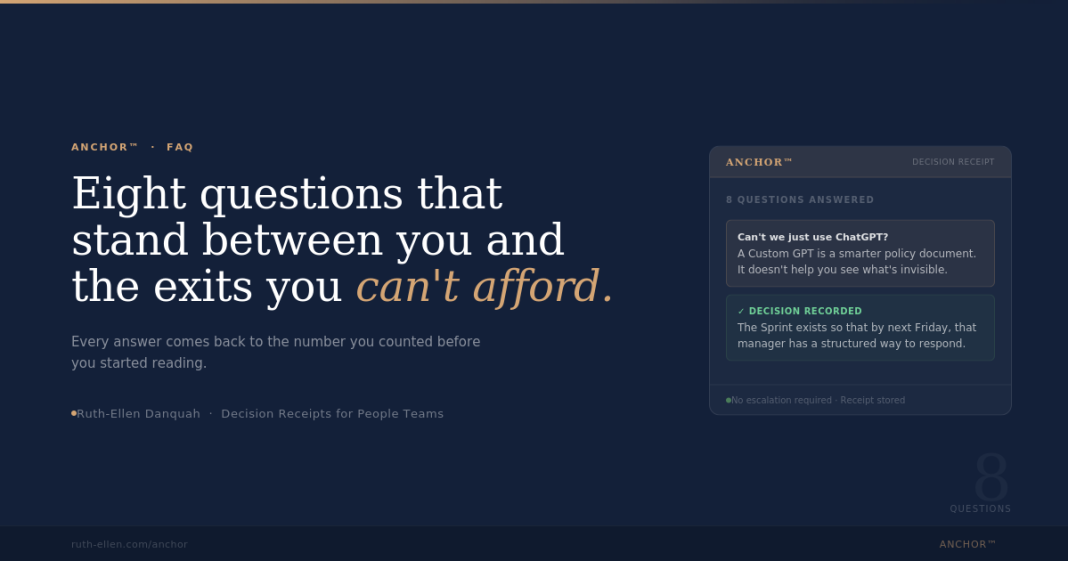
Eight Questions That Stand Between You and the Exits You Can’t Afford
Ruth-Ellen Danquah | Creator, ANCHOR™ Decision Support for People Teams
Before you read any further, answer one question honestly.
In the last six months, how many people have left your organisation where the manager said afterwards: “I didn’t know what to do”, “I was waiting for HR to come back to me”, or “I didn’t think I was allowed to make that call”?
If the answer is zero, this post probably isn’t for you. If it’s one or more, you already know what ANCHOR™ is for — even if you haven’t seen it yet.
The exits people notice come from manager hesitation. But most start earlier — with something the employee said out loud that should have been a signal but wasn’t recognised as one.
- “I find meetings really draining.”
- “I work better when I have things in writing.”
- “I’m struggling to keep on top of everything.”
- “Is there another way I could do this?”
These aren’t complaints. They’re adjustment requests in plain language. But without structured support, the manager hears “difficult,” “unmotivated,” or “not coping” — and responds with performance feedback instead of exploring what the employee actually needs.
Here’s what happens next, and your People team will recognise this pattern instantly: the employee stops asking. They came in loud — they raised it, they were specific, they even suggested solutions. But the response they got taught them it wasn’t safe to keep asking. So they go quiet. And quiet gets mistaken for “resolved.” The manager moves on. HR never hears about it. Three months later, the resignation arrives and everyone says they “never saw it coming.”
They saw it. They just didn’t recognise it. The signals were in the first conversation, not the last.
The Invisible Gap
A manager prided themselves on keeping their 1:1s fluid — no agenda, no structure, just an open conversation. The employee liked it too. They’d agreed to it. It felt like trust. But without structured prompts, barriers went unraised — not because the employee was hiding them, but because neither person had a reason to surface them. The workload concern didn’t get mentioned because it didn’t feel urgent enough for a free-flowing chat. The environmental issue didn’t come up because there was no question that invited it. Everything felt fine. The employee left four months later.
This is the retention gap that training doesn’t reach. It’s not always a missed request or an ignored complaint. Sometimes it’s the absence of the right question at the right moment — the awareness that never gets triggered because nothing in the conversation prompts it. ANCHOR doesn’t wait for the employee to raise the barrier. It prompts the manager to look for it.
The Misread Request
A People Partner at a financial services firm told me about an analyst who’d asked three times for meeting agendas in advance. His manager thought he was being controlling. She gave him feedback about “flexibility.” He handed in his notice on a Friday afternoon. Her response: “I didn’t know I was allowed to just send him the agenda.”
That’s the gap ANCHOR closes — whether the employee asked loudly and was misheard, or never had a reason to ask at all. I help Heads of People cut manager escalations by 40% in 10 weeks — without middle managers blocking it, or you having to prove ROI six months later.
Not with more training. Not with another policy. With structured support that helps managers hear what employees are actually saying — and surface what nobody thought to ask about.
These are the questions I hear most from Heads of People before they pilot. Every answer comes back to the number you just counted.
1. “Can’t we just do this with AI ourselves?”
This is the question I’m most glad people ask, because it means they’re taking it seriously. And the answer depends on what “this” means to you. So let me address both versions.
“We’ll just use ChatGPT.”
THE SCENARIO
A team lead at a tech company tells their manager they’re struggling to keep up with Slack messages and feel like they’re missing critical decisions.
What a manager does with ChatGPT:
Pastes the situation in. Gets a paragraph suggesting they “set boundaries around communication channels” and “consider asynchronous updates.” Reasonable advice. The manager reads it, feels slightly more informed, and does… roughly what they would have done anyway. There’s no record it happened. No framing around whether this might be a processing speed difference, an attention regulation issue, or simply a volume problem. No prompt to ask what this person does exceptionally well before deciding how to respond.
With ANCHOR:
In under 60 seconds, the scenario is classified (Adjustment, medium urgency, reversible). The framing surfaces that “struggling to keep up” could mean three different things — and the manager’s assumption about which one determines whether their response helps or harms. Five targeted questions prompt the manager to consider information processing preferences, workload versus capacity, and what’s already working before they act. The Decision Receipt timestamps what was surfaced and what was decided.
The difference isn’t the quality of advice. It’s whether the employee gets a considered response today, or silence while the manager works out what they’re allowed to do. One keeps people. The other is why your best talent updates their LinkedIn on a Sunday evening.
“We’ve already built a Custom GPT with our policies uploaded.”
Good — that tells me your organisation takes this seriously enough to have invested time in it. The output probably looks impressive: a branded chatbot that references your ER policy, your reasonable adjustments guidance, maybe your OH referral pathway. A manager asks a question and gets a policy-aligned answer.
A Custom GPT is a smarter policy document. It helps the manager find the right paragraph faster. It doesn’t help them see what they’re missing.
It doesn’t classify, it gives answers instead of surfacing what’s invisible, uploading a policy isn’t configuring guardrails, there’s no governance trail, and there’s no pattern intelligence. Each GPT conversation is isolated. Nobody is aggregating the patterns. ANCHOR’s Decision Receipts accumulate to surface where your retention risk actually lives — which teams, which scenario types, which gaps in manager capability.
Your Custom GPT was a good instinct. ANCHOR is what turns that instinct into a retention system.
2. “What does this actually look like in practice?”
THE SCENARIO
“I’ve suggested tools and solutions to help the employee manage their workload, but they seem hesitant to try them. I want to give constructive feedback that builds their confidence rather than causing them to withdraw.”
Without ANCHOR:
This manager would likely provide direct feedback about the employee’s reluctance to engage with the suggested tools. The conversation would focus on what the employee isn’t doing, not on what might be making the tools inaccessible in the first place. Repeated unsuccessful suggestions gradually erode the employee’s confidence. Within a few months, they’re either underperforming or gone.
With ANCHOR:
The framing immediately surfaces the question the manager hasn’t asked: what specific behaviours are they interpreting as “hesitance,” and could those behaviours indicate something other than reluctance? The manager who entered this scenario told us afterwards that question two — about what might be making the tools feel challenging — completely reframed how they approached the conversation. They hadn’t considered that the issue wasn’t motivation. It was method. The employee is still there.
3. “How is this different from the inclusion training we’ve already invested in?”
Your managers attended training six months ago. This morning, a senior developer told their line manager they’re finding open-plan noise unbearable. What does that manager actually do in the next ten minutes?
Training gave them principles. Principles don’t retain people — action does.
The gap between knowing and doing, under pressure, with a real person in front of you, is where most exits are born. Your investment in training isn’t wasted. But it’s incomplete without support at the point of decision. ANCHOR meets the manager at that gap — not in a refresher session next quarter, but at the moment the employee’s experience is being shaped.
4. “Our InfoSec team won’t approve AI tools that process employee data.”
They shouldn’t. And ANCHOR doesn’t ask them to.
ANCHOR is scenario-based, not identity-based. A manager describes a situation: “The employee gets overwhelmed in meetings.” No name. No employee ID. No protected characteristic data. The tool works on the situation, not the person. Decision Receipts record what was surfaced and what was decided — not who the employee is.
This matters for retention because the alternative is already happening: managers doing nothing because they’re unsure what’s compliant. ANCHOR removes the excuse by never requiring the data in the first place.
5. “We’ve got 300+ managers. What if they don’t use it?”
Managers don’t adopt tools because they’re mandated to. They adopt tools that remove friction from decisions they’re already struggling with. Right now, your managers are already facing these scenarios and already hesitating. The question isn’t whether they’ll use something that gives them clarity in under 60 seconds. It’s what happens to the employee during the weeks they hesitate without it.
The pilot is deliberately scoped to a small group — People Partners plus a manager cohort — so you can measure adoption before scaling to 300.
In my experience, the adoption problem isn’t getting managers to use it. It’s that once they do, they stop escalating to your People team first — which is exactly the capacity shift you need.
TRY IT YOURSELF FIRST:
Managers can try ANCHOR free at ruth-ellen.com/anchor/handle-escalations/ — no sign-up, no commitment. The adoption question tends to answer itself.
6. “My team is already stretched. We can’t take on another implementation.”
The stretch you’re describing is the symptom. Every routine decision that escalates to your People team — “can I offer this person compressed hours?”, “what am I allowed to do about the noise complaint?”, “should I refer to OH or handle it myself?” — is time your team isn’t spending on the retention strategy, workforce planning, and inclusion work that would actually prevent exits.
There’s no system to integrate, no training programme to schedule, no LMS to configure. A manager describes a scenario, gets framing, decides. The Sprint takes seven days. If it doesn’t work, you’ve spent £1,000 and one diagnostic call. If it does, you’ve just bought back hours of your team’s week.
7. “How do I get this past Legal and Procurement?”
I designed ANCHOR to be un-blockable by the internal gatekeepers that kill good ideas in slow organisations.
For Legal:
ANCHOR doesn’t give legal advice. It doesn’t diagnose conditions. It prompts reflection and documents that reflection happened. Clear disclaimers are built in. The Decision Receipt actually strengthens their position by creating evidence that adjustments were considered at the point of decision, not reconstructed after a claim.
For Procurement:
The Sprint is £1,000. In most organisations between 200 and 5,000 employees, that’s below the threshold that triggers formal procurement. One buyer decision. One PO. If it works, the £5,000 pilot follows with data to support the business case.
While you’re waiting for internal approval, your employees are forming views about whether this organisation is worth staying at.
8. “What’s the ROI?”
One avoidable exit of a mid-level professional in London costs £40,000–£80,000 when you factor in recruitment, onboarding, ramp-up time, and the institutional knowledge that walked out the door. A tribunal award for failure to make reasonable adjustments averages £27,000+ before legal costs.
THE MATHS
One avoidable exit: £40,000–£80,000
One tribunal claim: £27,000+
The Sprint: £1,000
The Pilot: £5,000
But the ROI that never appears on a spreadsheet is the one that matters most to your team: the hours recovered when managers stop escalating every uncertain decision. That’s capacity going back to retention strategy, workforce planning, and the culture work that prevents the next round of exits.
Retention isn’t one decision. It’s whether your organisation has a system that makes considered action the default, every time.
Download the Decision Audit to see three real UK tribunal cases — the decision the manager made, what ANCHOR would have surfaced in under 60 seconds, and the retention cost of the gap between the two.
Back to the number you counted
At the top of this post, I asked you how many people have left in the last six months where the manager didn’t know what to do.
Each of those exits cost your organisation £40,000–£80,000. Each one displaced hours of your People team’s strategic work. Each one told the remaining team that this is an organisation where raising a concern leads to silence.
Right now — while you’re reading this — one of your managers is sitting on the next one. They’re not being negligent. They’re unsupported. They don’t know what they’re allowed to do, so they’re doing nothing. And the employee is drawing conclusions from the silence.
The Sprint exists so that by next Friday, that manager has a structured way to respond — and the employee has a reason to stay.
Book the £1,000 Sprint
Seven days. Three scenarios. A go/no-go decision.
Not ready to spend £1,000 yet?

