LATEST ARTICLES

BAFTA 2026: When Disability Inclusion Planning Failed Black Attendees

Michael B. Jordan and Delroy Lindo walked onto the stage at the 79th BAFTA Film Awards to present the first award of the night.

They are two celebrated Black actors at the peak of their careers. Their film, Sinners, was the most nominated of the evening. Director Ryan Coogler would go on to become the first Black man to win the BAFTA for best original screenplay. It should have been a triumphant night.

Instead, as they stood on stage at the Royal Festival Hall, someone in the audience shouted the N-word at them.

Lindo paused. Then he continued. Because that’s what Black professionals are expected to do — absorb the impact, maintain composure, keep the show moving. He told Vanity Fair afterwards that he and Jordan “did what we had to do.” Then he added the part that should keep every events and People team awake at night: he wished someone from BAFTA had spoken to them afterwards.

Nobody did.

Here is the question that sits at the centre of this, and it’s the one nobody is asking:

“If an involuntary tic includes a racial slur directed at a Black presenter or attendee, what is our plan — in the room, on the broadcast, and afterwards?”

That question was never asked. And what follows is what that absence cost.


What happened at the 2026 BAFTAs — and what BAFTA knew beforehand

The person who shouted the slur was John Davidson, a Tourette syndrome campaigner and the subject of the BAFTA-nominated film I Swear. His tics are involuntary. He has no control over them. He has spent decades advocating for understanding of his neurotype. He has described feeling a “wave of shame” and has since reached out to apologise.

This is not a piece about Davidson. His tics are neurological. They are not a reflection of his beliefs or character. That is medically established and not in dispute.

This is a piece about BAFTA. About the BBC. About every organisation that plans for the comfort of inclusion but not for the harm that can follow when the structure isn’t stress-tested.

Because here’s what was known before the ceremony started:

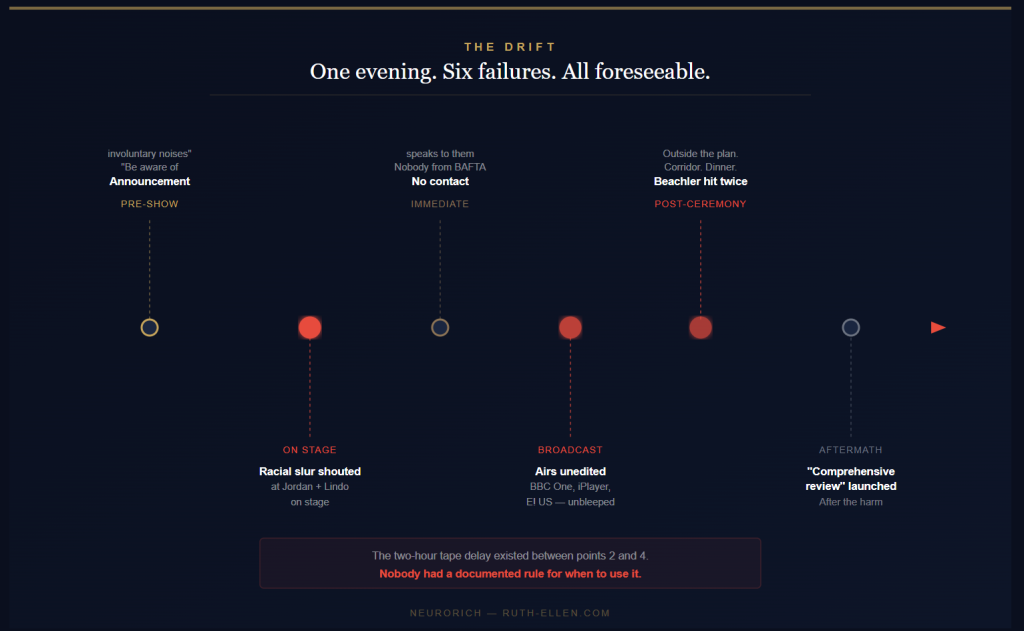
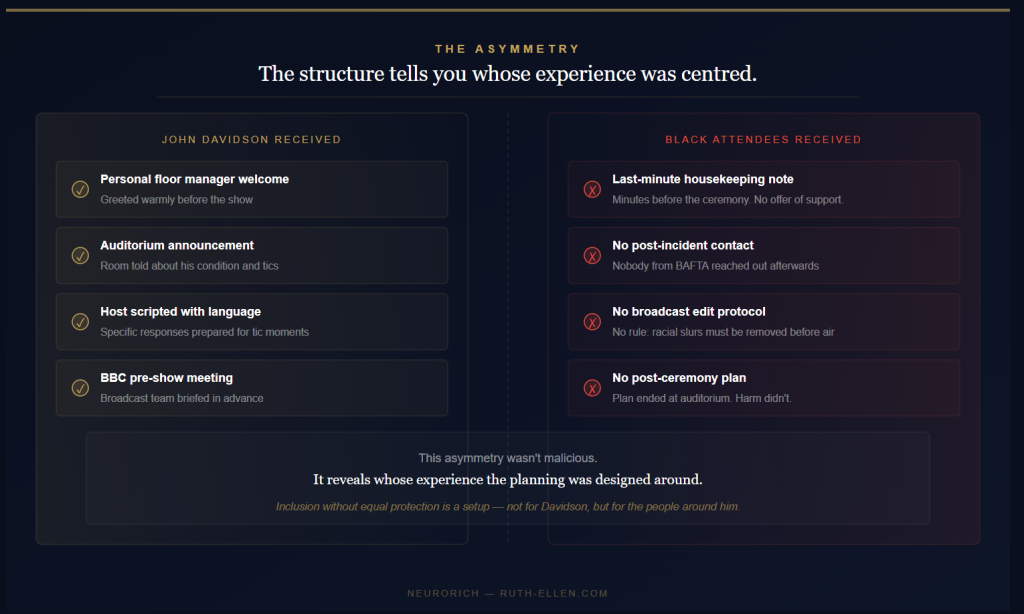
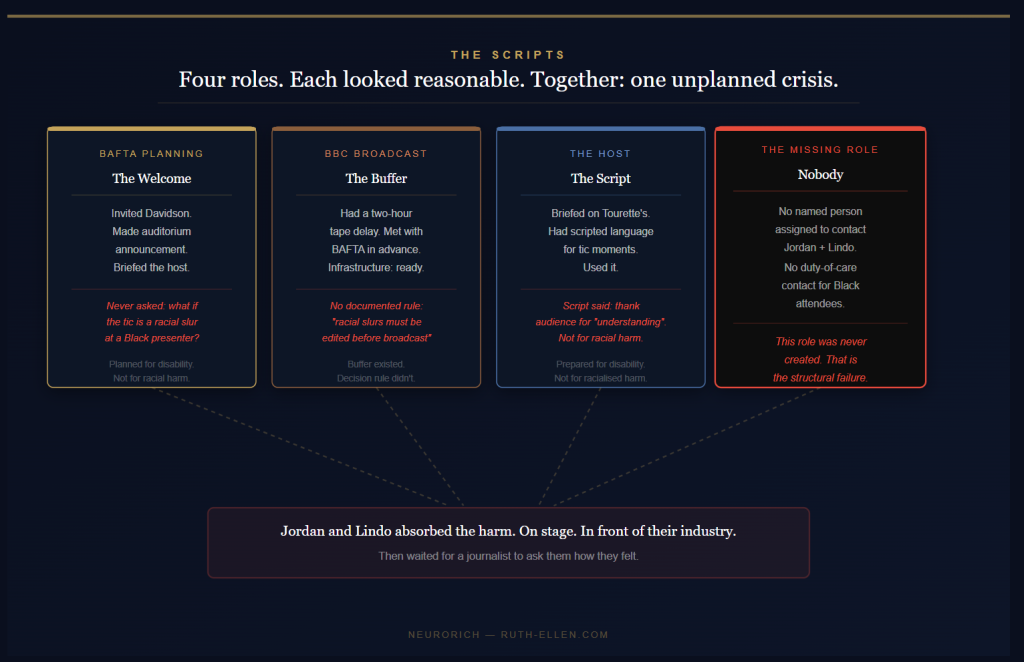
BAFTA knew Davidson would be in the auditorium. They knew his neurotype involves involuntary vocal tics, including expletives. The BBC had met with BAFTA in advance to discuss what might happen if he swore during the broadcast. A floor manager welcomed Davidson warmly before the show. An announcement was made to the auditorium: “John has Tourette’s Syndrome, so please be aware you might hear some involuntary noises or movements during the ceremony.”

Presenters were informed about Davidson’s tics just minutes before the ceremony began.

The intent was clear. The planning was genuine. The welcome was warm.

And none of it accounted for what actually happened.


The harm that the BAFTA inclusion plan didn’t address

Here is what the planning didn’t address:

It didn’t address the possibility that an involuntary tic might include a racial slur. Not a generic expletive — a word that carries centuries of dehumanisation, directed at Black people, shouted while two Black men stood on stage in front of their peers.

It didn’t address what would happen to the people on stage when that word was spoken. There was no protocol for reaching out to Jordan and Lindo afterwards. No one from BAFTA contacted them. Lindo had to say it himself, at an afterparty, to a journalist.

It didn’t address what the broadcast team should do. The ceremony was recorded with a two-hour tape delay — a buffer specifically designed for situations like this. The BBC had the capacity to edit the slur out before it aired. They didn’t. It went out on BBC One. It went out on iPlayer. It stayed on iPlayer for fifteen hours. It aired unbleeped on E! in the United States. Warner Bros. reportedly contacted the BBC to request the slur be removed. It still took until the following afternoon.

It didn’t address what would happen beyond the auditorium. Production designer Hannah Beachler, who was nominated for her work on Sinners, reported that she also experienced Davidson’s involuntary racial slurs — once directed at her on the way to dinner after the show, and once at another Black woman. Three incidents in one evening. All after the ceremony. All outside whatever containment the auditorium announcement was supposed to provide.

And it didn’t address the apology. Host Alan Cumming thanked the audience for their “understanding” and apologised if “anyone was offended.” Beachler called it a “throw-away apology” that made the situation worse. Journalist Jemele Hill named the pattern plainly: the expectation was that Black people should be okay with being disrespected and dehumanised so that other people don’t feel bad.

That’s not a failure of intent. BAFTA clearly intended to be inclusive. That’s a failure of structure. They planned for understanding. They didn’t plan for harm.


Disability and race are not competing values

One of the most damaging things about this incident is how quickly it was framed as a binary: either you support Davidson and understand Tourette’s, or you support Jordan and Lindo and condemn what happened.

That framing is false. And it lets the institution off the hook.

Davidson’s tics are involuntary. That is a medical fact. He did not choose to say that word. People with Tourette syndrome deserve to attend public events without being told they should stay home.

Jordan and Lindo were subjected to a racial slur on one of the biggest stages in their industry. The harm they experienced is real regardless of whether the word was spoken intentionally. The impact of anti-Black language does not depend on the intent behind it. It lands in the body of the person it hits.

Both of these things are true at the same time.

This is where a principle that every People professional knows — but that BAFTA failed to apply — becomes critical: intention does not determine impact.

We teach this in every inclusion training. We say it in every workshop on psychological safety. The person who causes harm may not have intended to. The harm is still real. And the responsibility for closing the gap between intention and impact does not sit with the person who was harmed — it sits with the institution that created the conditions.

The job of the institution was to hold both truths simultaneously and build a structure that protected everyone. That meant including Davidson. And it meant having a concrete, documented plan for the specific harm that could result from that inclusion.


What a structured inclusion decision would have looked like

If someone in BAFTA’s planning team had run through a structured decision framework — not just “should we invite Davidson?” but “what are the foreseeable consequences of his attendance, and do we have a plan for each one?” — several things would have been different.

Seating and proximity. Davidson’s seating position relative to the stage and to microphones could have been assessed. His proximity to presenters during transitions could have been managed.

Presenter briefing. Jordan and Lindo were told about Davidson’s tics minutes before the ceremony. A proper briefing — private, respectful, with an offer of support if something occurred on stage — would have been different from a last-minute housekeeping note.

Broadcast protocol. The two-hour tape delay existed for exactly this purpose. A documented protocol stating “any involuntary language that includes slurs will be edited from the broadcast” should have been agreed in writing with the BBC before the ceremony started. The fact that it wasn’t is an institutional failure, not a technical one.

Post-incident contact. A named person should have been assigned to check in with anyone directly affected by a tic during the ceremony. Jordan and Lindo should not have had to wait for a journalist to ask them how they felt at an afterparty.

Post-ceremony plan. The auditorium announcement covered the ceremony. It didn’t cover the dinner, the afterparty, or the walk between venues — where Beachler and another Black woman experienced further slurs. If Davidson was attending post-ceremony events, the same planning needed to extend beyond the auditorium.

Documentation. Every one of these decisions — what was considered, what was agreed, who was responsible — should have been written down before the event. Not as a legal exercise. As evidence that the institution thought about everyone in the room, not just the person they were trying to include.

None of this would have excluded Davidson. All of it would have protected the people around him.

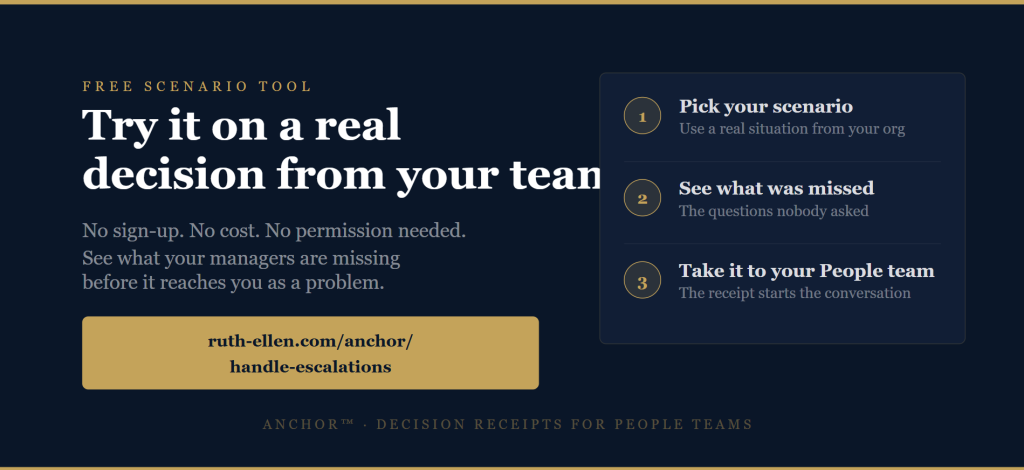
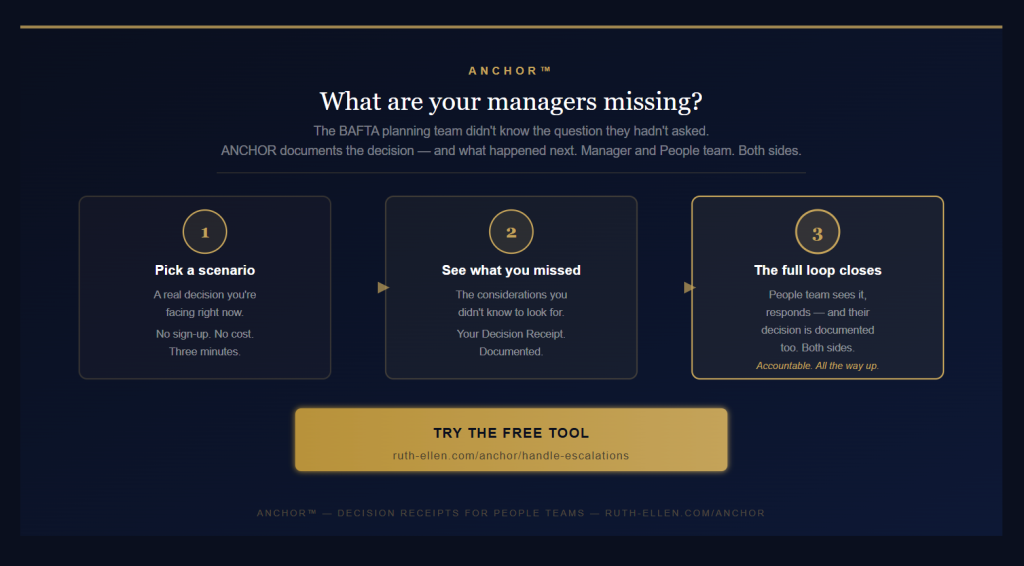
Try this on your own situation. If your organisation is planning an event or programme that involves neurodivergent colleagues, the free ANCHOR scenario tool walks you through the structured questions in three minutes — before the decision is

made, not after.


The six decisions BAFTA’s review probably won’t reach

BAFTA has launched a “comprehensive review.” That review will almost certainly address the obvious failures. But there are deeper structural decisions that most reviews don’t reach, because they require a different kind of thinking — not “what went wrong” but “what decisions were never made in the first place.”

The apology language problem. “Sorry if anyone was offended” centres the audience’s feelings, not the specific harm to specific people. There is a fundamental difference between a broadcast disclaimer and an acknowledgement of racialised harm. BAFTA needs a framework for knowing the difference — because the wrong language in the wrong moment doesn’t just fail to help. It makes things worse.

Who speaks to whom — and when. Nobody contacted Jordan or Lindo. But the question isn’t just “why didn’t someone reach out?” — it’s “who was designated to do it?” If no one was assigned, it’s not surprising no one acted. Someone needs to own this role before the event starts.

The boundary of the plan. BAFTA planned for the auditorium. The evening didn’t end at the auditorium. The plan’s boundary was the ceremony. The harm’s boundary was the entire night.

The tape delay decision authority. The BBC had a two-hour buffer. No one had a documented rule for when to use it. The infrastructure existed. The decision framework didn’t.

The consent and preparation asymmetry. Davidson received a warm personal welcome and a floor manager greeting. Jordan, Lindo, and every other Black attendee received a last-minute housekeeping note. The people most likely to be harmed received the least preparation, the least agency, and the least follow-up.

Having language ready for the false binary. Within hours, the public debate became “disability rights versus anti-racism.” BAFTA had no framework for holding both simultaneously. An institution that plans for inclusion should have that language ready before the event — not reactive statements drafted under pressure.


The structural question nobody is asking

There’s a deeper problem here. Davidson’s tics weren’t limited to one word or one moment. Over the course of the evening, he directed racial slurs at Jordan and Lindo on stage, at Beachler on the way to dinner, and at another Black woman separately. That is not one incident. That is a pattern across the entire evening.

And the institution treated all of these tics as if they were the same category of harm.

General expletives can be managed with a host acknowledgement and audience goodwill. A racial slur directed at Black attendees requires a different protocol — immediate private acknowledgement, a named duty-of-care contact, a broadcast edit decision, and post-event follow-up.

BAFTA had one tool. The evening required several.

The deeper question is why BAFTA had a plan for disability and no plan for race. Not because the planners were racist — but because disability inclusion was the narrative the institution was comfortable centring, and racial safety was treated as a problem that could be managed with a general announcement. That asymmetry — in briefing, in follow-up, in apology language — reveals whose experience the planning was designed around.

This maps onto a pattern that Black professionals across every industry recognise. The organisation invests deeply in one form of inclusion — and the people who bear the cost of its blind spots are disproportionately Black.


The cost of not planning — and what it means for your organisation

This case is not really about the BAFTAs. It is about every organisation that invites someone who is neurodivergent into a high-stakes environment and plans for the welcome but not for the full range of what might happen next.

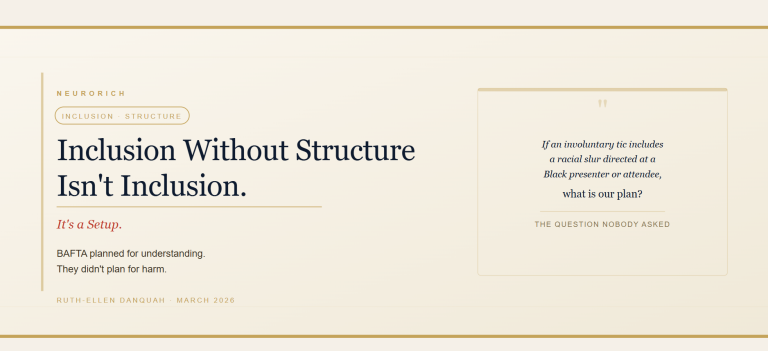
The uncomfortable truth is that inclusion without structure isn’t inclusion. It’s a setup. It sets up the person being included to become the centre of a crisis they didn’t cause. And it sets up the people around them to absorb harm that was entirely preventable.

The fix isn’t less inclusion. It’s better decision-making at the point the programme is designed. A documented plan. A structured framework. A paper trail showing that someone asked: “Who might be harmed, and what’s our plan for that?”

That’s what was missing at the BAFTAs. Variants of this gap play out in organisations every week — in events, in reasonable adjustment decisions, in return-to-work planning, in any situation where one person’s needs and another person’s protection need to be held simultaneously.

ANCHOR creates Decision Receipts for People teams — structured documentation at the point the decision is made, not after the crisis. ruth-ellen.com/anchor


Michael B. Jordan and Delroy Lindo deserved better. John Davidson deserved better. The Tourette’s community deserved better. And better was available — it just needed to be planned for.


Ruth-Ellen Danquah is the founder of ANCHOR™ and writes about the gap between good intentions and good decisions at NeuroRich on Substack.


FAQ schema (add to page for SEO)

Q: What happened at the BAFTAs 2026? A: John Davidson, a Tourette syndrome campaigner whose neurotype includes involuntary vocal tics, attended the 79th BAFTA Film Awards. During the ceremony, he involuntarily shouted a racial slur while Black presenters Michael B. Jordan and Delroy Lindo were on stage. The BBC broadcast the moment unedited despite a two-hour tape delay. Nobody from BAFTA contacted Jordan or Lindo afterwards.

Q: Was John Davidson at fault for the BAFTA incident? A: Davidson’s tics are neurological and involuntary — he had no control over them. The structural failure was BAFTA’s: they planned for neurotype awareness but had no documented protocol for what to do if an involuntary tic included a racial slur directed at Black attendees.

Q: What should BAFTA have done differently? A: Six decisions were never made: a documented broadcast edit protocol, a named duty-of-care contact for Black attendees, a proper presenter briefing for Jordan and Lindo, a post-ceremony plan covering events beyond the auditorium, specific apology language for racialised harm, and prepared framing for holding neuroinclusion and racial inclusion simultaneously.

Q: How does this apply to workplace inclusion planning? A: Every organisation that includes neurodivergent colleagues in high-stakes environments faces the same structural question: have you planned for the welcome, or have you also planned for the full range of foreseeable harm? Structured decision frameworks help People teams document both before the moment of crisis.

ANCHOR™ FAQ Roundup

Eight Questions That Stand Between You and the Exits You Can’t Afford

Ruth-Ellen Danquah  |  Creator, ANCHOR™ Decision Support for People Teams

Before you read any further, answer one question honestly.

In the last six months, how many people have left your organisation where the manager said afterwards: “I didn’t know what to do”, “I was waiting for HR to come back to me”, or “I didn’t think I was allowed to make that call”?

If the answer is zero, this post probably isn’t for you. If it’s one or more, you already know what ANCHOR™ is for — even if you haven’t seen it yet.

The exits people notice come from manager hesitation. But most start earlier — with something the employee said out loud that should have been a signal but wasn’t recognised as one.

  • “I find meetings really draining.”
  • “I work better when I have things in writing.”
  • “I’m struggling to keep on top of everything.”
  • “Is there another way I could do this?”

These aren’t complaints. They’re adjustment requests in plain language. But without structured support, the manager hears “difficult,” “unmotivated,” or “not coping” — and responds with performance feedback instead of exploring what the employee actually needs.

Here’s what happens next, and your People team will recognise this pattern instantly: the employee stops asking. They came in loud — they raised it, they were specific, they even suggested solutions. But the response they got taught them it wasn’t safe to keep asking. So they go quiet. And quiet gets mistaken for “resolved.” The manager moves on. HR never hears about it. Three months later, the resignation arrives and everyone says they “never saw it coming.”

They saw it. They just didn’t recognise it. The signals were in the first conversation, not the last.

The Invisible Gap

A manager prided themselves on keeping their 1:1s fluid — no agenda, no structure, just an open conversation. The employee liked it too. They’d agreed to it. It felt like trust. But without structured prompts, barriers went unraised — not because the employee was hiding them, but because neither person had a reason to surface them. The workload concern didn’t get mentioned because it didn’t feel urgent enough for a free-flowing chat. The environmental issue didn’t come up because there was no question that invited it. Everything felt fine. The employee left four months later.

This is the retention gap that training doesn’t reach. It’s not always a missed request or an ignored complaint. Sometimes it’s the absence of the right question at the right moment — the awareness that never gets triggered because nothing in the conversation prompts it. ANCHOR doesn’t wait for the employee to raise the barrier. It prompts the manager to look for it.

The Misread Request

A People Partner at a financial services firm told me about an analyst who’d asked three times for meeting agendas in advance. His manager thought he was being controlling. She gave him feedback about “flexibility.” He handed in his notice on a Friday afternoon. Her response: “I didn’t know I was allowed to just send him the agenda.”

That’s the gap ANCHOR closes — whether the employee asked loudly and was misheard, or never had a reason to ask at all. I help Heads of People cut manager escalations by 40% in 10 weeks — without middle managers blocking it, or you having to prove ROI six months later.

Not with more training. Not with another policy. With structured support that helps managers hear what employees are actually saying — and surface what nobody thought to ask about.

These are the questions I hear most from Heads of People before they pilot. Every answer comes back to the number you just counted.

1. “Can’t we just do this with AI ourselves?”

This is the question I’m most glad people ask, because it means they’re taking it seriously. And the answer depends on what “this” means to you. So let me address both versions.

“We’ll just use ChatGPT.”

THE SCENARIO

A team lead at a tech company tells their manager they’re struggling to keep up with Slack messages and feel like they’re missing critical decisions.

What a manager does with ChatGPT:

Pastes the situation in. Gets a paragraph suggesting they “set boundaries around communication channels” and “consider asynchronous updates.” Reasonable advice. The manager reads it, feels slightly more informed, and does… roughly what they would have done anyway. There’s no record it happened. No framing around whether this might be a processing speed difference, an attention regulation issue, or simply a volume problem. No prompt to ask what this person does exceptionally well before deciding how to respond.

With ANCHOR:

In under 60 seconds, the scenario is classified (Adjustment, medium urgency, reversible). The framing surfaces that “struggling to keep up” could mean three different things — and the manager’s assumption about which one determines whether their response helps or harms. Five targeted questions prompt the manager to consider information processing preferences, workload versus capacity, and what’s already working before they act. The Decision Receipt timestamps what was surfaced and what was decided.

The difference isn’t the quality of advice. It’s whether the employee gets a considered response today, or silence while the manager works out what they’re allowed to do. One keeps people. The other is why your best talent updates their LinkedIn on a Sunday evening.

“We’ve already built a Custom GPT with our policies uploaded.”

Good — that tells me your organisation takes this seriously enough to have invested time in it. The output probably looks impressive: a branded chatbot that references your ER policy, your reasonable adjustments guidance, maybe your OH referral pathway. A manager asks a question and gets a policy-aligned answer.

A Custom GPT is a smarter policy document. It helps the manager find the right paragraph faster. It doesn’t help them see what they’re missing.

It doesn’t classify, it gives answers instead of surfacing what’s invisible, uploading a policy isn’t configuring guardrails, there’s no governance trail, and there’s no pattern intelligence. Each GPT conversation is isolated. Nobody is aggregating the patterns. ANCHOR’s Decision Receipts accumulate to surface where your retention risk actually lives — which teams, which scenario types, which gaps in manager capability.

Your Custom GPT was a good instinct. ANCHOR is what turns that instinct into a retention system.

2. “What does this actually look like in practice?”

THE SCENARIO

“I’ve suggested tools and solutions to help the employee manage their workload, but they seem hesitant to try them. I want to give constructive feedback that builds their confidence rather than causing them to withdraw.”

Without ANCHOR:

This manager would likely provide direct feedback about the employee’s reluctance to engage with the suggested tools. The conversation would focus on what the employee isn’t doing, not on what might be making the tools inaccessible in the first place. Repeated unsuccessful suggestions gradually erode the employee’s confidence. Within a few months, they’re either underperforming or gone.

With ANCHOR:

The framing immediately surfaces the question the manager hasn’t asked: what specific behaviours are they interpreting as “hesitance,” and could those behaviours indicate something other than reluctance? The manager who entered this scenario told us afterwards that question two — about what might be making the tools feel challenging — completely reframed how they approached the conversation. They hadn’t considered that the issue wasn’t motivation. It was method. The employee is still there.

3. “How is this different from the inclusion training we’ve already invested in?”

Your managers attended training six months ago. This morning, a senior developer told their line manager they’re finding open-plan noise unbearable. What does that manager actually do in the next ten minutes?

Training gave them principles. Principles don’t retain people — action does.

The gap between knowing and doing, under pressure, with a real person in front of you, is where most exits are born. Your investment in training isn’t wasted. But it’s incomplete without support at the point of decision. ANCHOR meets the manager at that gap — not in a refresher session next quarter, but at the moment the employee’s experience is being shaped.

4. “Our InfoSec team won’t approve AI tools that process employee data.”

They shouldn’t. And ANCHOR doesn’t ask them to.

ANCHOR is scenario-based, not identity-based. A manager describes a situation: “The employee gets overwhelmed in meetings.” No name. No employee ID. No protected characteristic data. The tool works on the situation, not the person. Decision Receipts record what was surfaced and what was decided — not who the employee is.

This matters for retention because the alternative is already happening: managers doing nothing because they’re unsure what’s compliant. ANCHOR removes the excuse by never requiring the data in the first place.

5. “We’ve got 300+ managers. What if they don’t use it?”

Managers don’t adopt tools because they’re mandated to. They adopt tools that remove friction from decisions they’re already struggling with. Right now, your managers are already facing these scenarios and already hesitating. The question isn’t whether they’ll use something that gives them clarity in under 60 seconds. It’s what happens to the employee during the weeks they hesitate without it.

The pilot is deliberately scoped to a small group — People Partners plus a manager cohort — so you can measure adoption before scaling to 300.

In my experience, the adoption problem isn’t getting managers to use it. It’s that once they do, they stop escalating to your People team first — which is exactly the capacity shift you need.

TRY IT YOURSELF FIRST:

Managers can try ANCHOR free at ruth-ellen.com/anchor/handle-escalations/ — no sign-up, no commitment. The adoption question tends to answer itself.

6. “My team is already stretched. We can’t take on another implementation.”

The stretch you’re describing is the symptom. Every routine decision that escalates to your People team — “can I offer this person compressed hours?”, “what am I allowed to do about the noise complaint?”, “should I refer to OH or handle it myself?” — is time your team isn’t spending on the retention strategy, workforce planning, and inclusion work that would actually prevent exits.

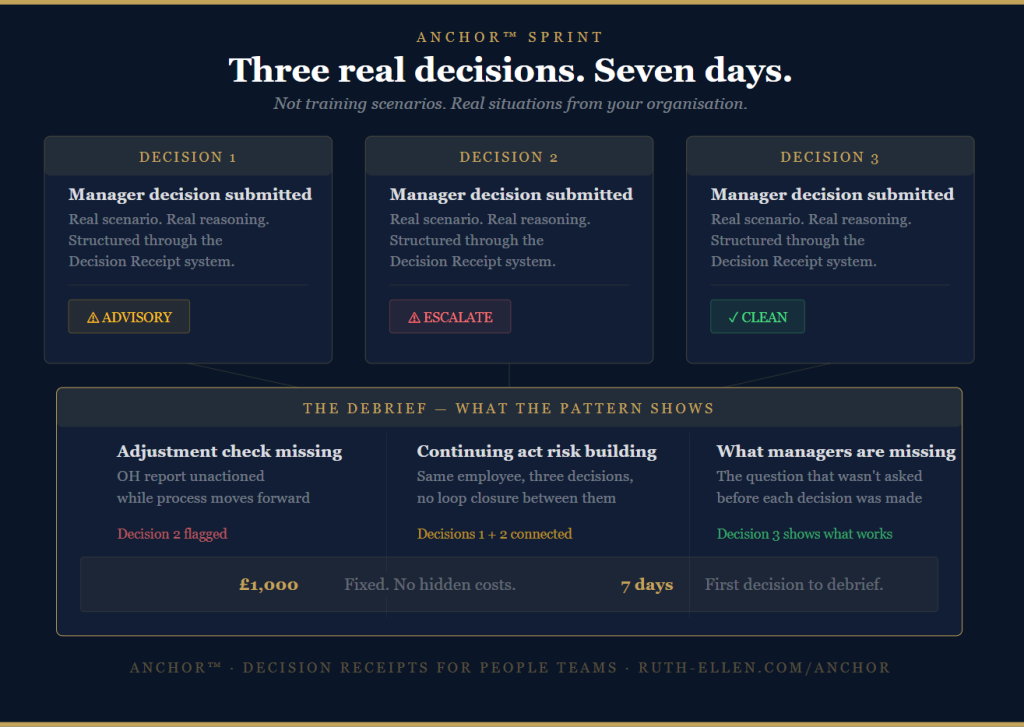
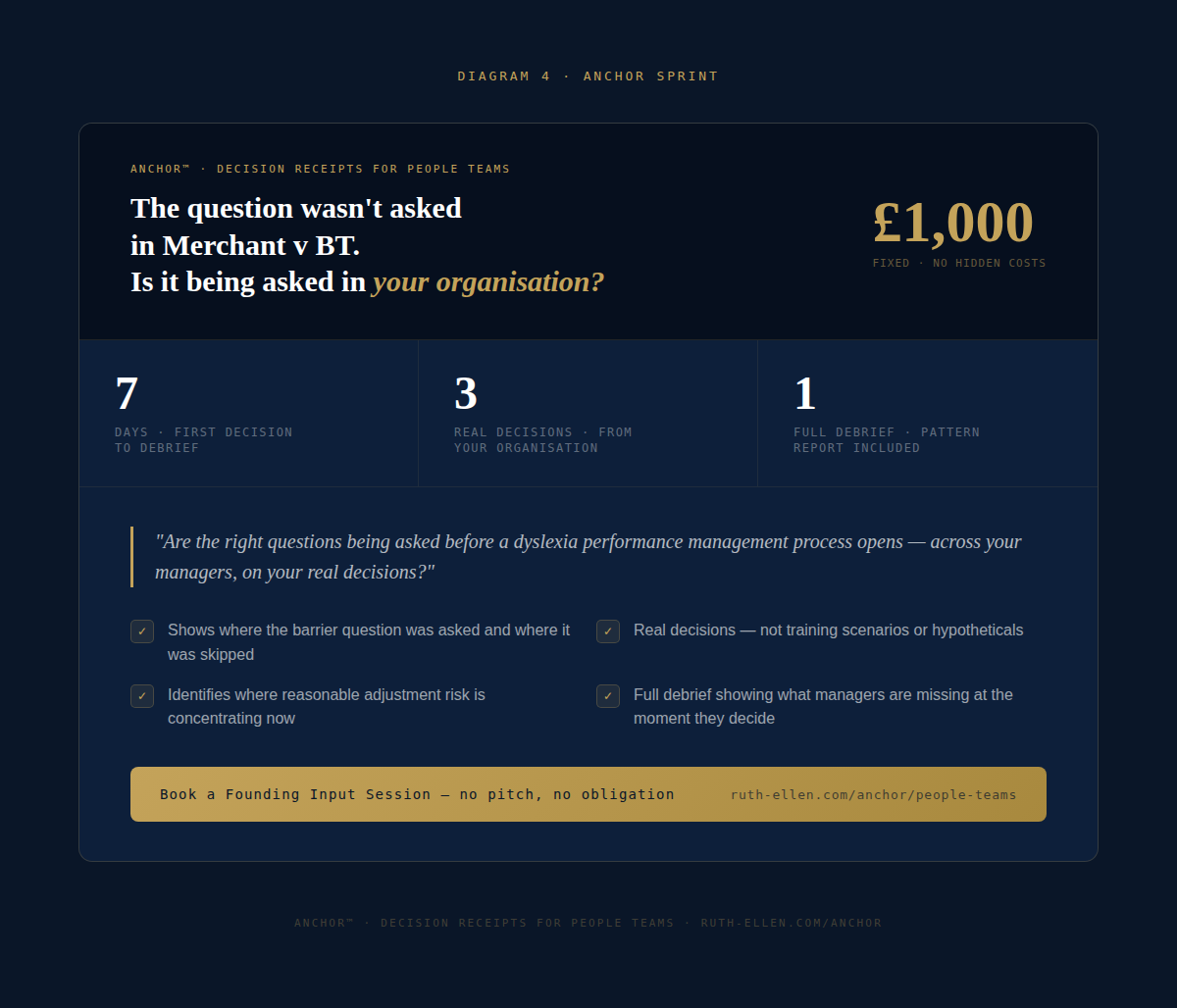
There’s no system to integrate, no training programme to schedule, no LMS to configure. A manager describes a scenario, gets framing, decides. The Sprint takes seven days. If it doesn’t work, you’ve spent £1,000 and one diagnostic call. If it does, you’ve just bought back hours of your team’s week.

7. “How do I get this past Legal and Procurement?”

I designed ANCHOR to be un-blockable by the internal gatekeepers that kill good ideas in slow organisations.

For Legal:

ANCHOR doesn’t give legal advice. It doesn’t diagnose conditions. It prompts reflection and documents that reflection happened. Clear disclaimers are built in. The Decision Receipt actually strengthens their position by creating evidence that adjustments were considered at the point of decision, not reconstructed after a claim.

For Procurement:

The Sprint is £1,000. In most organisations between 200 and 5,000 employees, that’s below the threshold that triggers formal procurement. One buyer decision. One PO. If it works, the £5,000 pilot follows with data to support the business case.

While you’re waiting for internal approval, your employees are forming views about whether this organisation is worth staying at.

8. “What’s the ROI?”

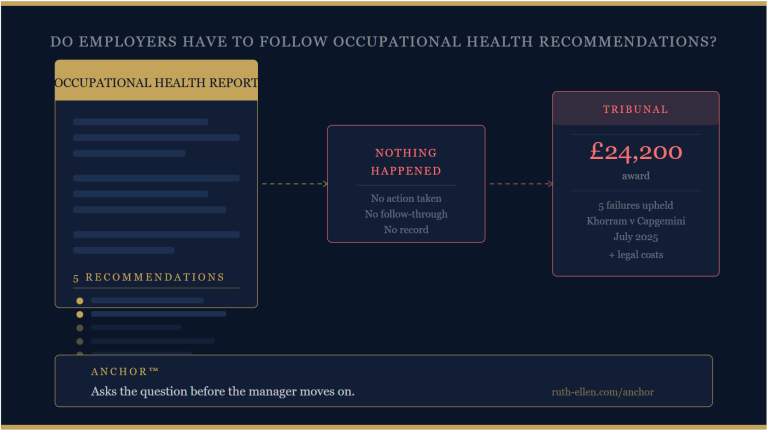
One avoidable exit of a mid-level professional in London costs £40,000–£80,000 when you factor in recruitment, onboarding, ramp-up time, and the institutional knowledge that walked out the door. A tribunal award for failure to make reasonable adjustments averages £27,000+ before legal costs.

THE MATHS

One avoidable exit: £40,000–£80,000

One tribunal claim: £27,000+

The Sprint: £1,000

The Pilot: £5,000

But the ROI that never appears on a spreadsheet is the one that matters most to your team: the hours recovered when managers stop escalating every uncertain decision. That’s capacity going back to retention strategy, workforce planning, and the culture work that prevents the next round of exits.

Retention isn’t one decision. It’s whether your organisation has a system that makes considered action the default, every time.

Download the Decision Audit to see three real UK tribunal cases — the decision the manager made, what ANCHOR would have surfaced in under 60 seconds, and the retention cost of the gap between the two.

Back to the number you counted

At the top of this post, I asked you how many people have left in the last six months where the manager didn’t know what to do.

Each of those exits cost your organisation £40,000–£80,000. Each one displaced hours of your People team’s strategic work. Each one told the remaining team that this is an organisation where raising a concern leads to silence.

Right now — while you’re reading this — one of your managers is sitting on the next one. They’re not being negligent. They’re unsupported. They don’t know what they’re allowed to do, so they’re doing nothing. And the employee is drawing conclusions from the silence.

The Sprint exists so that by next Friday, that manager has a structured way to respond — and the employee has a reason to stay.

Book the £1,000 Sprint

Seven days. Three scenarios. A go/no-go decision.

ruth-ellen.com/anchor

Not ready to spend £1,000 yet?

Book the free 30-minute call

Join the free monthly webinar

Try ANCHOR free (managers)

The Open Plan Problem Nobody’s Solving

A manager made a clean decision in under ten minutes. Here’s what she did differently.


He mentioned it on a Thursday.

Not formally. Not in a meeting. Not in an email with HR copied in. He said it at the end of a 1:1, the way people always say the thing that matters most — quietly, almost as an afterthought, already half-standing to leave.

“I don’t know if this is even a thing, but — the open plan is really getting to me. I can’t concentrate. By 2pm I’ve got nothing left.”

He said it like he was apologising. Like admitting the office was too loud was the same as admitting he couldn’t do his job.

And this is the moment.

Right here. This exact second. This is the decision point that determines whether this becomes a clean decision or a tribunal case file eighteen months from now.


What Most Managers Do

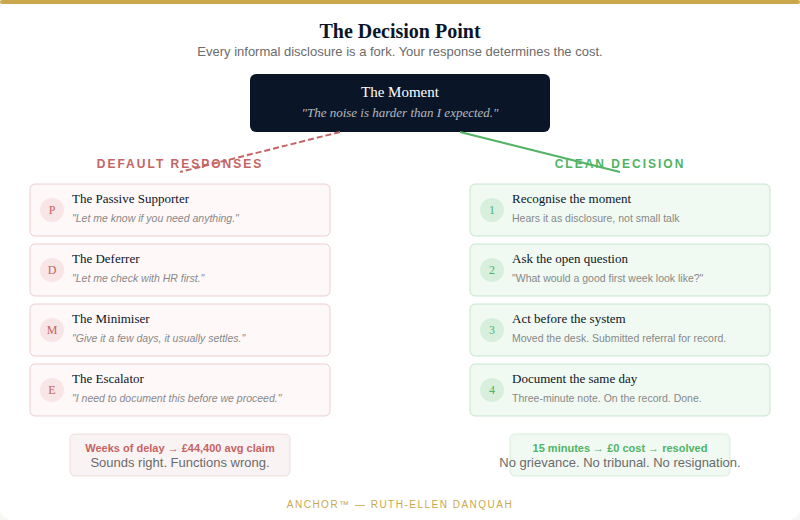
Most managers hear “the open plan is getting to me” and their brain runs one of four scripts:

Script 1: Minimise. “Yeah, it’s noisy for everyone. You get used to it.” The employee hears: my experience doesn’t count. He stops mentioning it. He starts masking. Three months later his performance dips and nobody connects it to this conversation.

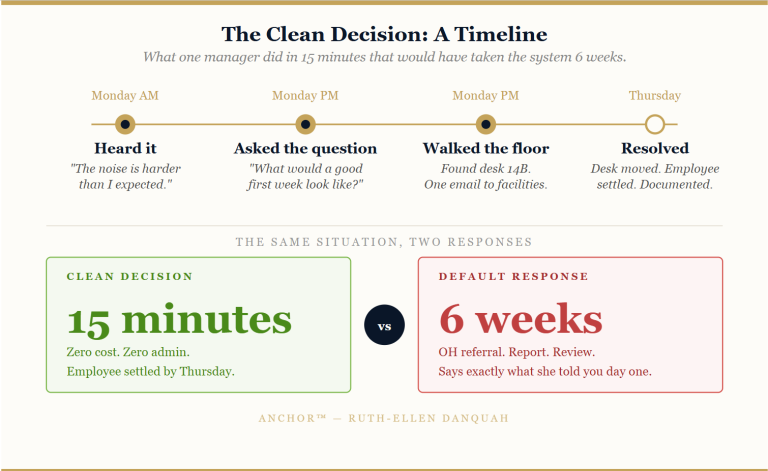
Script 2: Defer. “Let me speak to HR about that.” The manager sends an email. HR adds it to a list. Someone suggests an Occupational Health referral. The referral takes six weeks. OH recommends adjustments. The recommendations sit in someone’s inbox. Four months pass. Nothing changes.

Script 3: Sympathise. “I totally get it — I struggle with noise too. Have you tried noise-cancelling headphones?” The employee now has to solve his own problem with a suggestion that may or may not work, while the manager feels helpful without having done anything structural.

Script 4: Freeze. “Okay. Thanks for letting me know.” Then silence. The manager doesn’t know what they’re allowed to do, what requires a formal process, or whether this counts as a disclosure. So they do nothing. And nothing, as always, is the most expensive decision a manager can make.

All four scripts have something in common. In none of them does the manager do the one thing that would have made a difference: act, right now, in the room, and write it down.


What This Manager Did Instead

Her name doesn’t matter. What matters is what she did in the ten minutes after he said “the open plan is really getting to me.”

She didn’t minimise. She didn’t defer. She didn’t sympathise. She didn’t freeze.

She asked one question.

“Is there anything about how we’re set up here that I could change this week to make it easier for you?”

Look at what that question does.

It doesn’t ask him to diagnose himself. It doesn’t ask him to name a condition. It doesn’t ask him to fill in a form or wait for an assessment. It focuses on the environment — “how we’re set up” — not on him. And it puts a timeline on it: “this week.” Not “at some point.” Not “when OH gets back to us.” This week.

He paused. Then he said: “Honestly? If I could work from the quiet room on the days I need to do deep focus work — Tuesdays and Thursdays — that would change everything. And maybe if I could wear headphones without people thinking I’m being antisocial.”

Two things. A quiet room twice a week. Permission to wear headphones.

No cost. No procurement. No six-week OH referral. No policy review. No committee.

She said: “Done. Let’s try it from next Tuesday. I’ll book the quiet room for you on Tuesdays and Thursdays for the next month, and I’ll mention to the team that headphones are fine for focus work — for everyone, not just you. We’ll check in after a month and see if it’s working. Sound good?”

He nodded. He looked relieved. Not because the solution was complicated. Because someone had actually done something.

The whole conversation took ten minutes.


Then She Did the Thing That Separates a Good Manager from a Clean Decision

She documented it.

Not because HR told her to. Not because she was covering herself. Because documentation is the thing that protects the employee, the manager, and the organisation — and it’s the thing that almost never happens after informal conversations.

Here’s what she wrote. It took three minutes:


Date: [Thursday’s date] Employee: [Name] Context: End of regular 1:1. [Name] mentioned difficulty concentrating in open plan environment. Described feeling depleted by early afternoon.

Discussion: Asked what changes to our setup might help. [Name] requested access to quiet room on Tuesdays and Thursdays for deep focus work, and permission to use headphones during concentration periods.

Action taken: Booked quiet room for Tuesdays and Thursdays for the next four weeks. Will normalise headphone use for the whole team during focus time. Review scheduled for [date one month from now].

No formal referral requested or required at this stage. [Name] did not disclose a specific condition and was not asked to. Adjustments are based on workplace environment, not medical need.

Next review: [date]


Read that last line again. “Adjustments are based on workplace environment, not medical need.”

That’s the sentence that changes everything.

She didn’t wait for a diagnosis. She didn’t need one. She didn’t ask “do you have a condition?” or “have you been assessed?” or “should we do an OH referral?” She responded to what he actually said: the open plan is getting to me. And she solved the environment problem.

If he does have an underlying condition — ADHD, autism, anxiety, sensory processing differences, anything — this note becomes the evidence that the organisation responded promptly and appropriately at the first indication of a barrier. If a formal process happens later, this is the document that shows the manager didn’t wait. She acted.

And if he doesn’t have a diagnosed condition? If the open plan is just hard for him because open plans are hard for a lot of people? The adjustments still make sense. A quieter space for focus work and permission to wear headphones aren’t medical interventions. They’re good management.

The documentation protects everyone either way.


Why the Documentation Matters More Than the Adjustment

I study tribunal cases. Hundreds of them. And the pattern is always the same.

It’s never that the organisation didn’t care. It’s rarely that the adjustment was expensive or complicated. It’s almost always that one of two things happened:

Nobody wrote it down. The conversation happened. The manager said something supportive. Maybe they even made a verbal agreement. But six months later, when things have escalated, there’s no record. The employee says “I told them in June.” The manager says “I don’t remember the specifics.” The tribunal sees a gap.

Everybody waited. The manager referred it to HR. HR referred it to OH. OH sent a questionnaire. The questionnaire came back with recommendations. The recommendations went to the manager. The manager wasn’t sure how to implement them. Another email to HR. By the time anything happened, it was four months later, the employee’s performance had been flagged, and someone had started a capability process for the very thing the adjustment was supposed to prevent.

The manager in this story did neither of those things. She acted in the room and she wrote it down the same day.

That’s a clean decision.


The ANCHOR Method in Ten Minutes

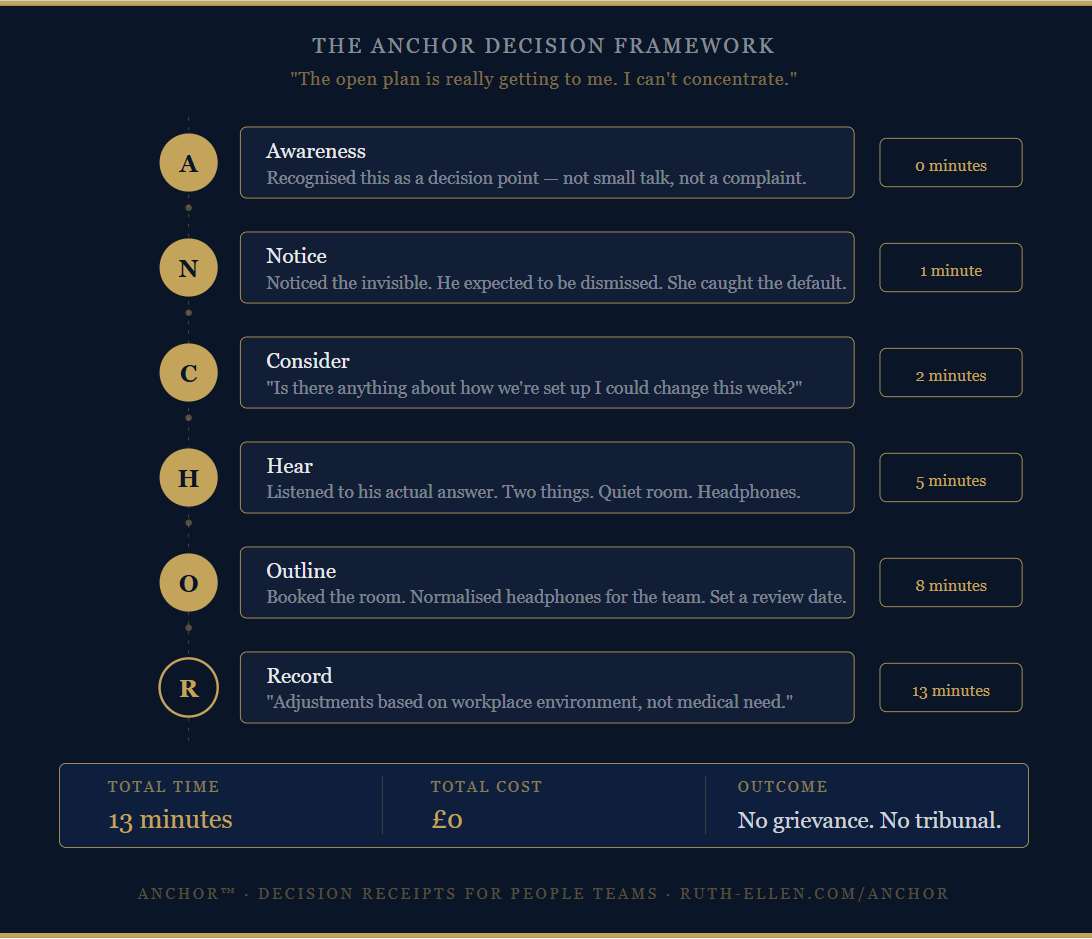
What this manager did — probably without knowing it — was the ANCHOR decision-framing method in real time:

A — Awareness. She recognised this as a decision point. Not admin. Not a complaint. Not something to “keep an eye on.” A moment where her response would determine what happened next.

N — Notice. She noticed what was invisible. He was apologising for having a need. He expected to be dismissed. The default response (“yeah, it’s noisy for everyone”) was right there, ready to come out of her mouth. She caught it.

C — Consider. She asked the question she didn’t know she needed to ask. “Is there anything about how we’re set up that I could change this week?” — not “what’s wrong with you?” or “should I refer you to OH?”

H — Hear. She listened to his actual answer. Two things. Quiet room. Headphones. She didn’t add complexity. She didn’t ask for more information than she needed. She heard what he said and took it at face value.

O — Outline. She framed the action. Booked the room. Normalised headphones for the whole team. Set a review date. Simple. Immediate. Reversible if it doesn’t work.

R — Record. She documented it. Three minutes. Clear, factual, focused on the environment. Protected him, protected her, protected the organisation.

Ten minutes from disclosure to action. Three minutes to document. No OH referral. No four-month delay. No grievance. No tribunal.


The Question You Should Be Asking

If you’re a Head of People, an HR Director, or anyone responsible for how managers make people decisions in your organisation, here’s the question:

How many of your managers would have made the same decision this woman made?

Not “would they have cared?” — of course they care. Not “do they know the policies?” — they’ve done the e-learning. Not “are they good people?” — they are.

Would they have asked that specific question, in that specific moment, and documented it that same day?

If the answer is “some of them” or “I’m not sure” or “probably not,” that’s the gap. And the gap is costing you more than you think.

Every open plan office in the country has someone sitting in it right now who mentioned something three months ago that nobody acted on. Someone who’s masking. Someone whose performance is about to dip. Someone who’s going to leave — and when they do, the exit interview will say “personal reasons,” and nobody will connect it to the conversation that went nowhere in September.


What I Built to Close the Gap

The ANCHOR Manager Development Programme is a six-module programme that teaches managers to do what this woman did — instinctively, consistently, at every decision point.

Not one good conversation. Every conversation. Not when they’ve had time to prepare. In the moment.

Three phases. Nine steps. Ninety days.

Recognise — see the gap, map the defaults, understand what they’re costing. Reframe — replace defaults with structured questions, practise until the words feel natural. Lead — embed the practice, sustain the quality, prove it’s working.

The programme builds the capability. The ANCHOR tool sustains it after I leave the room. The dashboard proves it’s working — escalations down, clean decisions up, measurable.

All programmes invoiced directly. A conversation first — because that’s the whole point.

ruth-ellen.com/anchor


That manager made a clean decision in ten minutes. It cost nothing. It protected everyone. And it started with one question: “Is there anything about how we’re set up that I could change this week?”

What would your managers have said instead?

Listen. Learn. Lead.


Ruth-Ellen Danquah is the creator of the ANCHOR™ Manager Development Programme and the NeuroRich™ newsletter. She has delivered over 600 leadership programmes to global organisations across financial services, gaming, insurance, FMCG, and the cultural sector. She writes weekly about the gap between good intentions and good decisions at NeuroRich on Substack.

What Most Leaders Get Wrong About AI and Their Workforce

Reading time: 5 minutes

Every leadership team I speak to right now is asking the same question: what do we do about AI?

Most of them are getting the answer wrong. Not because they’re not intelligent — they are. But because they’re framing the question incorrectly.

The dominant narrative goes something like this: AI will automate tasks, so we need to identify which roles are at risk, upskill people into new capabilities, and maybe reduce headcount along the way. It’s a workforce planning problem with a technology trigger.

This framing is dangerously incomplete.

The real question isn’t about automation

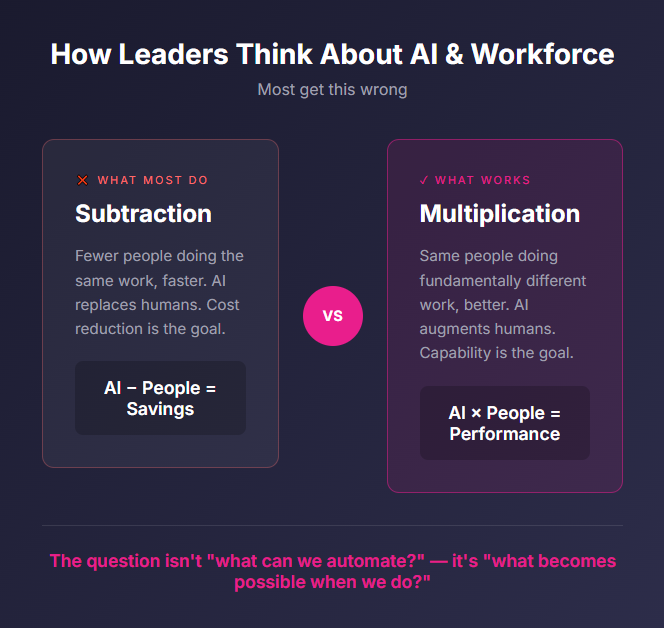
Yes, AI will automate certain tasks. That’s already happening. But the strategic question for leaders isn’t “what can we automate?” — it’s “what becomes possible when we do?”

When you automate administrative load, you don’t just save costs. You change the nature of the work that remains. You shift what you need from your people. You alter which capabilities matter.

Most organisations are still thinking in subtraction: fewer people doing the same work, faster. The opportunity is in multiplication: the same people doing fundamentally different work, better.

Three mistakes I see repeatedly

First, leaders are delegating AI strategy to IT or digital transformation teams. This treats AI as a technology implementation problem. It isn’t. It’s a people strategy problem with technology implications. The CPO should be as central to this conversation as the CTO.

Second, upskilling programmes are being designed in a vacuum. Organisations are rushing to train people on “AI tools” without first answering: what do we actually need people to be brilliant at in three years? Capability building without strategic clarity is just activity.

Third, the human implications are being treated as change management. As if this is just another transformation to be “landed” with comms and engagement plans. What’s actually happening is a fundamental renegotiation of the relationship between people and work. That requires a different kind of leadership.

What the best organisations are doing differently

The leadership teams getting this right are asking a different set of questions:

Where does human judgement remain essential — and how do we protect and develop it?

What capabilities become more valuable, not less, in an AI-enabled environment?

How do we build an organisation that can continuously adapt — not just to this wave, but to the next five?

They’re also being honest about what they don’t know. The leaders I trust most right now are the ones saying: “We’re building the plane while flying it. Here’s how we’re making decisions in uncertainty.”

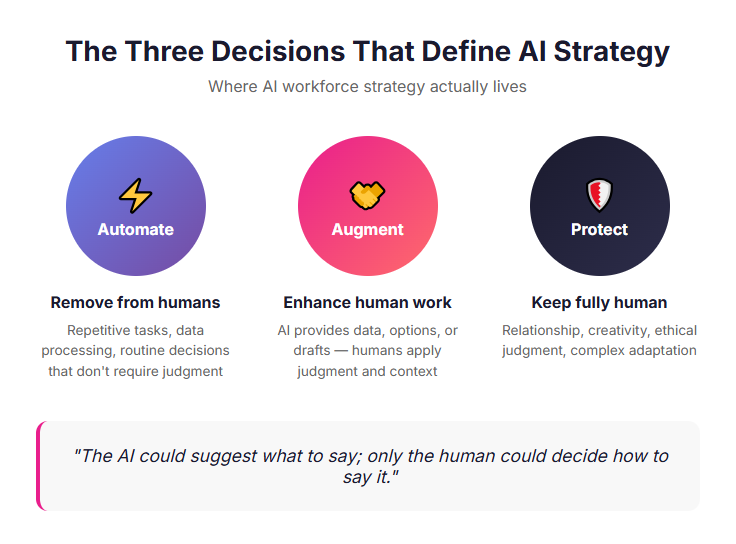
Framework: The Three AI Workforce Decisions

The people function has to lead, not follow

This is the moment for HR and People leaders to step forward — not as implementers of someone else’s strategy, but as architects of how the organisation will work in the future.

That means bringing a clear point of view to the boardroom. It means challenging assumptions about what AI will and won’t do. It means designing talent systems that are genuinely adaptive, not just responsive.

AI will reshape how organisations operate. The question is whether your people strategy shapes that future — or just reacts to it.

The organisations that get this right won’t just survive the AI era. They’ll define it.

Why Shaming ADHD Entrepreneurs Fails — and What Actually Works

I keep noticing something when I work with ADHD entrepreneurs and creatives, and when I reflect on my own history:


People still believe shaming ADHD entrepreneurs will spark change.


They think if they point out every mistake, every missed deadline, every moment of “inconsistency”… we’ll somehow fix ourselves.

They call it “accountability.”
They frame it as “being supportive.”

But here’s the truth:
Shame doesn’t build consistency.
It fractures self-trust.
It doesn’t create momentum.
It collapses it.

And the damage it leaves behind is far deeper than one missed project or one forgotten task.
It seeps into your self-image.
It rewires your nervous system to expect punishment for simply being human.


Let me show you what I mean.

When I was with my ex, it started small.
A late reply.
An unpaid bill.
A forgotten errand.

Each one became an interrogation:

  • “You’re unreliable.”
  • “If you cared, you’d do better.”
  • “You’ll never succeed if you keep this up.”

At first, I thought they were helping me.
I thought shame was the medicine and consistency was the cure.
So I masked harder.
Pushed myself through exhaustion.
Pretended I could outwork my wiring.

But the harder I pushed, the more I froze.
The more I masked, the more disconnected I became — from my goals, from my joy, from myself.

Because when shame surrounds you, even trying feels dangerous.
Every new attempt feels like another opportunity to fail — and to be judged for it.

Eventually, trying at all feels like stepping into an ambush you already know you won’t survive.


And it goes deeper still.

The most damaging shame isn’t what others place upon you.
It’s the shame you internalise — until it feels like your own voice inside your head.

You stop needing anyone else to criticise you.
You do it yourself:

  • You freeze more.
  • You dismantle your self-trust.
  • You bleed your limited energy into survival, not growth.
  • You stop asking for help, even when you desperately need it.
  • You shrink your dreams to fit the size of your current self-doubt.

You start seeing your ambition as a liability.
You start seeing your brilliance as a burden.
And you start seeing your future as something smaller, safer, quieter than it was ever meant to be.


This is why I build differently.

Inside Scaling Simplified™ with AI, we don’t just rebuild your business operations.
We rebuild the way your nervous system relates to success.

When you apply, we work together to:

  • Build your ADHD-friendly lead-to-client system — so leads qualify, book, and follow-up automatically, without your constant input.
  • Align your offers with your real energy — so you stop burning out trying to deliver work that was never capacity-matched.
  • Create plug-and-play content systems that make showing up possible even on your hardest days.
  • Design your personal Momentum Map™ — your customised sabotage-rescue blueprint for when old patterns try to pull you backwards.
  • Save 5–10 hours a week by automating the most draining parts of your visibility, admin, and lead generation.

We don’t force you into someone else’s system.
We build systems around your real rhythms, your real energy, your real brilliance.

We make it safe to trust yourself again.


If you say yes…

You wake up to qualified leads already waiting on your calendar — without anxiety about “keeping up.”
You price and sell your offers in ways that honour your energy — not the guilt and shame you were conditioned to feel.
You show up visibly — not perfectly, but powerfully — because your business no longer demands masking to succeed.
You stop spiralling when life inevitably wobbles, because your systems catch you before you fall.
You finally create sustainable momentum — the kind that carries you even when motivation disappears.

In 30 days, you could be standing inside a business that holds you steady — not a business that demands you betray yourself daily to survive.


Ready?

Click here to apply.

Here’s what happens after you apply:

  1. Complete a short application to share a little about where you’re stuck and what you want to create.
  2. Within 24–48 hours, I’ll personally review your application and respond via email.
  3. If it’s a good fit, you’ll receive a private invitation to book your Kickoff Clarity Call — where we map your first energy-safe quick wins together.
  4. If it’s not the right fit, you’ll still receive a personalised Momentum Plan — clear next steps designed to support your goals, whether we work together or not.

There is no pressure to perform.
No expectation to be “ready.”
Only an invitation to remember what it feels like to be supported by systems that finally match your brain, your energy, and your truth.

Because building a business that fits you is not about working harder.
It’s about working with yourself — not against yourself — for the first time.

The door is open.
The work is ready.
And the next version of you — visible, regulated, powerful — is closer than you think.

Click to apply.
Your next chapter starts here.

Why ADHD Entrepreneurs Lose Momentum (And How To Finally Stop Ghosting Your Own Goals)

If you’re an ADHD entrepreneur, losing momentum probably feels like an embarrassing secret.

You start strong — full of energy and ideas — only to watch your consistency collapse when real life happens.

This isn’t a mindset problem. It’s a system problem.

In this post, I’m sharing why ADHD entrepreneurs lose momentum (even when things should be working) — and how to create business systems that help you stay visible, consistent, and supported without burning yourself out.

I see it all the time.

Brilliant, creative, passionate ADHD entrepreneurs who start strong — only to watch their momentum collapse overnight.

→ They stop posting.
→ They disappear from their own goals.
→ They blame their inconsistency.
→ They spiral into shame.

Sound familiar?

Here’s what I need you to know:

This isn’t a willpower problem.

It’s a system design problem.


Why Momentum Never Lasts for ADHD Entrepreneurs

ADHD brains don’t struggle because they’re lazy or unmotivated.

They struggle because most business systems are built for productivity culture — not for people whose energy, focus, and nervous systems move in cycles.

The reality is:

If your business only works when you’re in hyperfocus…
It doesn’t actually work.

And this is exactly why so many ADHD entrepreneurs:

→ Ghost their own launches
→ Abandon social media for weeks
→ Feel allergic to their own offers
→ Start believing they are the problem (instead of their systems)


I Break It All Down In This Video:

In this YouTube video, I’m sharing:

  • Why self-trust collapses so easily for ADHD entrepreneurs
  • The real reason momentum never sticks (even when things are working)
  • The invisible pattern behind ghosted launches & disappearing acts
  • And how to build a business that holds you — even on foggy, frozen, or low-energy days

Watch Now: Why ADHD Entrepreneurs Keep Losing Momentum (And How To Build A Business That Actually Holds You)

What Happens When You Build Brain-Safe Systems?

This is what I help my clients create inside Scaling Simplified™ — my 30-day 1:1 experience built for ADHD entrepreneurs who are done ghosting their goals.

Inside, we co-create:

🧠 Systems that remember for you (so you can stop relying on hyperfocus)
⚡ Automation that filters dream clients while you rest
💡 Offers built around your actual capacity — not your masked self


Ready To Rebuild Your Business Around Your Brain (Not Your Burnout)?

→ Apply for Scaling Simplified™ here → https://ruth-ellen.com/wwm/

→ DM me the word “SIMPLIFY” on Instagram → https://instagram.com/theruthellen

Because your business should hold you — not hurt you.

And scaling should feel like an exhale… not another cycle of burnout.

ADHD & Social Media & The Scroll Spiral

Why Social Media Feels Like A Time-Sucking Black Hole (And The One Rule That Gets You Out)

Let’s talk about ADHD & social media

You know that moment when you open Instagram just to check your DMs…

And suddenly it’s 45 minutes later.

Your energy’s gone.
Your brain feels foggy.
Your ideas feel like they’ve evaporated.

You close the app feeling smaller than when you opened it.

This isn’t you being bad at boundaries.
This isn’t laziness or lack of discipline.

This is social media doing exactly what it was designed to do — and your ADHD brain responding exactly as it’s built.

The Myth:

“Just get off your phone. Set better limits. Use screen time blockers.”

Sounds good in theory.

But for ADHD entrepreneurs?

That advice completely ignores the real issue.

ADHD & Social Media

The Truth:

ADHD brains aren’t struggling because of “bad habits.”

They’re struggling because social media is built to:
→ Hijack your dopamine pathways
→ Bypass your time awareness
→ Flood you with novelty, comparison, and distraction triggers

And ADHD brains?
We’re wired to chase novelty + reward faster than neurotypical brains.

Not because we’re weak.
Because we’re built to seek stimulation, pattern recognition, and connection.

Social media preys on that.

What Happens In The Scroll Spiral:

→ You open the app with a purpose (DM check, content post).
→ The feed catches you.
→ You see someone doing what you do — only “better.”
→ You feel behind.
→ You question everything you’ve been working on.
→ You close the app feeling depleted and stuck.

This isn’t a mindset problem.

This is a system design problem.

ADHD-Friendly Social Media Isn’t About “Willpower.”

It’s about pre-deciding:
→ Your purpose before you open the app
→ Your exit plan before the scroll starts
→ Your visibility system so you don’t have to hang out online to get clients

This is exactly what we build inside Scaling Simplified™ with AI.

Not just content plans.

But nervous-system-safe visibility systems designed for:
→ Foggy brain days
→ Low energy days
→ Distraction-heavy environments

What This Looks Like Practically:

→ Pre-written content banks so you never start from zero
→ Follow-up automation that remembers for you
→ Closed-loop content rituals (so you can post + leave with pride)
→ Offer pathways that invite people to work with you while you rest

The One Thing I Want You To Try Today:

Before you open social media — ask yourself:

“What am I here to give — and what am I here to get?”

→ Am I here to post?
→ Am I here to connect?
→ Am I here to respond?
→ Am I here to rest or consume?

This is your exit strategy.

ADHD brains lose time on social because we enter without a purpose — and the algorithm fills that gap for us.

A 5-second pause to name your purpose will protect your energy more than any app blocker ever will.

And If You Know You Need More Than A 5-Second Rule…

If you’re ready to build a business that protects your energy — even after you close the app…

This is exactly what we do inside Scaling Simplified™ with AI.

→ Pre-built systems that remember for you
→ Offers designed for your real energy
→ Visibility strategies that don’t drain your nervous system

Apply here

Let’s rebuild a business that feels like an exhale — not a trap.

Your scroll spiral doesn’t mean you’re bad at business.

It means your environment was working against your brain — not with it.

And the good news?

That’s fixable.

P.S. Listen…

If you’ve been nodding along to this post — feeling seen, but also thinking:
“Yeah… but I never stick to things.”
“Yeah… but I always fall behind.”
“Yeah… but what if I invest and then ghost myself again?”

Please hear me on this:

I built Scaling Simplified™ with AI for that version of you.

The version who starts with energy and then gets hit with life.
The version who shows up strong — until you can’t.
The version who’s brilliant — but so tired of systems that forget how your brain actually works.

This isn’t a shiny productivity plan.
This isn’t another dopamine-spike idea you’ll abandon in a week.

This is a 30-day done-with-you business rebuild — designed to be impossible to fail.

Because I don’t let my clients build systems that rely on their perfect energy.

We build:

→ Systems that hold you on your messiest, lowest, foggiest days.
→ Offers that energise you without you having to perform.
→ Automated visibility loops that keep working when you can’t.

You will leave with a business that knows how to carry you.

Not because you suddenly fixed your brain.

But because we built it for your brain from day one.

ADHD Decision Paralysis: Why You Can’t Pick a Path (And How to Finally Move Without Burning Out)

ADHD decision paralysis is one of the most painful — and most misunderstood — struggles I see in entrepreneurs.

It’s that gut-wrenching moment where every option feels wrong.
Every next step feels like a risk.
Every choice feels like a future regret waiting to happen.

Not because you don’t know what you want.
Not because you’re flaky or inconsistent.

But because your brain — your brilliant, sensitive, pattern-seeking brain — is doing its best to protect you.

Your Brain Isn’t Broken — It’s Protecting You.

Let me guess…

You’ve mapped every scenario.
Planned every step.
Thought about every risk.

And still — you’re stuck.

Not because you’re bad at deciding.

But because every option feels like a trap door.

This isn’t indecision.
This is your nervous system doing its job.

“Just pick something. Take action. Clarity comes from doing.”

That’s the advice ADHD entrepreneurs hear over and over.

It sounds empowering.
It sounds practical.
It sounds harmless.

But here’s what nobody tells you…

For a neurodivergent brain — that advice isn’t neutral.

It’s dangerous.

Here’s what really happens when you force a decision from the wrong state:

Your brain floods with cortisol — the stress hormone.

Your body shifts into survival mode.

And you move from clarity to collapse.

→ Freeze (stuck, looping, planning endlessly)
→ Fawn (people-pleasing, picking what others expect)
→ Flight (abandoning your idea entirely)
→ Fight (over-working or perfectionism)

And sure — maybe you do pick something…

But not from self-trust.
Not from clarity.
Not from sustainability.

You pick from fear.

And here’s the real cost ADHD entrepreneurs know all too well:

→ You create an offer you can’t sustain.
→ You over-give until you’re depleted.
→ You ghost your own goals because the system you built feels unsafe to stay inside.

This isn’t because you’re flaky.

This is because your brain is smart.

Your nervous system remembers every decision that cost you:

→ Energy
→ Peace
→ Safety

And it whispers:
“Let’s not do that again.”

ADHD Decision Paralysis

This is why ADHD decision paralysis isn’t about poor planning.

It’s about pattern recognition.

Your brain isn’t confused.
It’s protecting you from another cycle of self-betrayal.

And the longer you stay stuck?

It’s not just time you lose.

It’s self-trust.

And often, what keeps ADHD entrepreneurs stuck here is a hidden self-sabotage loop they don’t even realise they’re in.


Learn how ADHD self-sabotage shows up — and how to break free — in this post

And without self-trust…

→ Consistency collapses.
→ Visibility dries up.
→ Momentum dies.

This is why I built the Capacity-Based Offer Matrix™ inside Scaling Simplified™ with AI.

Because clarity doesn’t come from pushing harder.

Clarity comes from creating safety.

From designing a system where your next decision feels like relief — not risk.

How It Works:

1. Map Energy Patterns — Not Just Goals

We start with:
→ What drains you fastest
→ What regulates you consistently
→ What energises you without the crash

Because clarity isn’t about ambition.
It’s about energy availability.

2. Create a Decision Hierarchy — Without Pressure

Most frameworks ask:
“What’s your big goal?”

Mine asks:
“What’s your next safe step?”

Safety creates momentum.

3. Build Offers You Can Actually Live Inside

We don’t build for your hyperfocus self.

We build for your real self — the one showing up on foggy, frozen, or flat days.

That’s the difference between a scalable business…


And an energetic trap.

Decluttering with ADHD: Practical Tips to Tackle Doom Piles and Maintain Order

This is how clients inside Scaling Simplified™ with AI stop getting stuck.

Together we create:

→ Systems that filter decisions before they flood the brain
→ Follow-up flows that remember for you
→ Content loops that work even when energy dips
→ Offers that feel like an exhale — not an obligation

You were never bad at deciding.

You’ve just never had a business designed for your nervous system.

Until now.

Ready to stop ghosting your own goals — and start building a business that feels like an exhale?

I only work with 3 ADHD entrepreneurs per month — because real support takes real attention.

Apply here

We won’t pick a path based on pressure.

We’ll pick the next safe step — together.

Your pace isn’t the problem.

Your system is.

Let’s rebuild it — for your brain, your business, and your peace.

P.S.

Scaling Simplified™ with AI isn’t a Notion template you’ll get excited about for 3 days… and then ghost when life happens.

It’s not another tool you have to remember to use.

This is a 30-day done-with-you experience where we rebuild your business to remember for you — even on the days your brain doesn’t want to.

Together, we co-create:

→ Systems that run quietly in the background (without needing your hyperfocus to keep them alive)
→ Offers that fit your energy — not drain it
→ A visibility plan that works on foggy, flat, or frozen days

This isn’t a dopamine spike.

This is a nervous-system-safe foundation that holds you — long after the initial motivation fades.

Because that’s what real sustainability feels like.

Apply here if you’re ready: https://ruth-ellen.com/wwm/

3 AI Systems You’ve Heard Of — Just Not Like This

I keep noticing something fascinating when I look at ADHD entrepreneurs who are trying to simplify their workflow…

They’re not beginners.
They’re not clueless.
They’re not lazy.

They’re brilliant and burned out.

They’ve built incredible things in bursts of genius — offers that work, communities that respond, content that lands.
But behind the scenes? The backend is duct-taped together with half-saved Notion templates and unread DMs.

Here’s what’s really happening:

It’s not that they lack strategy.
It’s that their systems only work when they’re “on.”
And when they’re not? Everything collapses — and so does their self-trust.

If that’s you, take this in:

You don’t need to try harder.
You need systems that can carry you when your energy crashes.
You need automation that protects your peace, not just your productivity.

So let’s rewrite the script.
Let’s take tools you’ve already met — and give them a new job:
🧠 Regulation. Capacity. Calm. Follow-through.

Here are 3 familiar AI tools you’ve probably used before — just not like this.


🔁 HACK 1: The DM Bot That Feels Like a Human Hug

Tool: ManyChat
New Role: Energy-protecting, emotionally safe pre-qualifier

✅ Filters leads gently using voice-aligned questions
✅ Offers a “Not Ready Yet?” flow — no pressure, just presence
✅ Follows up for you — even while you rest, crash, or unplug
✅ Feels like: finally not having to prove your worth to every lead


⚙️ HACK 2: The System That Celebrates You Back

Tool: Zapier
New Role: Co-regulation and invisible emotional support

✅ Sends YOU celebration pings when something works
✅ Reminds you of progress when the shame fog sets in
✅ Automates follow-ups and updates without overwhelm
✅ Feels like: having a quiet assistant who tracks your wins when you forget


🧠 HACK 3: Your Low-Spoon Creative Studio

Tool: ChatGPT + Notion
New Role: Gentle, fog-proof content repurposing

✅ Repurpose one idea into 5+ formats (posts, emails, captions, DMs)
✅ Organize content by energy level — Foggy / Brave / Fired-Up
✅ Use past-you’s brilliance to support future-you’s capacity
✅ Feels like: finally posting without performance pressure


🧘‍♀️ Why These Work When Others Don’t

They remove:

  • ✖️ Decision fatigue
  • ✖️ Follow-up dread
  • ✖️ “If I stop, everything stops” panic

They create:

  • ✅ Clarity without chaos
  • ✅ Momentum without masking
  • ✅ Systems that hold you — especially when you can’t

💡 Want This Built With You?

Let me hold the map while we build this for your real energy — not your ideal productivity self.

Inside Scaling Simplified™ with AI, we co-create:

🧠 Your ADHD-friendly lead-to-client flow
💌 A visibility system that keeps working when you don’t
✍️ A plug-and-play content bank for foggy, frozen, or flat-out days
🗺 A personalised Momentum Map™ that helps you stay regulated — without shame


📩 DM me on IG with the word SIMPLIFY and tell me:

✔️ What your business feels like right now
✔️ What’s draining your energy the most
✔️ What would feel like peace 30 days from now

✨ Just 3 spots/month — because real support takes real presence.

Let’s build a business that holds you when you’re tired, meets you when you’re scattered, and rises with you — exactly as you are.

No pressure. Just possibility.
💛 — Ruth-Ellen

ADHD Self-Sabotage: Why You’re Stuck in the Restart Loop (And How to Break Free)

If you’re tired of starting strong and losing steam a week later, you’re not alone—and you’re not broken. ADHD Self-sabotage feels like a constant loop for many ADHD brains, but it’s not because you’re lazy or careless. It’s because your brain’s wiring has its own quirks: rejection sensitivity, emotional overwhelm, impulsivity, and executive dysfunction all play a role.

These patterns aren’t your fault, but understanding them is the first step in breaking free from the restart cycle. You’ll learn why the clean slate you crave often leaves you stuck and how to create real momentum without burning out.

Ready to rewrite the story? It’s time to work with your brain, not against it. Join The Momentum Club for ADHD-friendly strategies that actually stick.


P.S. Curious for more tools? Check out our Rejection Sensitivity Journal for insights designed with ADHD in mind.

Understanding the Link Between ADHD and Self-Sabotage

For many people with ADHD, self-sabotage isn’t just a bad habit—it’s a recurring theme woven into everyday experiences. Whether it’s procrastinating on a big goal, ghosting your own to-do list, or hitting reset on a project for the third (or tenth!) time, the struggle is strikingly common. But why? It comes down to four complex patterns linked to ADHD traits: rejection sensitivity, executive dysfunction, emotional dysregulation, and impulsivity. Let’s take a closer look at these underlying dynamics.

Rejection Sensitivity: Avoidance as a Defence Mechanism

Rejection Sensitivity Dysphoria (RSD) can feel like a spotlight shining directly on your insecurities, magnifying even minor criticisms into a full-blown fear of judgment. For ADHDers, it’s not just fear of messing up—it’s a deep dread of being misunderstood, dismissed, or outright rejected. And this dread can steer behaviours in ways that seem like self-sabotage.

Here’s how it plays out:

  • You procrastinate because if you don’t try, you can’t fail (or risk judgment).
  • You set smaller, safer goals, convincing yourself it’s “realistic.”
  • You bail on commitments before anyone else has the chance to critique your effort.

RSD makes avoidance feel logical, even protective, when in reality you’re building walls where bridges could be. Tools like The Rejection Sensitivity Journal can be life-changing, offering prompts and exercises to untangle emotional barriers and rewrite those self-critical scripts.

Executive Function Overload and the High Cost of Overwhelm

Imagine your brain as a chaotic filing cabinet where nothing is in the right folder. That’s what ADHD executive dysfunction often feels like. Planning, prioritising, and decision-making don’t come naturally, leaving you caught between doing too much and, paradoxically, doing nothing.

Here’s the spiral:

  1. You look at your endless to-do list and freeze.
  2. Deadlines loom, so you rush at the last minute.
  3. The result? A less-than-perfect effort you didn’t want in the first place. Shame creeps in, and before you know it, you’ve stopped midway to “start over fresh” instead.

But starting over isn’t always the solution—it’s often just part of the overload. Breaking big plans into bite-sized tasks is incredibly effective. Focus on achievable wins, even if they feel absurdly small (“write one email draft”). Start with 5-minute tasks to rebuild trust in your ability to follow through.

If decision paralysis is keeping you frozen in place, read this next: Why You Can’t Pick a Path (And How To Finally Move Without Burning Out).

The Emotional Floodgate: Dysregulation Leading to Resets

ADHD emotions don’t drip; they pour. A harsh word, an unexpected challenge, or even a moment of discomfort can send your brain spiralling. It’s like your emotional floodgate swings open, and suddenly a small hiccup feels like an insurmountable tsunami.

What happens next? Many people hit the “reset” button:

  • They quit before they’re fully derailed for fear of failing even harder.
  • They disengage entirely as a form of self-protection.
  • They tell themselves, “Next time will be different,” without addressing the root issue.

Instead of giving in to the flood of emotions, introducing grounding practices can be a game-changer. Create a “pause ritual”—step away, acknowledge what you’re feeling, and ground yourself through mindfulness or movement. For journaling enthusiasts, tailored prompts for emotional regulation can help process those overwhelming moments constructively.

The Dopamine Trap: How Impulsivity Fuels Restart Loops

Why does starting something new feel so irresistible—but sticking with it feels like wading through mud? For ADHD brains, this never-ending cycle isn’t about laziness or an inability to care; it’s about how our brains crave—and react to—dopamine. The neurochemical that governs pleasure and reward is both our muse and our downfall. Let’s explore the dynamics behind what I like to call “The Dopamine Trap.”

Why We Chase the Thrill of the Start

When you begin a new project—whether that’s downloading an app to organise your life, buying supplies for a big creative idea, or planning a fresh fitness routine—it feels incredible. That’s dopamine lighting up your brain like a firework. Novelty gives us the hit we’ve been craving.

But here’s the catch: Once the shine wears off, and the hard, repetitive part begins, dopamine levels take a nosedive. The excitement fades, the tasks feel tedious, and the urge to abandon ship kicks in. What’s more appealing: slogging through the messy middle or getting that dopamine rush again by starting over?

This is why impulsivity often masquerades as “new beginnings”—it’s not you being flaky; it’s your brain chasing its next fix. Research has even shown that ADHD is linked to disrupted dopamine pathways, making it harder to regulate attention and sustain focus source.

Impulsivity and the Restart Pattern

Impulsivity isn’t just a momentary lapse in judgment—it’s a pattern driven by your biology. One moment, you’re set on your current plan, and the next, a shiny new idea swoops in and knocks the wind out of your commitment. Sound familiar?

The problem is that this doesn’t just impact productivity; it chips away at self-trust. You tell yourself, “Next time, I’ll get this right.” But when next time comes, the same pattern repeats. Without addressing the root cause, it’s easy to spiral into the restart loop.

To break free, scaffolding is key. Instead of relying on willpower—which is draining anyway—structure your environment to manage impulsive tendencies. Apps like Focusmate or support spaces like The Momentum Club offer external accountability, a dopamine boost through collaboration, and just enough structure to keep you anchored.

Working With Your Brain (Instead of Against It)

You can’t force your ADHD brain into a framework built for neurotypical folks—and you don’t have to. The trick is working with your own unique wiring rather than resisting it. Here are some ideas to help you stay focused and avoid falling prey to the dopamine trap:

  • Write Down Your “Why”: Think about why you’re tackling a specific project or goal and jot it down. When impulsivity urges you to bail, return to this anchor. It helps combat the emotional pull of novelty.
  • Set Checkpoints Instead of Deadlines: Deadlines can freak your brain out, leading to procrastination. Instead, use progress checkpoints as motivators. Completing smaller chunks keeps dopamine flowing.
  • Celebrate Micro Wins: Your brain needs frequent pats on the back. Tick tiny milestones off the list, and let that small “win” fuel your momentum. Read more in ADHD & The Inner Critic for practical ways to shift negative self-talk and reward yourself.

External Support: Not a Weakness, But a Strength

The journey out of impulsivity isn’t one you need to go alone. In fact, trying to go solo often makes the issue worse. Many ADHDers thrive in “co-regulated” environments where accountability, shared energy, and encouragement create a safe space to stay grounded.

Tools like Flown or ADHD-specific communities like The Momentum Club can be game-changers because they understand how to meet your brain where it’s at. Sharing responsibility for staying on track isn’t “cheating”—it’s adapting your rhythms to your unique needs.

Finding your way out of the dopamine trap doesn’t happen overnight. It’s one small step, one checkpoint, one external anchor at a time. But with the right support and systems in place, the cycle can stop, and true momentum can finally start.

Breaking Free: Strategies to Overcome Self-Sabotage

Living with ADHD can sometimes feel like a constant tug-of-war between potential and progression. If you’re stuck in a cycle where self-sabotage rears its head every time you try to build momentum, you’re not alone. Here’s the thing: breaking the cycle doesn’t mean forcing yourself into systems that don’t work for you. It’s about aligning with your natural flow and redefining success in a way that feels authentic. Let’s tackle it.

Aligning With Your Natural Blueprint

Human Design offers a fresh perspective on how to work with your ADHD energy instead of resisting it. Think of it as a roadmap tailored to your innate tendencies. Whether you’re a Generator, Manifestor, or Projector, there are strategies to help you honour your own rhythm.

Generators: If you’re a Generator, you thrive when you respond to tasks or situations. Waiting for the right “aha” moment might seem counterproductive, but it’s your superpower. Build a to-do list that lets you prioritise these inspired moments. Avoid packing your day too tightly; burnout strikes when you’re in overdrive.

Manifestors: You’re here to initiate and bring new ideas to life. That buzz of excitement you feel at the start of projects? It’s your fuel. But here’s the catch—sometimes you dive in so fast that you leave little room for sustaining that same energy. Add structured breaks to your workflows and lean on trusted collaborators who can carry some responsibility.

Projectors: Your strength is in guiding and seeing the bigger picture. Like a lighthouse, you’re designed to shine on what matters. Don’t drown yourself in “doing mode.” Instead, focus on delegating or collaborating to bring your vision to life.

Whether you’re familiar with Human Design or just curious, this coaching guide provides strategies to integrate these principles seamlessly into your day.

👉 Want more on rethinking neurodivergency and alignment? Dive into the Ruth-Ellen blog here.

Redefining Success Beyond Perfectionism

For ADHDers, the standard ideals of “success” can feel suffocating. If your inner dialogue is a constant loop of “That’s not good enough,” it’s time to burn that script. Success doesn’t require perfection—it requires action.

Shift Your Mindset:

  • “Done is better than perfect.” Repeat this like a mantra. Every time you’re tempted to keep tweaking, ask yourself, “Is it good enough to move forward?”
  • Celebrate mini-milestones. Instead of fixating on the finish line, acknowledge the steps along the way. Crossed off one task? Brilliant. Showed up for 10 minutes instead of none? A win’s a win.

Simplify Through Delegation: Perfectionists hate letting go, but delegation can be your ticket out of overwhelm. Handing off tasks doesn’t mean giving up control; it means giving yourself the space to focus on what you’re actually good at.

Are you trapped by the need for constant precision? Looking at ways to quiet that inner critic can be transformational—check out this quick guide on managing your inner dialogue.

Quick Wins for Progress-Over-Perfection Path:

  1. Break it into chunks: If the task feels monstrous, slice it smaller.
  2. Use visual trackers: Watch your progress unfold—it’s deeply motivating.
  3. Reward yourself often: Spark that dopamine with incentives for each step.

When you stop chasing polish and start celebrating action, you break free from analysis paralysis. And trust me, life isn’t about having it all figured out. It’s about learning, adapting, and showing up—even imperfectly.


Looking for ADHD-friendly solutions that stick? Join The Momentum Club for strategies that align with your strengths—not fight against them.

Conclusion

The cycle of starting over doesn’t mean you’re flawed—it’s a reflection of how your brain operates. By embracing strategies that honour your ADHD traits, you can trade self-blame for self-compassion and finally break free from the restart loop. Small shifts in mindset and tools tailored to your needs can create lasting change.

Ready to work with your brain and not against it? Join The Momentum Club for practical support, ADHD-friendly strategies, and a community that gets it.

You’ve got what it takes—let’s do this together.